Delivered prices
Humanoid robot prices in South Korea, delivered
What each humanoid robot with a confirmed route to South Korea costs delivered to an address there, in KRW: the machine, freight, duty 8%, 10% VAT and customs clearance, and the duty rate here does not change with the machine's origin. These are estimates, not seller quotes or confirmation that an import is legally cleared.
5 matching listings
Continue in catalogHow this list is selected and ordered
Includes catalog listings that take orders, with a recorded delivery route to South Korea (a seller's checkout quote for shipping there) and either a usable pre-import machine price or a seller in this market who lists the machine on a comparable basis. Each is ranked by its lowest delivered price: the lower end of the import estimate, or that seller's price where it is lower. Overlapping ranges do not establish a cheapest option. Optional equipment and configuration upgrades are excluded. Buyer restrictions still apply.
An imported machine is listed here only when a seller's own checkout has quoted shipping to South Korea. So far that is the checkout of Unitree direct (Unitree Robotics R1, Unitree Robotics R1 Air and Unitree Robotics R1 EDU, read 2026-10-24). Machines made in South Korea (Robotis OP3 and Rainbow Robotics RB-Y1) are listed as domestic purchases, with no import duty. Other machines may still reach South Korea through a local dealer or a quote: each datasheet lists every seller we know.
한국어판: 휴머노이드 로봇 가격 총정리- 1

Unitree Robotics · Compact
R1 Air₩8,777,827 to ₩9,568,424
Shipping nowConsumerIt saves $1,000 on the R1 by dropping the waist, the moving head and the depth camera, and like the R1 it cannot be programmed: a remarkable demo machine, not a platform.
Estimated delivered total. Confirm the configuration and a complete seller quote before ordering.
- 2

Unitree Robotics · Compact
R1₩10,436,868 to ₩11,267,008
Shipping nowConsumerIt is the R1 most dealers sell, but it is a sealed demo machine with a one-hour battery: if you want to write code for it, only the R1 EDU allows that.
Estimated delivered total. Confirm the configuration and a complete seller quote before ordering.
- 3

Robotis · Desktop
OP3₩17,763,074 to ₩17,813,003
Shipping nowConsumerIt is one of the most genuinely open platforms you can buy, but it is a Linux-and-terminal research bench, not something that does anything useful around a house.
Estimated delivered total. Confirm the configuration and a complete seller quote before ordering.
- 4

Unitree Robotics · Compact
R1 EDU₩17,802,793 to ₩18,632,934
Shipping nowConsumerThis is the R1 you can actually code, but the one-hour battery and configuration-dependent hardware mean extra equipment depends on the work you plan to do.
Estimated delivered total. Confirm the configuration and a complete seller quote before ordering.
- 5
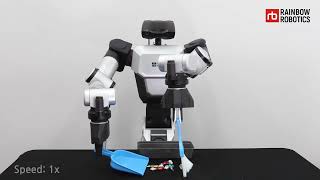
Rainbow Robotics · Wheeled base
RB-Y1₩118,762,784 to ₩119,195,502
Shipping nowConsumerIt is a bring-your-own-AI research base: you get excellent dual arms on wheels and a dev kit, but no legs, no end effectors unless you add the optional gripper, and no autonomy until you build it.
Estimated delivered total. Confirm the configuration and a complete seller quote before ordering.
What importing into South Korea takes
Yes, with work. A humanoid can be legally brought into and operated in South Korea, but the connected, battery-powered nature means it hits three separate KC regimes at once (electrical safety, radio/EMC, and lithium battery), each requiring in-country testing and a Korea-based applicant. The real catch: for a single unit imported for genuine personal (non-sale) use, you can lawfully skip RRA radio conformity assessment via a formal UNI-PASS exemption, but the moment you sell, deploy commercially, or import in quantity you owe full KC certification, and there is currently no settled safety-certification scheme purpose-built for a general-purpose humanoid (Korea is still building one).
Marks and registrations
- KC mark (electrical safety, Safety Confirmation)Electrical safetyThe whole machine is an electrical/electronic appliance under the Electrical Appliances and Consumer Products Safety Control Act, administered by KATS under MOTIE. A mains-charged, motor-driven humanoid typically needs KC Safety Confirmation (the self-regulatory scheme: product testing at a Korean KATS-accredited lab such as KTL, KTR, or KTC, no factory audit) rather than the stricter Safety Certification. Foreign FCC/CE reports are generally not accepted as substitutes; testing is done to KC standards (electrical safety plus, for the electronics, the KC 62368-1 IT/AV-equipment standard that replaced the older 60950/60065 family). The KC mark plus certificate number must be permanently marked.
- KC (RRA) radio + EMC conformity assessmentRadio / EMCWiFi and Bluetooth are radio functions regulated under the Radio Waves Act by the National Radio Research Agency (RRA) under MSIT. These fall under Registration of Conformity (the mid-tier scheme for common WiFi/Bluetooth/SRD and EMC products). RF and EMC testing must be done at an RRA-accredited lab, a Korea-based applicant/representative is required, and Korean-language labeling and user documentation are needed. A genuine single-unit personal-use import can instead take the UNI-PASS exemption (see gotchas).
- KC 62133 (lithium battery, Safety Confirmation)BatteryThe lithium-ion pack is separately regulated. Portable/secondary lithium cells and packs are covered by KC 62133-2 (harmonized with IEC 62133-2) under KATS, most commonly as a self-regulatory Safety Confirmation (testing at a KATS-accredited lab, no factory audit). Where a manufacturer already holds an IECEE CB report, CB-to-KC conversion is generally accepted (with the Korean national deviation applied). The battery carries its own KC certificate number.
- KCs (KOSHA) safety certification (only if used as an industrial robot)Machinery / robot safetyKCs is Korea's occupational/machinery safety mark under the Occupational Safety and Health Act, administered by KOSHA. Industrial robots with manipulators of 3 or more axes are specified for a self-regulatory safety confirmation under a Ministry of Employment and Labor notification. A humanoid deployed on a workplace or production line can be pulled into this regime; a consumer/service humanoid currently sits in a regulatory gap that Korea is working to fill with a dedicated humanoid-robot certification scheme. Treat KCs as conditional on the use case, not automatic.
- Import declaration + UN 38.3 / SDS at customsCustoms / dutyEvery commercial import is declared to the Korea Customs Service (KCS) through the UNIPASS electronic system. For the lithium pack, carriers and customs expect a UN 38.3 test summary and a Safety Data Sheet before the shipment is accepted and cleared. A private importer needs a Personal Customs Clearance Code (PCCC); a passport number alone is no longer accepted.
- Who imports it
- The importer of record must be an entity able to file an import declaration with the KCS through UNIPASS. A private individual does this personally using a Personal Customs Clearance Code (PCCC), a 13-character code starting with P, issued free at unipass.customs.go.kr (foreign residents now need an Alien Registration Card, a Korean address, and a Korean mobile number to register). A foreign buyer with no Korean entity cannot be the commercial importer or the KC/RRA applicant directly: they must appoint either a licensed Korean customs broker or a Korea-resident third-party importer-of-record provider, and for certification a Korea-based applicant/local representative must be named (via a Letter of Authorization). Note the lock-in risk: if a Korean importer holds the KC/RRA certificate as applicant, switching distributors later can mean re-certifying.
- How long it takes
- Personal single-unit route with the UNI-PASS radio exemption: roughly 2 to 6 weeks, dominated by dangerous-goods freight booking and customs clearance (the RRA exemption confirmation itself is fast). Full commercial route with real KC certification: plan on about 3 to 6 months. In-country RF/EMC and electrical-safety testing plus KC 62133-2 battery testing and Korean documentation typically run several weeks to a few months in parallel, before freight and clearance, and longer if a KCs machinery-safety pathway or the still-forming humanoid framework is triggered.
- Private buyer or business
- Private individual: import one unit for genuine personal, non-sale use and you can apply through KCS UNIPASS for a conformity-assessment exemption on the radio (RRA) side (one unit, not for sale, under the Radio Waves Act exemption provisions), which removes the biggest single hurdle; you still need a PCCC, pay 10% import VAT, and any applicable customs duty (Korea's general rate averages around 8%, though many machinery classifications are lower or zero, so confirm by HS code), and the dangerous-goods shipping and UN 38.3/SDS rules still apply. Business/registered company: no personal-use exemption once you intend to sell, deploy commercially, or import in quantity. You need full KC electrical-safety certification, RRA radio conformity assessment, and KC 62133-2 battery certification, all with in-Korea testing, a Korea-based applicant, Korean labeling and manuals, and (for workplace/industrial use) a KCs machinery-safety assessment. A business also imports under a business registration rather than a PCCC.
Where buyers get caught
- The personal-use radio exemption is only for the RADIO side and only for one genuinely non-sale unit. It does not waive KC electrical safety or KC 62133-2 battery certification for resale, and it must be filed as an exemption confirmation through KCS UNIPASS before import, not claimed after the fact.
- Foreign FCC and CE test reports are generally NOT accepted as drop-in substitutes. RF, EMC, and electrical-safety testing typically has to be redone at a Korean (RRA/KATS) accredited lab, which is the main cost and time driver, even if the robot is already certified elsewhere. (An existing IECEE CB report for the battery is the main exception, since CB-to-KC conversion is accepted.)
- There is no clean, settled KC scheme purpose-built for a general-purpose humanoid yet. Depending on how it is used it can land in consumer electrical safety (KC), industrial-robot machinery safety (KCs/KOSHA, 3-or-more-axis manipulators), or the humanoid framework Korea is still building. Confirm the classification before you commit to a certification path.
- The 1 January 2026 30% state-of-charge cap is new and easy to miss, but its scope matters: it binds loose batteries (UN 3480) and batteries packed with equipment (PI 966), while a battery installed in the robot (PI 967) is exempt. Ship any loose spare drained to under 30% of rated capacity, or the airline can refuse it.
- Since January 2025 a passport number alone no longer works for personal customs clearance: a private buyer must obtain a PCCC first (foreign residents need an Alien Registration Card, a Korean address, and a Korean phone number), and every KC/RRA certificate is held by the Korea-based applicant, which can create distributor lock-in for a foreign brand.
Sources
- RRA (National Radio Research Agency), Conformity Assessment System, official English site
- RRA CCAC, Procedure for Exemption Requirements (personal-use single-unit radio exemption)
- KATS, Electrical Appliances product safety certification (official English site)
- TUV Rheinland, KC 62133 amended safety standards for secondary lithium cells
- TUV Rheinland, KOSHA (KCs) machinery/industrial-robot safety certification
- Lion Technology, 2026 IATA DGR 30% state-of-charge limit for lithium batteries
Narrow it to you
Set your country and use case on the catalog for a personal shortlist, with delivery estimates where available.
Compare the first 3 listings
See these configurations side by side and choose which models to keep in your comparison.
Have it sourced
Request a seller quote and confirm delivery, documentation and support for your destination.
More lists like this