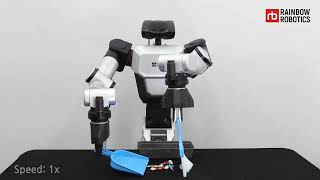
Waseda University (JST Moonshot Program) · Japan · Wheeled base
AIREC
A government-funded Waseda research prototype designed to physically lift and roll frail people for caregiving, not a robot you can buy: soft rubber hands and full-joint torque sensing let it touch bodies gently, but it is a supervised lab machine still years from any care facility.
Price on request
Verified last monthWhat is in the crate
7 included|5 not included
Grippers, not dexterous hands
AIREC is built to touch human bodies safely, so its hands prioritize softness over dexterity. The fingertips and palms are covered with a specially selected rubber, and the whole arm runs in force and impedance control (tunable mass, damping, spring) so it can apply gentle, distributed pressure when rolling or lifting a person. These are compliant contact surfaces, not multi-finger dexterous manipulators. There is no separately purchasable dexterous-hand option because there is no purchase at all.
In the crate
Reality check
You cannot buy this, and you will not be able to until around 2030 at the earliest. AIREC is a Moonshot research prototype from Waseda's long humanoid-research tradition: the $67,000 you have seen quoted is a professor's estimate of a future launch price, not a real one, and even then it targets institutions, not individuals.
Can you get one, and what will it cost?
A planning estimate with machine, freight, duty, and tax shown separately.
You cannot order the AIREC today: it is research only.
Nobody can buy AIREC. It is a Moonshot Goal 3 research project at Waseda University with academic and industry partners (Tokyo Robotics, AIST, University of Tokyo, University of Edinburgh, and others). Access means being inside or partnered with that research consortium, not placing an order.
Import requirements for United StatesConformity, battery shipping, paperwork, and source documents. Review before ordering.
Loading import requirements…
Open the import referenceAvailability
Catalog checked 2026-09
Research institutions only. Confirm eligibility and configuration with the maker.
Nobody can buy AIREC. It is a Moonshot Goal 3 research project at Waseda University with academic and industry partners (Tokyo Robotics, AIST, University of Tokyo, University of Edinburgh, and others). Access means being inside or partnered with that research consortium, not placing an order.
Price notes: Not for sale. The $67,000 (about 10 million yen) figure is Professor Sugano's estimate of the INITIAL price if and when a commercial version reaches nursing and medical facilities, projected for around 2030. No EUR price, no order form, no channel exists today. The current hardware is a government-funded research prototype, not a product with a list price.
No seller listing is recorded. Check the sources below for the maker’s latest information.
Prices remain in the seller’s listed currency. Tax, freight, options, and rental periods follow each seller’s terms. A seller’s region does not guarantee delivery to your address.
How the AIREC rates
Editorial ratings based on listed specifications and sales availability. They do not measure task performance, autonomy, or reliability.
- Class
- Frontier machineA cutting-edge full-scale humanoid aimed at real work. Mostly enterprise, or still proving out.
- CapabilityHardware specification indicators
- 2/5
- Baseline: any humanoid+1
- Degrees of freedom: 20 DOF+1
- Dexterity: grippers, not dexterous hands+0.25
- Scale: not published0
Key specifications
Height
n/a
Width
n/a
Depth
n/a
Weight
149 kg
Degrees of freedom
20
Battery
n/a
Payload
n/a
Top speed
n/a
You cannot buy the AIREC yet
Nobody can order one yet. Register to hear the moment it opens to buyers.
One email when it matters. No spam, unsubscribe anytime.
Size to scale
Drawn next to a 1.80 m (5 ft 11 in) person. Every robot on the site uses this same reference, so you can trust the comparison at a glance.
What it does on day onewith zero programming
Nothing, for a buyer: you cannot obtain one, and it does not run autonomously out of a crate. In the lab it does supervised caregiving maneuvers that have been taught or teleoperated: rolling a person from their back onto their side for a diaper change or to prevent bedsores, helping someone sit up, putting on socks, folding laundry, cooking scrambled eggs, and even a mock ultrasound exam, all under researcher supervision.
Best for: Researchers, care-robotics labs, and policy watchers tracking physical human-robot caregiving. It is a reference point for what compliant, body-contact caregiving hardware looks like, not a purchase for anyone who wants a working robot now.
What it takes to developskills, gear, and SDK access
This is a research platform, not a dev kit. Working with it realistically means being part of the AIREC consortium or Waseda's Sugano Lab. The technical stack around it is deep predictive learning (deep neural networks with somatosensory attention), impedance-control-based direct teaching via motion capture, bilateral teleoperation, and simulation training in NVIDIA Isaac Sim on RTX GPUs. None of that is packaged as a public SDK you can download.
Sources and verificationchecked 2026-09
Next step
Looking for an alternative to AIREC?
Tell us where you are and what it should do. We answer with real numbers: current price, landed cost for your country, lead time, and whether this is honestly the right machine, or whether something else fits better.