Unitree R1 Price in 2026: Every Edition and Seller
· 62 min read · Yuma Heymans
What a Unitree R1 really costs in October 2026: all three editions, every seller we could verify, and the delivered price in your country.
The Unitree R1 is the cheapest walking humanoid a major manufacturer sells, at $4,900 on Unitree's own store. That headline is real, and it is also the least useful number about the robot. It buys the R1 Air, the stripped edition with 20 joints and a single camera; it excludes shipping, which Unitree quotes at $300 to $1,200, and every duty and tax; and like the $5,900 standard R1, it cannot be programmed - Unitree. American dealers sell the same three machines at $6,870, $8,990 and $15,950 with the import already done, European dealers list the standard R1 at EUR 8,400 before VAT but could not ship one this month, and the research editions with hands run past $30,000.
So the honest answer to "how much is a Unitree R1?" depends on three choices you may not know you are making. Which edition: the Air, the R1 or the R1 EDU differ in joints, sensors, warranty and, above all, in whether you may write code for the robot. Which route: buying from Unitree in China and importing it yourself, or paying a dealer in your own market to do that for you. And which country: a 40% import duty in the United States, about 20% VAT in Europe and almost nothing in Canada or Australia turn the same robot into very different bills.
This guide works through all three. It explains what each edition is and is not, scores every seller we could verify on its own page, and computes the delivered cost of buying direct versus buying from a dealer for buyers in the US, Europe, the UK and beyond. It then covers the research editions tier by tier, what owners report about living with an R1, the security record, the robots that compete for the same money, and a framework for deciding which R1 to buy, if any. Every price was read on the seller's own page on 15 October 2026, and the live versions sit on the R1, R1 Air and R1 EDU datasheets in our catalog, where the delivered price follows the country you pick.
Contents
- Unitree R1 price in October 2026: the short answer
- The three R1 editions: Air, R1 and EDU
- Buying direct from Unitree: the price and the fine print
- Why Unitree can sell a walking humanoid for $4,900
- Buying an R1 in the United States: duty, the FCC and the dealer price
- Buying an R1 in Europe: VAT, empty shelves and a direct import
- R1 prices in the UK, Canada, Australia and the rest of the world
- R1 EDU price: the research editions, tier by tier
- What the R1 does out of the box, according to the people who own one
- Developing on the R1 EDU: what works in October 2026
- Running costs, warranty and repairs
- Renting an R1 instead
- Security, data and the account you need
- What else you can buy for R1 money
- Which R1 to buy, and from whom: a decision framework
- What could change the R1's price next
- How this guide was researched, and how we earn
Where to Buy a Unitree R1: Every Seller, Scored
Before the detail, here are the fifteen ways to buy an R1 that we could verify on the seller's own page, scored the same way. The ranking measures what a buyer gets for the money in their own market, so a seller is compared with the cheapest route a buyer in the same market has for the same edition, not with a seller on another continent. Unitree's own store appears twice because it is a different proposition in the US, where a 40% duty lands on the buyer, and in Europe, where the duty is 1.7%.
The four criteria come from what decides a purchase. Price versus the cheapest route (35%) compares the seller's delivered price with the cheapest way to get the same edition into the same market: 10 means it is that route, lower means paying more for the same machine. Availability (20%) is stock and lead time as the seller's page shows them for that option. Warranty and support (25%) covers warranty length, returns, local repair and the consumer rights that come with buying in your own market. Edition range (20%) is how many of the three editions and ten research tiers the seller lists with a price. Each criterion is scored from 0 to 10, and the final score is the weighted average.
| # | Seller | Market | What It Offers | Price vs the cheapest route (35%) | Availability (20%) | Warranty and support (25%) | Edition range (20%) | Final |
|---|---|---|---|---|---|---|---|---|
| 1 | RobotShop | US | Authorized distributor, every edition and tier | 10 - Air $6,870, the cheapest US route; R1 $8,990 | 6 - 'ships within 3-4 weeks' as a special order | 7 - manufacturer warranty, customs clearance handled | 10 - Air, R1 and EDU U1 to U10 | 8.5 |
| 2 | RobotLAB | US | Education dealer, purchase or lease | 9 - same US list, $6,870 to $32,900 | 5 - quote only, lead time on a call | 8 - quoted, supported and serviced from the US | 10 - 12 configurations listed | 8.2 |
| 3 | RoboStore | US | Long Island reseller with a cart | 9 - R1 $8,990, inside our import range | 7 - Add to cart, White and Blue only, up to 30 days | 6 - Unitree's 8 or 12 months; repairs are paid | 7 - R1 and EDU U1 to U6; no Air | 7.5 |
| 4 | Scan | UK | UK computer retailer | 8 - Air GBP 4,799.99 below our import estimate; R1 GBP 6,998.99 above it | 7 - R1 and lower EDU tiers in stock, Air on pre-order | 5 - UK seller, but its pages state two warranty lengths | 8 - Air, R1 and five EDU tiers | 7.1 |
| 5 | Global Drone HQ | US | Reseller sourcing from Unitree's US distribution | 7 - US list prices, freight quoted on top | 4 - quote only; EDU U1 out of stock | 7 - US warranty, 6, 8 or 12 months; POs welcome | 10 - Air, R1 and U1 to U10 | 7.0 |
| 6 | Toborlife | US | Self-described official Unitree partner | 9 - R1 $8,990 and U1 $15,950, free shipping | 3 - deposit pre-orders, 'shipments begin in the coming months' | 7 - US-based; 15-day returns, 25% restocking fee | 7 - R1 and U1 to U6; no Air | 6.9 |
| 7 | SVRC | US | Silicon Valley dealer that also leases | 6 - list prices plus a shipping estimate near $2,700 | 6 - 'In stock, 1-3 weeks' shown on every R1 page | 6 - leasing and setup support; warranty not stated | 10 - Air, R1 and U1 to U10 | 6.8 |
| 8 | Robots International | US | Las Vegas reseller, also as Robots USA | 8 - R1 $9,990 ($8,990 at Robots USA); U4 to U6 below the common list | 5 - 'In stock' beside 'subject to availability' | 5 - 8-month warranty stated; dealer status not stated | 7 - R1 and U1 to U6 | 6.5 |
| 9 | Unitree direct, to the EU | EU | Maker's store; buyer imports and pays VAT | 10 - R1 about EUR 7,000 in Germany incl. VAT, the cheapest route; Air the only route | 4 - in stock, ships within 30 business days, then transit | 3 - no returns; falls excluded; repairs via China | 6 - Air, R1, EDU Standard; other tiers by quote | 6.3 |
| 10 | Generation Robots | EU | French robotics distributor | 4 - R1 EUR 8,400 excl. VAT, about EUR 3,000 over an import | 3 - stock counter at zero, no lead time shown | 8 - EU seller: statutory guarantee for private buyers | 10 - R1 and all ten EDU versions | 6.0 |
| 11 | Unitree direct, to the US | US | Maker's store; buyer imports and pays duty | 7 - Air dearer than a dealer after duty; R1 and EDU at parity | 4 - in stock, ships within 30 business days, then transit | 3 - no returns; falls excluded; repairs via China | 6 - Air, R1, EDU Standard; other tiers by quote | 5.2 |
| 12 | quadruped.de | EU | German Unitree specialist (MYBOTSHOP) | 5 - R1 EUR 8,400 and EDU U1 EUR 12,200 excl. VAT, the lowest EU dealer prices | 1 - nothing ships before 28 December 2026 | 7 - specialist with its own R1 manual and RMA in Germany | 7 - R1 and U1 to U6 | 5.1 |
| 13 | reichelt | EU | German electronics retailer | 4 - R1 EUR 9,930, EDU U1 EUR 15,500 incl. 19% VAT | 4 - R1 sold out; most EDU tiers about 4 weeks | 6 - sells to businesses and institutions only | 7 - R1 and U1 to U6 | 5.1 |
| 14 | C.R. Kennedy | Australia | Photo and electronics importer | 1 - Air AUD 14,630 against an import near AUD 9,000 | 3 - backorder, ETA 14 November 2026 | 5 - local importer; GST basis not stated | 8 - Air, R1 and EDU Standard to Pro D | 3.8 |
| 15 | OpenELAB | EU | Shenzhen seller with EU prices | 4 - R1 EUR 9,969.75 incl. German VAT | 1 - sold out | 7 - handles customs and VAT; 14-day EU withdrawal right | 2 - the R1 only | 3.8 |
The ranking says something useful about how this market works. In the US, the authorized dealers all sell at one shared list, and that list sits almost exactly where a direct import lands once the 40% duty is paid, so the dealer route costs nothing extra for the R1 and the EDU and is the cheaper route for the Air. That makes the decision in America about stock, lead time and support rather than price, which is why a dealer with every tier and a real distributor's logistics ranks first. In Europe the picture flips: a direct import is about EUR 2,400 to 3,000 cheaper than a dealer for the standard R1, and on 15 October no European dealer could actually ship one.
Two cautions on reading the table. First, a high score is not a recommendation for every buyer: a school that needs a quote, a purchase order and a lease may be best served by RobotLAB, and a buyer who will never program the robot does not care about edition range. Second, this site earns a commission on purchases through some of these sellers (Unitree's own store and Robots International), and as the table shows, both rank where the evidence puts them, in the bottom half. Section 17 sets out every relationship.
1. Unitree R1 Price in October 2026: The Short Answer
The R1 is sold in three editions, and each has three prices that matter: what Unitree charges before shipping and tax, what a dealer in your market charges with the import done, and what the robot costs at your door if you buy from Unitree and import it yourself. The table sets those out for the two largest markets. US figures exclude state sales tax on both routes, because it applies to a dealer sale as well; European figures include Germany's 19% VAT, and the dealer column applies it to the common net list of EUR 8,400.
| Edition | Unitree's store | US dealer | US, imported yourself | Germany, imported yourself | EU dealer, incl. 19% VAT |
|---|---|---|---|---|---|
| R1 Air | $4,900 | $6,870 | $7,452 to $7,971 | EUR 5,909 to 6,439 | none listed |
| R1 | $5,900 | $8,990 | $8,888 to $9,432 | EUR 7,026 to 7,583 | EUR 9,996 (none in stock) |
| R1 EDU Standard | $10,500 | $15,950 (U1) | $15,328 to $15,872 | EUR 11,986 to 12,542 | EUR 14,518 to 16,660 (U1) |
Unitree's three prices come from its store, where all six colour options (White and Red for each edition) were in stock on 15 October - Unitree store. The US dealer prices are the same at RobotShop, RobotLAB, SVRC, Global Drone HQ, RoboStore and Toborlife wherever each lists the edition - RobotLAB. The import columns come from the delivered-cost engine that prices every robot in our catalog, using each country's duty, VAT, freight for a boxed 27 to 29 kg robot with a lithium battery, and a customs broker.
The pattern in the chart is the first thing to understand about R1 pricing. US dealers charge about 40% more than Unitree for the Air and about 52% more for the R1 and the EDU, and that markup is almost exactly what the US duty, freight and clearance add to a direct order. For American buyers the dealer is therefore the default route, not a luxury. For European buyers the arithmetic is reversed, because the duty is small and the dealer markup is not.
1.1 What "from $4,900" leaves out
Three things separate the headline from what most buyers end up paying. The first is the edition: the $4,900 Air drops the R1's waist joints, its moving head and its depth camera, and comes with a 6-month warranty instead of 8, so many buyers who start at $4,900 end at $5,900. The second is delivery: Unitree's shipping alone is $300 to $1,200, and the buyer pays every customs charge on arrival. The third is programming: neither the Air nor the R1 can run your code, so anyone who intends to develop on the robot is really shopping for a $10,500 to $32,900 machine.
That last point decides more purchases than any price. Unitree's store says it in one line, "Only the EDU version supports secondary development", and its stock-market prospectus says the base and Air models are "not configured with secondary development" and run "walking, running, dancing and interaction" programs from standard commands - Unitree prospectus. If you want a robot to perform, the Air or the R1 does that. If you want a robot to learn on, the cheapest R1 that qualifies costs more than twice as much.
2. The Three R1 Editions: Air, R1 and EDU
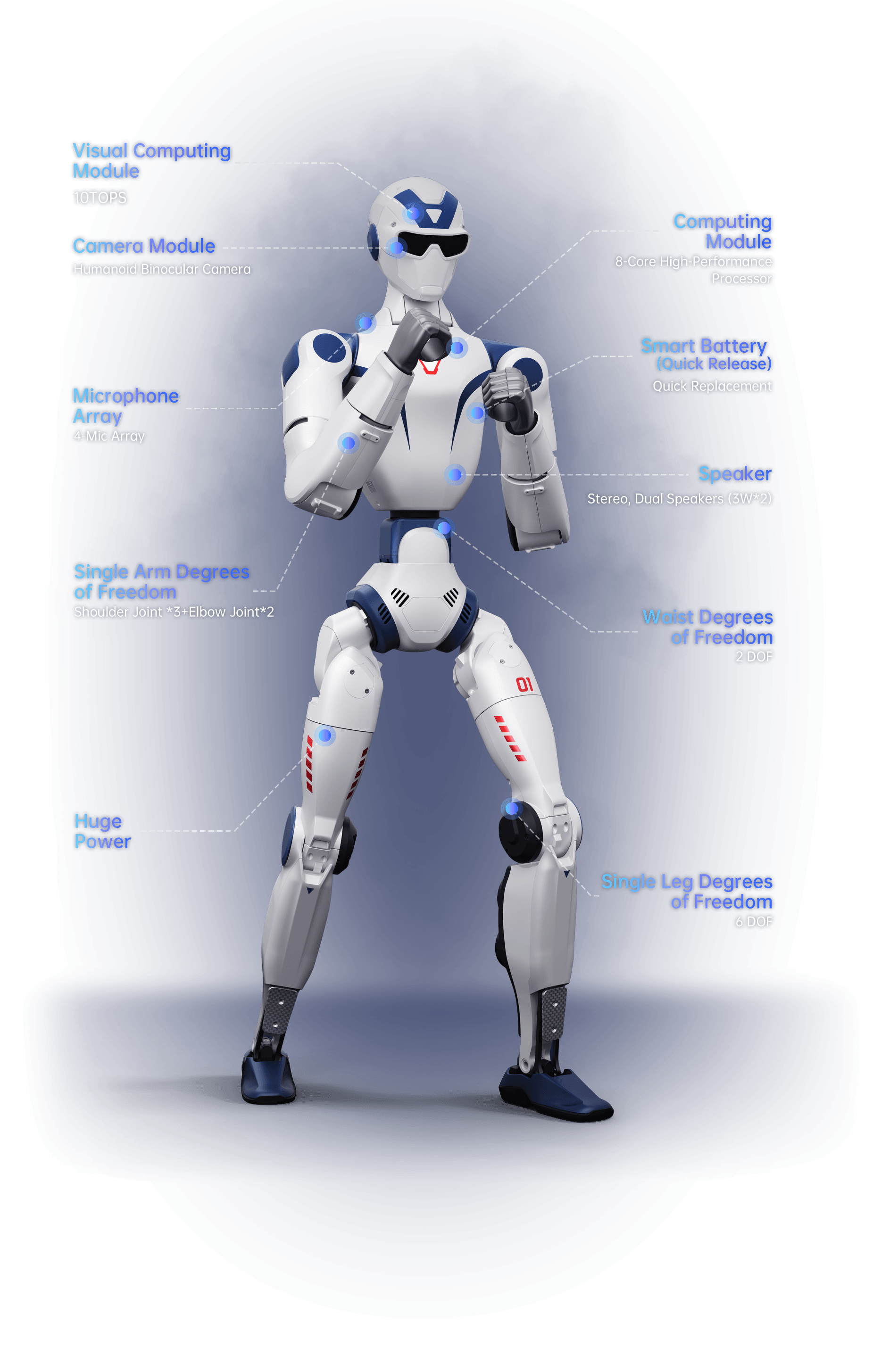
All three editions share one body. Unitree's specification table gives the same standing size for each, 1230 x 357 x 190 mm (about 123 cm tall), the same eight-core processor, four-microphone array, speaker, Wi-Fi 6 and Bluetooth 5.2, the same quick-release battery rated at "About 1h", and the same arm load of about 2 kg - Unitree. What changes between them is the number of joints, the camera, the warranty and the software you are allowed to run, and those four differences are what the extra $1,000 and $5,600 buy.
| R1 Air | R1 | R1 EDU | |
|---|---|---|---|
| Unitree price | $4,900 | $5,900 | $10,500 (Edu Standard) |
| China price, tax included | RMB 29,900 | RMB 39,900 | Contact sales |
| Weight with battery | about 27 kg | about 29 kg | about 29 kg |
| Joints (degrees of freedom) | 20 | 26 | 26 to 40 |
| Arm joints, waist, head | 4 per arm, none, none | 5 per arm, 2, 2 | 5 per arm, 2, 2 |
| Head camera | Monocular | Binocular (depth) | Binocular (depth) |
| Extra compute module | No | No | Optional, such as Jetson Orin 40 to 100 TOPS |
| Dexterous hands | No | No | Optional |
| Secondary development | No | No | Yes |
| Warranty | 6 months | 8 months | 12 months |
The table is Unitree's own, from its English and Chinese product pages - Unitree China. One detail on the same page is easy to miss: the marketing copy promises "Fully open control interfaces for joints and sensors", while the table limits secondary development to the EDU. The table is right, and the EDU is the only edition with open interfaces.
2.1 The R1 Air: the headline price
The Air is the R1 with the expensive parts removed. Its arms have four joints instead of five, it has no waist joints and no head joints, and its head carries a single wide camera rather than the depth camera of the other editions. Unitree's manual describes the Air's camera as monocular with a horizontal field of view of up to 146 degrees, and the standard R1's as a depth camera with the same width - Unitree R1 manual. The result is a robot that walks, runs and performs exactly as well as the R1 but turns its whole body to look at you instead of its head.
The Air arrived after the R1. Unitree launched the R1 on 25 July 2025 as a single model at $5,900, and the Air first appears on its English product page between captures of 21 October and 19 November 2025, when the headline changed to "Price from $4,900" - Internet Archive, 19 Nov 2025. It is sold to anyone, and in the US it is the only R1 edition that a dealer sells below the cost of importing it yourself, at $6,870.
2.2 The R1: what most sellers mean
The standard R1, which dealers call the R1 Basic, is the edition most sellers list and the one in most videos. It adds the two waist joints that let the robot twist and bend, a two-joint head that nods and turns, a fifth joint in each arm and the depth camera, for $1,000 more than the Air. It weighs about 29 kg, which one owner describes as "surprisingly heavy" but light enough to lift with one arm, not as heavy as the G1 - Benjamin Bolte on YouTube. Its arms end in rubber hands that do not move.
For most people choosing between the two consumer editions, the R1 is the better buy, because the waist and head are what make a humanoid look alive in a room and the warranty is two months longer. The Air makes sense when the robot will mostly walk, dance and run through preset routines, or when $1,000 matters more than expression. Neither can be upgraded to the EDU later: Unitree sells the editions as different products, and nothing on its pages offers an unlock.
2.3 The R1 EDU: the only one you can program
The EDU is the research and teaching edition. It has the R1's 26 joints and depth camera, plus secondary development, optional dexterous hands that raise the joint count to as many as 40, and an optional high-power computer, which Unitree describes as "Multiple brands and models available such as Orin(40-100TOPS)". Unitree's store sells one configuration, the Edu Standard Edition at $10,500, and asks buyers who want "additional optional accessories" to contact its sales team - Unitree store. Dealers sell ten configurations, from U1 to U10, which section 8 prices one by one.
A practical warning sits between those two facts. Unitree's store does not say what its $10,500 Edu Standard includes beyond the edition name, while dealers' U1 "Edu Standard" at $15,950 explicitly includes an NVIDIA Jetson Orin module of 40 TOPS. Before buying the EDU direct, ask Unitree in writing whether the compute module is part of the $10,500, because a development robot without one is a much smaller machine than the dealer's U1.
2.4 A name trap: the R1-A and R1-D are different robots
Searches for "Unitree R1 price" also return the R1-A5, R1-A7 and R1-D, which are not editions of the walking R1 at all. They are a dual-arm upper-body robot on a fixed or wheeled base, sold from $4,290, and Unitree's store lists every option as sold out with a request to contact sales - Unitree. Dealers list them beside the walking R1 at prices from $4,290 to $50,000, and Chinese headlines in April 2026 reported a "26,900 yuan R1" that was this torso. Unitree's developer tools also use R1 labels for arm configurations, which section 10 returns to.
The launch video shows what made the R1 famous: a 123 cm robot running, boxing, doing handstands and getting up from the floor. Unitree's own page adds a caution that belongs next to it, "Some sample functions on this page are still being developed and tested, and will be opened to users in the future", and advises individuals "to thoroughly understand the limitations of humanoid robots before making a purchase" - Unitree. Section 9 sets out what owners report the robot actually does when it arrives.
3. Buying Direct from Unitree: The Price and the Fine Print
Unitree's online store is the cheapest place to buy an R1 almost everywhere outside the US, and it works much like any other web shop until the robot leaves the factory. The terms below come from the store's own policy pages, which read like those of an industrial supplier rather than a consumer retailer, and they are the reason a direct order is cheaper. Read them before you pay, because several of them are unusual and none of them can be negotiated after the order.
Start with payment. The store accepts PayPal only, and every order passes Unitree's verification: "Unitree reserves the right to refuse an order if the order or payment information is not verifiable" - Unitree store. Its terms also reserve the right to "limit or prohibit orders that, in our sole judgment, appear to be placed by dealers, resellers or distributors", and they are governed by the laws of the UK - Unitree store terms. A school ordering several robots for a classroom should expect questions.
Then delivery. The product page quotes "Shipping costs between $300 and $1200", says the customer "is responsible for all applicable customs duties, taxes, and import clearance", and warns that "A contactable phone number and email are required for customs clearance" and that some countries also need a tax ID. The shipping policy adds that an order "will normally be shipped within 30 business days" and arrives "20-45 business days" later, from China - Unitree shipping policy. Stock on the page does not shorten that window: in practice a direct R1 can take two to three months from payment to delivery.
3.1 Returns, warranty and what is not covered
The return policy is one sentence: "We do not accept returns for ALL items due to the specificity of the product." You can cancel and be refunded before delivery, and you are asked to inspect the robot on arrival and report damage immediately - Unitree store. There is no cooling-off period and no right to send back a robot that works but disappoints, which is the single biggest difference from buying through a dealer in your own market.
The warranty is 6 months for the Air, 8 for the R1 and 12 for the EDU, counted "from the day you receive the product". Unitree's after-sales terms exclude "Damage caused by tumble or fall when manipulating robot on level ground", damage "In the developer mode" when your own programs control the robot, and any sign of disassembly or non-original parts, and they say the owner must "bear the postage cost first" when sending a robot in - Unitree terms. For a walking robot that will fall, those exclusions matter more than the length.
Taken together, the terms explain the dealer premium better than any spreadsheet. A dealer in your country gives you a seller you can reach, often a return window, a repair bench on your continent and someone to argue with about whether a fall was your fault. Buying direct trades all of that for the lower price, which in Europe is a large saving and in the US, as section 5 shows, is no saving at all.
3.2 A short history of the R1's ship date
The R1 was announced long before it shipped, and the store's own history shows how long. Captures of the product page show it titled "Unitree R1 (Pre-sale)" in December 2025 with the Air at $4,500 and a promise that shipments would begin in April 2026; by March 2026 the Air was $4,900; in April the start moved to May, and in May to June, when the EDU first appeared on the store at $10,500 - Internet Archive, 11 May 2026. By 18 July 2026 the page read "In Stock".
Two lessons follow. The US price of the Air went up by $400 during the pre-sale, not down, which is worth knowing when you read that humanoid prices only fall. And the first owner videos appeared from late April 2026, so the R1 has been in customers' hands for about six months: long enough for a pattern of problems to show in public forums, and short enough that nobody yet knows how the robot ages.
4. Why Unitree Can Sell a Walking Humanoid for $4,900
The R1's price makes more sense once you see the company behind it. Unitree listed on Shanghai's STAR Market in August 2026, and its prospectus had to disclose how many humanoids it sold and for how much. It sold 5 humanoids in 2023, 412 in 2024 and 5,215 in 2025, while the average selling price fell from about RMB 593,400 to RMB 260,400 and then RMB 166,400 - Unitree prospectus. Those years are almost all G1s and H1s, because the R1 only began shipping in 2026, but they show the curve the R1 sits on.
The prospectus is explicit about the R1's role in that curve. It describes the R1 as a lightweight robot meant to give "individual consumers, AI developers, educational institutions and tech enthusiasts" a cost-effective development platform, and it presents the R1 Air's RMB 29,900 starting price as lowering "the market price threshold for high-performance general-purpose humanoids" once again, after the G1's RMB 85,000 - Unitree prospectus. It also says the average price fell partly because Unitree "appropriately lowered product prices in 2025" in response to more competition. Volume, a cheaper product mix and deliberate price cuts all point the same way.
4.1 The price cut that was not a price cut
On 24 June 2026 headlines around the world reported that Unitree had cut the R1's price by 25%, from RMB 39,900 to RMB 29,900, and begun selling it from stock. Xinhua's version reads: "Unitree has cut the starting price of its Unitree R1 from 39,900 yuan ($5,800) to 29,900 yuan and begun offering the model for immediate delivery" - Xinhua via Hangzhou government news. The second half is true. The first half is not quite what happened.
Unitree's Chinese product page had listed the R1 Air at RMB 29,900 since at least 13 December 2025, and the standard R1 at RMB 39,900, and it lists the same two prices today - Internet Archive, 13 Dec 2025. Its May 2026 prospectus already cited the Air's RMB 29,900 starting price, and the South China Morning Post described the R1 as "priced from 29,900 yuan" in April - OODA Loop, republishing SCMP. Unitree's own video that day was titled "Unitree R1 | Price from $4,900, Ready Stock" - Unitree on YouTube. What changed on 24 June was delivery: the R1 moved from pre-order to stock.
The distinction matters for anyone timing a purchase. If you believed a 25% cut had just happened, you might expect another one soon. What the record shows instead is a stable price ladder (RMB 29,900 and 39,900 in China, $4,900 and $5,900 abroad) that has not moved since late 2025, apart from the Air's rise from $4,500 to $4,900 on the export store. Our market tracker logs the event as availability, not price.
4.2 What the R1 costs on AliExpress
In April 2026 Unitree began selling the R1 internationally through Alibaba's AliExpress, its first humanoid sold that way. Bloomberg reported that the R1 "would cost around $8,150 after import fees, while a scaled-down version is priced at roughly $6,800", with free shipping to the US - VnExpress, citing Bloomberg. AliExpress's Brand+ channel offers "free shipping and returns" - Interesting Engineering. We could not read the listing itself, which renders only in a browser, so treat those April figures as indicative.
They are revealing all the same. An AliExpress price that includes US import fees, about $6,800 for the Air and $8,150 for the R1, sits within a few hundred dollars of both the US dealer list and our own import estimate. Three independent routes into the US arriving at almost the same number is good evidence that the number is the real cost of getting an R1 to an American address, and that nobody in the chain is charging a large premium for it.
5. Buying an R1 in the United States: Duty, the FCC and the Dealer Price
For an American buyer the R1 is a case where buying from a dealer costs the same or less than importing it yourself. That sounds backwards, because the dealer needs a margin, so it is worth seeing why. Unitree ships on terms where the buyer pays every duty and clearance fee on arrival, and since July 2026 a Chinese-made robot carries about 40% in US import duty: a 2.5% base rate, a 25% Section 301 tariff that has applied to the robot's tariff heading since 2018, and a further 12.5% Section 301 duty on Chinese goods that took effect on 24 July 2026 - USTR. Our Unitree G1 price guide traces each layer through the US tariff schedule.
US dealers hold stock that has already cleared customs, and they all sell it at one list: $6,870 for the Air, $8,990 for the R1 and $15,950 for the EDU U1. RobotShop, which lists every edition and tier, describes its service as complete end-to-end logistics "including customs clearance" and names itself an authorized distributor - RobotShop. The question for a buyer is therefore simple: does importing it yourself beat that list?
5.1 Direct import versus a US dealer, line by line
The table works through a direct order of each edition with the same engine that prices every robot on this site. Freight is priced for a boxed robot of 27 to 29 kg with a lithium battery shipped as dangerous goods, which our engine puts at $525 to $947, inside Unitree's own $300 to $1,200 quote. US duty is assessed on the price of the goods without freight, a customs broker is included, and sales tax is left out of both routes.
| Line | R1 Air | R1 | R1 EDU Standard |
|---|---|---|---|
| Unitree's price | $4,900 | $5,900 | $10,500 |
| Freight (boxed, dangerous-goods battery) | $525 to $887 | $561 to $947 | $561 to $947 |
| US duty at 40% | $1,960 | $2,360 | $4,200 |
| Customs broker and entry | $67 to $225 | $67 to $225 | $67 to $225 |
| Delivered, imported yourself | $7,452 to $7,971 | $8,888 to $9,432 | $15,328 to $15,872 |
| US dealer list | $6,870 | $8,990 | $15,950 (U1) |
The result splits by edition. For the Air, the dealer is cheaper by $580 to $1,100, because the dealers' $6,870 is a smaller markup over Unitree's price than for the other editions. For the R1, the two routes are at parity: the dealer's $8,990 sits inside our $8,888 to $9,432 import range, so a direct order saves at most about $100 and can cost $440 more. For the EDU, a direct import can save up to about $600, but only if Unitree's $10,500 Edu Standard includes what the dealer's U1 includes, which section 2.3 suggests you confirm first.
Given that, the dealer wins for nearly every American buyer. You pay about the same, you get the robot in weeks rather than months, the duty risk is the dealer's, and there is a seller in your own country to call when something breaks. The one buyer who might still import is an experienced lab that wants the EDU direct, has confirmed the configuration in writing and is happy to deal with Hangzhou for service.
5.2 What "in stock" means at US dealers
The shared list hides real differences in what a buyer gets next week. RoboStore has a working cart for the R1 and EDU tiers but says "White + Blue color is the only option available for initial orders" and "Allow up to 30 days for delivery" - RoboStore. Toborlife, which calls itself Unitree's official US partner, sells every R1 tier as a pre-order with a deposit that is "100% refundable anytime before shipment" and promises delivery "when shipments begin in the coming months", even though its structured data tells search engines the robots are in stock - Toborlife. Two of its EDU pages still promise delivery beginning "in July 2026".
The others vary in a different way. RobotShop gives a lead time of 3 to 4 weeks for the R1 family as a special order. RobotLAB and Global Drone HQ quote rather than sell from a cart, so price, freight and lead time arrive in writing. SVRC shows "In stock" and "1-3 weeks" on every R1 page, including a generic $6,370 listing that names no edition, and its order summary adds a US shipping estimate near $2,700, which changes the comparison completely - SVRC. Before paying anyone, ask for the delivery date and the delivered total in writing.
5.3 Is an R1 legal to buy in the US after the FCC's robot rule?
Yes, and by a narrow margin. On 28 July 2026 the FCC added foreign-produced "advanced robotic devices", humanoids included, to its Covered List, so a new foreign robot model can no longer receive the equipment authorization it needs before it can be imported or sold in the US - FCC Public Notice DA 26-786. Models authorized earlier are not affected: as IEEE Spectrum put it, "those already certified are not restricted for sale or use" - IEEE Spectrum.
The R1 was authorized 36 days before that cutoff. Its FCC ID, 2A5PE-YUSHU010, "R1 Humanoid Robot", was granted to Unitree's parent company on 22 June 2026 after testing by TUV Rheinland in Shenzhen - fccid.io. It is a single ID for the R1 model; Unitree holds no separate ID for the Air or the EDU, and the grant's multiple-model declaration, which would settle that formally, is not public. US dealers treat all three editions as covered, and Global Drone HQ prints the R1's FCC ID on its Air page. Had Unitree filed a few weeks later, no R1 could be sold in the US today.
That history is worth holding when you think about the future. Any successor to the R1 that Unitree has not already authorized would need a Department of War conditional approval to reach US shelves, and none has been granted for a humanoid. If you are an American buyer weighing whether to wait for an "R2", the R1 you can order now is legal, and the next one may simply not arrive. Our import rules record the authorization status of every machine in the catalog.
5.4 The duty can still move
Two open processes could change the US price of an R1 within months. The 12.5% forced-labor duty is being challenged at the Court of International Trade, which heard argument on 30 September 2026 and asked for further briefing this month, so a ruling could remove that layer or keep it. Separately, the Commerce Department's Section 232 investigation of robotics imports, opened in September 2025, could add a robot-specific tariff - Bureau of Industry and Security. The dealers' list has not moved through any of this, because they bought their stock at the old rates.
For a buyer, the practical rule is to buy at a locked price. A dealer's $8,990 already includes the duty it paid, so a change after you order is the dealer's problem. A direct import is assessed on the day it clears customs, which can be two or three months after you pay Unitree, and if a duty is later struck down, refunds have historically reached only the importers who preserved their claims. If you do import directly, keep every customs document.
6. Buying an R1 in Europe: VAT, Empty Shelves and a Direct Import
Europe is the mirror image of the US. The EU's duty on a robot from China is just 1.7%, so the cost of importing an R1 yourself is mostly VAT, freight and a customs broker. By our estimate a standard R1 bought from Unitree and delivered to Germany costs EUR 7,026 to 7,583 including 19% VAT, and an R1 Air EUR 5,909 to 6,439. European dealers list the R1 at a common EUR 8,400 before VAT, which becomes EUR 9,996 with German VAT, so the dealer premium on the standard R1 is about EUR 2,400 to 3,000.
The more striking fact on 15 October was that no European dealer could ship one. quadruped.de shows "Verfügbar ab: 28.12.2026" in place of its cart - quadruped.de. reichelt lists the R1 Base as "z.Zt. ausverkauft" (currently sold out) and delivers these robots "ausschließlich an gewerbliche Kunden, Institutionen und Behörden", to businesses, institutions and agencies only - reichelt. OpenELAB, which handles customs and VAT for EU buyers, shows "Sold out" - OpenELAB. Generation Robots offers Add to cart, but its own stock counter for every R1 version reads zero and the page shows no lead time.
No European dealer lists the Air at all. An EU buyer who wants the cheapest R1 therefore has exactly one route, a direct order from Unitree, and an EU buyer who wants any R1 before the end of the year has, in practice, the same single route. That makes a direct import the default in Europe this autumn, whatever you think of Unitree's return policy.
6.1 Import versus dealer, country by country
VAT is the variable that moves the delivered price across Europe, from 17% in Luxembourg to 27% in Hungary. The chart compares our import estimate for the standard R1 with the common dealer price of EUR 8,400 before VAT, with each country's VAT added, for four large markets.
The import column assumes you can receive a 29 kg robot, deal with a customs broker who will want a phone number, an email and possibly an EORI or tax number, and accept a warranty that runs through Unitree in China. For a business, VAT on an import is usually reclaimable, which shrinks both columns in proportion without changing the gap. Our guide to importing a humanoid robot walks through the customs, CE and battery-shipping steps a direct import involves.
For a private buyer, the dealer route buys EU consumer rights: a legal guarantee of at least two years against the seller - Directive (EU) 2019/771, and a 14-day withdrawal right on distance purchases, which OpenELAB, for example, states on its page. Those rights are worth something real on a robot whose maker accepts no returns and excludes falls from its 8-month warranty. The catch this year is that the dealers who would give you those rights cannot deliver, and reichelt will not sell to you at all.
6.2 The EDU in Europe
The research edition is easier to find. quadruped.de lists the U1 at EUR 12,200 before VAT, the lowest EU dealer price, but again from 28 December; Generation Robots lists its Edu Standard at EUR 14,000 before VAT, about EUR 16,800 with French VAT; and reichelt sells the U1 at EUR 15,500 including 19% VAT with a delivery time of about four weeks, to businesses and institutions only - Generation Robots. Against a direct import of EUR 11,986 to 12,542 in Germany, the cheapest dealer charges about EUR 2,000 more and the dearest about EUR 3,500 more.
For universities that must buy on an EU invoice, reichelt's four weeks is the only real delivery date on the continent. For anyone else, the same advice as for the standard R1 applies: if you can import and accept Unitree's terms, the saving is large; if your procurement rules forbid it, the dealer price is the real price.
7. R1 Prices in the UK, Canada, Australia and the Rest of the World
Outside the US and the EU, the R1 is sold through a thinner network of dealers whose prices vary far more than the cost of getting the robot there. In most of these countries the import duty on a robot is zero or low, so a direct order costs little more than the sticker, the shipping and the local consumption tax, while some dealers charge 60% more than that. The figures below are each dealer's own price on 15 October 2026, set against our estimate of a direct order.
In the United Kingdom, robots enter duty-free and pay 20% import VAT. Our estimate for a direct R1 is GBP 5,922 to 6,392 delivered, and for the Air GBP 4,981 to 5,428. Scan lists the R1 at GBP 6,998.99 including VAT, in stock with next-day delivery, and the Air at GBP 4,799.99 as a pre-order "awaiting an ETA" - Scan. That Air price is below what an import costs, which makes Scan the best Air offer we found anywhere if it delivers. Scan's own pages give two warranty lengths, 8 and 12 months on the R1, so settle that in writing.
In Canada, robots also enter duty-free and the federal GST is 5%. A direct R1 comes to CAD 9,726 to 10,501 before provincial tax by our estimate, and an Air to CAD 8,178 to 8,918. We found no Canadian dealer with a public price: one lists all three editions at a placeholder of $0.00 on backorder. Toborlife ships to Canada from the US, but at its US pre-order terms and with any Canadian taxes and fees charged on delivery.
7.1 Australia, Japan, the Gulf and Asia
Australia shows the widest gap we found. A direct R1 lands at about AUD 10,355 to 11,194 including 10% GST, and an Air at AUD 8,710 to 9,511, while C.R. Kennedy lists the Air at AUD 14,630 and the R1 at AUD 17,050, both on backorder with an ETA of 14 November 2026 - C.R. Kennedy. Roboworks in Sydney prices the R1 at USD 9,800 delivered at place with duties extra, but says "At the present time, the Unitree R1 is not available for delivery" and takes deposits - Roboworks. An Australian buyer who can handle an import saves around AUD 6,000 against the cheapest listed dealer.
In Japan, where robots are duty-free and consumption tax is 10%, a direct R1 comes to about JPY 1.13 to 1.22 million by our estimate; we found no Japanese dealer with a public R1 price. In the United Arab Emirates, a 5% duty and 5% VAT bring a direct R1 to about AED 26,400 to 28,500. In Singapore it is about SGD 9,100 to 9,900, in South Korea, with an 8% duty and 10% VAT, about KRW 10.4 to 11.3 million, and in India, with an effective 8.25% duty and 18% GST, about INR 800,000 to 863,000, where the one dealer we found lists the R1 at "Price on request".
Switzerland deserves a note for European readers: no duty and 8.1% VAT put a direct R1 at CHF 5,830 to 6,305, cheaper than anywhere in the EU. In Poland, one owner who rents robots quoted local dealer prices of about 40,000 zloty for the Air, 50,000 zloty for the R1 and 80,000 to 140,000 zloty for the EDU - Techia on YouTube, against our estimate of PLN 31,800 to 34,300 for a direct R1. Every one of these estimates is live on the R1 datasheet for the country you choose, and the rules behind them are on our import rules page.
8. R1 EDU Price: The Research Editions, Tier by Tier
The EDU is where R1 pricing gets complicated, because dealers sell it in ten configurations with codes from U1 to U10 and names like "Edu Smart" and "Pro D". They differ in two things: the onboard computer and the hands. Unitree's own store sells only the Edu Standard at $10,500 and quotes everything else through its sales team, so the tier ladder below comes from US dealers, who all use the same list, and from Generation Robots, the one European dealer that prices all ten.
| Tier | Dealer name | What it adds | US list | Generation Robots, excl. VAT |
|---|---|---|---|---|
| U1 | Edu Standard | Jetson Orin NX 40 TOPS, 26 joints, no hands | $15,950 | EUR 14,000 |
| U2 | Edu Smart | Jetson Orin 100 TOPS, no hands | $18,900 | EUR 15,700 |
| U9 | Pro G | Two Dex1-1 two-finger grippers, 28 joints | $19,800 | EUR 16,500 |
| U7 | Pro E | Two Linker Hand O6 hands, 38 joints | $22,900 | EUR 18,000 |
| U10 | Pro H | Two tendon-driven five-finger hands, 30 joints | $23,000 | EUR 18,000 |
| U8 | Pro F | Linker Hand O6, tactile, 38 joints | $23,200 | EUR 18,500 |
| U5 | Pro C | Two BrainCo Revo 2 five-finger hands, 38 joints | $28,900 | EUR 23,500 |
| U3 | Pro A | Two Dex3-1 three-finger hands, 40 joints | $30,900 | EUR 26,500 |
| U4 | Pro B | Dex3-1 hands with touch sensing, 40 joints | $32,900 | EUR 28,500 |
| U6 | Pro D | BrainCo Revo 2 Touch hands, 38 joints | $32,900 | EUR 28,000 |
The tier contents are as RobotShop, Toborlife and Generation Robots describe them, and the prices are each dealer's own - Toborlife. Robots International lists U2 at $18,800 and U4 and U6 at $31,260, slightly below the common list, while Roboworks in Australia asks USD 19,000 to 44,000 for its tiers. The four tiers from U7 to U10 are not sold everywhere: in the US only RobotShop, RobotLAB, SVRC and Global Drone HQ list them, and in Europe only Generation Robots.
8.1 Reading the tier ladder
The less widely sold tiers change the economics of an R1 that can hold things. Among the six tiers every dealer lists, the cheapest with anything at the end of its arms is the U5 at $28,900. The U9 at $19,800 gives you two of Unitree's Dex1-1 two-finger grippers for $900 more than the U2, and the U7 and U10 give you five-finger hands for about $23,000. For a lab that wants to study manipulation on a small humanoid, those tiers cut the entry price by about $9,000, and the question becomes whether a gripper or a cheaper five-finger hand is enough for the work.
The compute choice is the other decision. The U1's 40 TOPS Jetson Orin NX runs a trained walking or manipulation policy comfortably, while the 100 TOPS module of the U2 and above matters if you want to run larger vision or language models on the robot itself rather than on a laptop over Wi-Fi. Unitree's specification table lists the module only as "such as Orin(40-100TOPS)", so confirm the exact module, memory and storage of the tier you are quoted.
8.2 The cost of a research setup, not just a robot
The robot is rarely the whole bill. One owner who bought a heavily optioned EDU reports a final price of $29,756 for an R1 "Edu Pro D" with two BrainCo Revo 2 Touch hands, a 100 TOPS Jetson Orin and two batteries - Sabrina Ramonov on YouTube, below the $32,900 that US dealers list for that tier, which suggests that the top of the ladder is open to negotiation. Most labs will also want a second battery at $500 from Unitree's store, a development stand or gantry (Toborlife includes one with its Edu Standard), and a workstation with a capable GPU for training in simulation.
A realistic budget for a teaching or research setup is therefore the tier price plus 10 to 20%, and our guide to what you actually get with a humanoid prices the gap between a robot that arrives and a robot that does work. The cost of everything around a humanoid, from batteries to insurance, is set out in our page on what a humanoid robot costs to own.
9. What the R1 Does Out of the Box, According to the People Who Own One
No major publication had published a hands-on review of a production R1 by mid-October 2026, as far as we could find: the coverage in the large outlets is launch news, the stock-market listing and the FCC rule. The real record of living with an R1 comes from owners who filmed their first days with it, from Unitree's own manuals, and from the developers who have started filing issues on Unitree's code. Together they give a consistent picture of a polished piece of hardware with software that does a few things very well and many things not yet.
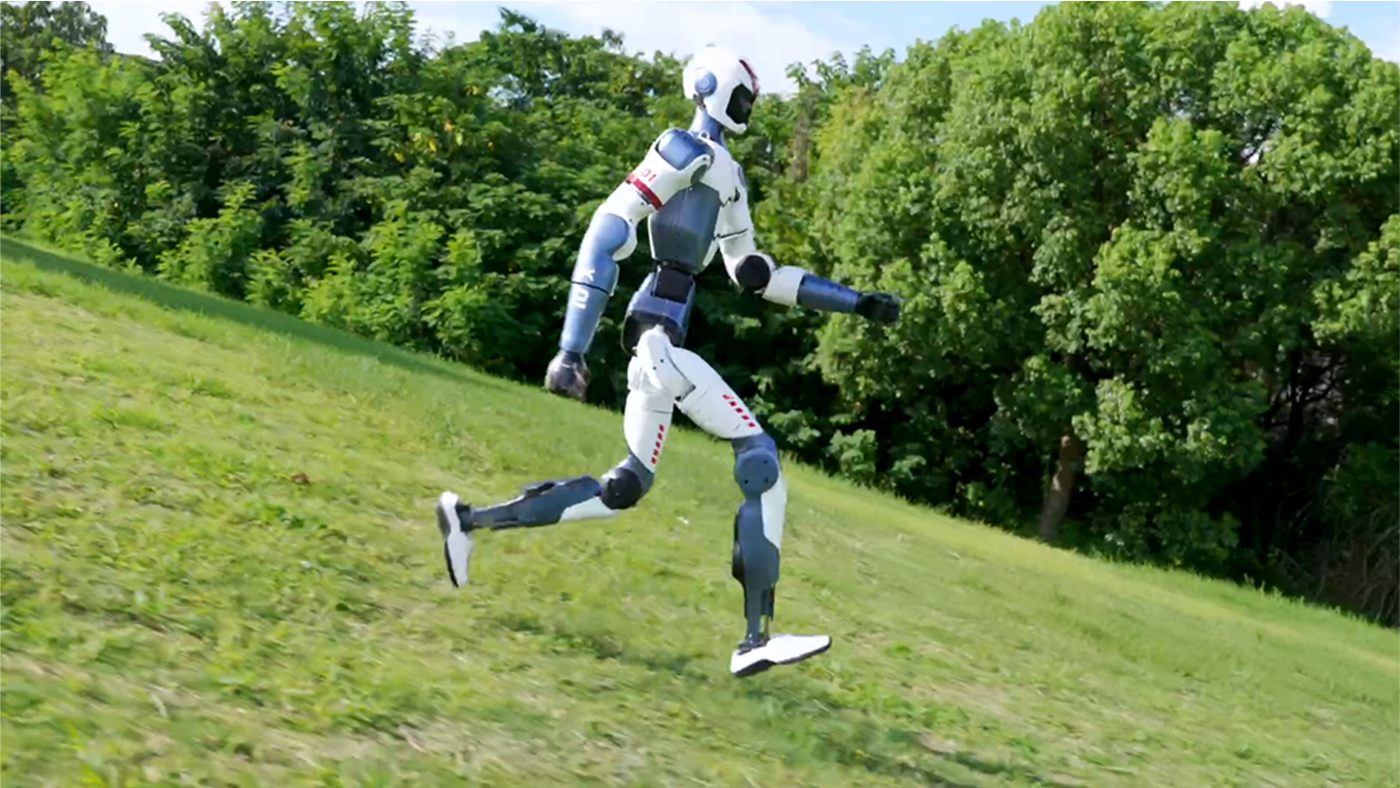
What the Air and the R1 do is perform. Unitree's prospectus says the base editions run "walking, running, dancing and interaction" programs from standard commands, and The Robot Report's launch coverage put it plainly: "Unitree's R1 is remote-controlled" - The Robot Report. From the handheld remote you make the robot stand, walk, run and play preset moves; from the phone app you see through its camera, take photos and video, record arm movements by moving its limbs by hand and replay them, and send it voice messages. Its built-in assistant answers spoken questions using a large language model that Unitree does not name.
9.1 The first day
Owners describe a setup that is closer to commissioning a machine than unboxing a gadget. Benjamin Bolte, who filmed a 48-minute unboxing in July 2026, found that the battery shipped separately and arrived half charged, that the robot starts with a "very loud fan" but walks quietly, and that its walking controller is a learned policy that does not use the cameras, so it will walk into things you do not steer it around - Benjamin Bolte on YouTube. He also calls it "very nice hardware, frankly". His quotes come from the video's automatic captions.
A Polish owner who bought an R1 for his robot-rental business reports more friction. His unit needed its joints calibrated twice and its inertial sensor once, because the right foot landed wrongly while walking; the Android app was not on Google Play and had to be installed from a file; the assistant, which he says runs on Alibaba's Qwen model, accepted spoken commands only in English; and the app does not let you control the legs - Techia on YouTube. A German distributor's manual adds that "The R1 cannot actively maintain its own balance while transitioning into a standing posture", so a person holds the robot by its shoulder handle the first time it stands - MYBOTSHOP R1 manual.
9.2 What the manual asks of you
Unitree's own manual is more cautious than its videos. It says the R1 "is intended to be used in industrial, commercial and other similar scenarios", that it should be operated between 0 and 40 C, that "The robot is NOT waterproof", and that you should keep "a safe distance of at least 2 meters from obstacles, complex terrain, crowds, water and other objects" - Unitree R1 manual. It is "not a toy" and not for anyone under 18. The app requires a registered Unitree account, binds the robot to it, and warns that a lost account must be recovered through Unitree's staff.
None of this makes the R1 a bad purchase, but it defines the right one. An R1 is a demonstration machine for a hall, a stage, a classroom or a lab, operated by someone who has read the manual, with space around it. It is not a household companion that wanders a flat on its own, and nothing in the base editions will make it one, because you cannot add software to them. Our guide to humanoid robots for the home explains what is and is not available for that job.
10. Developing on the R1 EDU: What Works in October 2026
The EDU is a younger platform than its hardware suggests. Unitree's software development kit gained R1 support in 2026, not at launch: the R1 locomotion client was added to unitree_sdk2 on 12 March 2026, low-level joint examples on 25 March, an audio client for speech recognition and synthesis on 10 June, and arm control examples on 9 July and 15 September - unitree_sdk2 on GitHub. A Python SDK mirrors the C++ one, and both talk to the robot over DDS on Ubuntu 20.04.
Simulation support is narrower than for the G1. Unitree's MuJoCo-based reinforcement-learning framework, unitree_rl_mjlab, includes an R1 walking task and code to deploy a trained policy on the real robot - unitree_rl_mjlab. Its older frameworks do not: unitree_rl_gym supports "Unitree Go2, H1, H1_2, and G1", its Isaac Lab project supports Go2, H1 and G1, and Unitree's ROS 2 package says it supports "Unitree Go2, B2, and H1". A researcher choosing between an R1 EDU and a G1 EDU should weigh that gap, because most published humanoid research code targets the G1.
10.1 What owners report
The early record is encouraging in one important way. A developer who measured his R1 against Unitree's simulation model found the simulated hip overshooting "about 30% where the real hip overshoots about 2%", corrected it, and reported that "a policy trained purely in simulation walked on the real robot on the first attempt", adding that "we need to make a R1 support group" because there is so little information - GitHub issue. Another team published its own learned walking policy running on a physical R1 the same week - XRobotix on YouTube.
The same issue trackers show the rough edges. Owners report that a velocity command through the SDK always returns an error in some configurations, that publishing arm commands can lock the robot out of walking until it is restarted, and that Unitree's teleoperation image server could not find an R1 EDU's head camera - GitHub issue. Unitree's tools name the R1's arm configurations R1_A5 and R1_A7, labels it also uses for its dual-arm torso, so read each tool's notes to see which robot it supports. The one arXiv paper we found that ran experiments on a physical R1 did so with "the robot supported", noting that "free-standing execution is future work" - arXiv.
The practical reading is that the R1 EDU is a real development platform with a small community, suited to a lab or an experienced developer who can work from source code and GitHub issues rather than tutorials. Unitree's manual adds one procedure every EDU owner needs: the built-in motion controller starts at power-on, so low-level control requires putting the robot into a debug mode first, during which the remote no longer works - Unitree R1 manual. One owner's write-up of driving a single elbow joint from Python is a good picture of where development starts - Sabrina Ramonov.
11. Running Costs, Warranty and Repairs
The R1 is cheap to run and potentially expensive to fix. Its battery holds 194.4 Wh and charges in about 1.5 hours on the supplied 114 W charger, according to Unitree's battery manual, which also warns that usable capacity can be 5 to 10% below the rating - Unitree battery manual. A full charge costs a few cents of electricity. The constraint is time: about one hour of operation per battery, less when the robot walks fast, carries a load or climbs a slope.
A second battery is the first accessory most owners buy. Unitree sells it for $500 with free shipping - Unitree store, and the Polish owner quoted above found it at over 3,000 zloty locally. With two batteries an R1 can run for a demonstration of about two hours with a swap in the middle; for an all-day event you need three or four, or long pauses to charge. RobotShop also lists a spare R1 charger at $115 and a replacement remote at $385, from its own store data. Beyond batteries, the manual's only routine maintenance is greasing the ankle joints to prevent noises.
11.1 What happens when it breaks
This is where the edition and the seller matter most. Unitree's warranty runs 6, 8 or 12 months from receipt and excludes "Damage caused by tumble or fall when manipulating robot on level ground", so a fall during a demonstration is likely to be the owner's cost. The owner pays postage to send a robot to Unitree, and Unitree "will scrap" seriously damaged batteries rather than return them - Unitree terms. No Unitree page lists R1 spare joints, limbs or shells for sale.
Local dealers soften this unevenly. RoboStore says its repairs are paid services and that it provides no warranty of its own beyond Unitree's; Global Drone HQ says its robots are serviced in the US through an authorized distributor; and quadruped.de runs returns through its workshop in Germany. Ask any seller three questions before buying: who repairs the robot in your country, how long a repair takes, and what a fall that breaks a joint costs.
12. Renting an R1 Instead
If you need an R1 for a single event, renting would be the obvious alternative, but the R1 rental market barely exists yet. The one provider we found that lists the R1, Futurobots, rents only the EDU U4 with touch-sensing hands, prices it on request by country and dates, and states a one-month minimum on its R1 page, while describing a robot of 168 cm and 55 kg that is not an R1 - Futurobots. Confirm the exact machine in writing before booking.
The larger G1 is easier to rent, and its rates are a useful benchmark: self-service rentals start at about EUR 269 a day in Europe, and a staffed event day in the US costs $2,800 to $3,500, as our humanoid rental comparison shows provider by provider. At those rates the break-even against buying an R1 at about $9,000 delivered comes after roughly 30 self-service days or three staffed event days. A company that expects to show a humanoid more than a handful of times a year should buy; anyone else should rent the bigger robot.
13. Security, Data and the Account You Need
Every Unitree robot sold since 2025 carries some security history, and the R1 inherits its maker's record even where it was not tested itself. In September 2025, researchers disclosed a Bluetooth flaw they called UniPwn that let an attacker take over Unitree robots nearby; IEEE Spectrum reported that "The exploit impacts Unitree's Go2 and B2 quadrupeds and G1 and H1 humanoids" - IEEE Spectrum. The R1 had not shipped, and the researchers' own write-up does not list it, though it records that Unitree stopped replying after it "launched R1 marketing" - UniPwn on GitHub.
Two later findings are broader. A paper by Alias Robotics asserted the same Bluetooth weakness "across all G1, H1, and R1 units" and documented a G1 sending sensor and status telemetry to remote servers every 300 seconds, though it tested only the G1 - arXiv. In 2026 a researcher found two root-level remote code execution chains on the G1 EDU, was paid a $5,000 bounty by Unitree, and wrote that firmware 1.5.5.0 "reportedly blocks the exploit chain", adding that he had not verified the fix or tested the R1 - Boschko. No vulnerability record names the R1, and Unitree now runs a security programme and a bug bounty.
13.1 Sensible precautions
The R1's own manual lists its network surfaces: a web service on port 9991 used to set up video connections, a Bluetooth link to the app and a radio link to the remote, and it carries a four-microphone array and cameras - Unitree R1 manual. The app needs a Unitree account and the robot is bound to it. A distributor's manual for the EDU documents a default login for its onboard computer, which every owner should change on the first day.
For most buyers the risk is manageable with ordinary care. Keep the firmware current, change default passwords, put the robot on its own network rather than the one your laptops use, switch it off when nobody is using it, and do not run a robot with cameras and microphones in rooms where you would not run a webcam. A university or company with a security policy should treat an R1 like any other networked device from a foreign supplier, and the US defence department cited the 2025 Unitree findings in the reasoning behind the FCC rule - IEEE Spectrum.
14. What Else You Can Buy for R1 Money
The R1 is the cheapest walking humanoid from a major maker, but it is not the only robot a buyer with $5,000 to $16,000 should consider, and the most important difference between the alternatives is not size but whether you may write code for them. The table compares the R1 editions with their closest rivals, with each delivered price taken from our catalog for a US and a German buyer.
| Robot | Height and weight | What you can do with it | US delivered | Germany delivered |
|---|---|---|---|---|
| Unitree R1 Air | 123 cm, 27 kg | Remote-controlled demos; no programming | $6,870 (dealer) | EUR 5,909 (import) |
| Noetix N2 | 114 cm, 30 kg | Demo biped built to order; developer edition separate | $8,347 (import) | EUR 6,615 (import) |
| Unitree R1 | 123 cm, 29 kg | Demos with a moving head and waist; no programming | $8,888 (import) | EUR 7,026 (import) |
| Booster K1 | 95 cm, 19.5 kg | Programmable on every tier; gets up by itself | $11,799 (dealer) | EUR 8,925 (dealer) |
| Unitree R1 EDU | 123 cm, 29 kg | Programmable; hands on higher tiers | $15,328 (import) | EUR 11,986 (import) |
| Unitree G1 | 132 cm, 35 kg | Larger demos; no programming | $17,990 (dealer) | EUR 15,462 (import) |
Read the third column first. If you want to program a walking humanoid on the smallest budget, the Booster K1 is the R1 EDU's real rival: Booster lists secondary development as supported on all three K1 editions, rates the larger battery at 1 hour 10 minutes of walking and says a knocked-down K1 "can get back up autonomously" - Booster. It is smaller than an R1 and costs about $4,000 less than an R1 EDU in the US, and it plays in the RoboCup robot soccer league. The R1 EDU answers with a taller body, a depth camera and hands on its higher tiers.
If you only want a robot to perform, the choice is between the R1 Air, the R1 and, one step up, the G1 at about twice the price, which our Unitree G1 price guide covers edition by edition. Side-by-side detail is in our comparisons of the three R1 editions, the R1 and the Booster K1 and the R1 and the G1, and our list of affordable humanoid robots under $10,000 shows everything orderable below that line.
15. Which R1 to Buy, and From Whom: A Decision Framework
Most R1 buyers are not individuals. Unitree's filings with the stock exchange show that 73.6% of its humanoid revenue in the first nine months of 2025 came from research and education - The Robot Report, and the R1 was designed to bring that market down to a classroom budget. The framework below starts from what you will do with the robot, because that decides the edition, and then from where you live, because that decides the seller.
The edition question has a clear answer for each kind of buyer. A school, university or lab should buy the EDU, because the Air and the R1 cannot be used to teach programming, and should budget the tier price plus 10 to 20% for batteries, a stand and a workstation. An events or marketing company should buy the R1 rather than the Air, because the moving head and waist are what audiences notice, and should buy at least one spare battery. An individual enthusiast should be honest about the goal: the R1 is a remarkable remote-controlled machine to own and show, and a poor way to learn robotics, which the K1 or the EDU teach better.
15.1 Recommendations by country
In the United States, buy from a dealer with stock and a written delivery date: RobotShop or RobotLAB for the full range, RoboStore for a White R1 from a cart, and Toborlife only if a refundable pre-order suits you. Importing yourself makes sense only for the EDU, and only after Unitree confirms in writing what its $10,500 includes. In Europe, a direct import from Unitree is the cheapest route by about EUR 2,400 to 3,000 and, until dealers restock, the only one; a private buyer who values the two-year legal guarantee can wait for quadruped.de's stock from 28 December.
In the UK, Scan's in-stock R1 at GBP 6,998.99 is a reasonable premium of about GBP 600 to 1,100 over an import for local stock and a UK seller, and its Air pre-order is cheaper than importing. In Australia and Canada, import directly: the duty is zero, and local prices, where they exist, are far above the landed cost. Everywhere, ask for the delivered total, the delivery date and the repair route in writing before paying, and keep the seller's page as a screenshot.
16. What Could Change the R1's Price Next
Prices for the R1 have been unusually stable for a new robot. Unitree's export prices of $4,900 and $5,900 and its Chinese prices of RMB 29,900 and 39,900 have not changed since late 2025, the US dealer list is shared by every authorized dealer, and the European net list of EUR 8,400 is common to every dealer. Three things could move them in the next few months, and they point in different directions.
The first is the US duty. A ruling from the Court of International Trade on the 12.5% forced-labor layer could lower the cost of a direct import by about $600 to $1,300 depending on the edition, and dealers would follow over time; a Section 232 robot tariff would push the other way. The second is European stock: if quadruped.de, reichelt and Generation Robots receive the units they expect around the end of the year, the gap between dealer and direct prices may finally be tested by competition. The third is the next Unitree: any successor would need to clear the FCC's new rule to be sold in the US, which no new humanoid has done, so American buyers should not assume one is coming.
We update this guide when any of these happen, and the live prices on the R1 datasheet change the day a seller's does. Our market tracker logs every price, availability and regulatory event for the robots in the catalog, including the R1 Air's move to ready stock in June.
17. How This Guide Was Researched, and How We Earn
Every price, stock state and term in this guide was read on the seller's or maker's own page on 15 October 2026: the Shopify, WooCommerce and PrestaShop data behind each store where it was readable, the visible page where it was not, archived captures of Unitree's pages for the history, and Unitree's manuals and stock-market prospectus for the specifications and the sales record. The delivered costs come from the engine that prices every robot in our catalog, using each destination's duty, consumption tax, freight and clearance rules as set out in our import rules. The research was split into three threads (Unitree's own word, every seller, and the ownership record), each handled by an AI research agent required to return the exact sentence it relied on and the address it read, and the figures were checked against those saved pages again before publication. The whole catalog behind these numbers is published as open data.
This site earns a commission on some purchases. Unitree's own store pays us up to 10% of an order placed through a link on our datasheets, and Robots International pays 3%; OpenELAB has approved us for its programme, though its links are not yet commission links, and our application to Toborlife's programme is pending. Links inside this guide are plain links with no tracking. As the scored table shows, the paying sellers rank where the evidence puts them: Unitree's store 9th and 11th, Robots International 8th and OpenELAB last. Every commission link on the site is marked where it appears, and our buying guide explains how we choose what to list.
This guide reflects prices, stock and policies as of 15 October 2026. Robot prices, tariffs and exchange rates change often, so check the current figures on each seller's page and on our datasheets before you buy.