Unitree G1 Price in 2026: Every Edition and Seller
· 69 min read · Yuma Heymans
What a Unitree G1 really costs in October 2026: every edition, every seller, and the delivered price in your country.
The Unitree G1 costs $13,500 on Unitree's own store, and almost nobody pays that. The figure excludes tax and shipping, it buys the edition you are not allowed to program, and for an American buyer it is the start of a bill that reaches about $20,000 once a 40% import duty, freight and a customs broker are added - Unitree. US dealers sell the same robot for $17,990 from stock, European dealers for EUR 25,000 to 28,600 including VAT, and the research editions that universities buy run from about $42,000 to more than $80,000. The same 132 cm robot can cost six times as much depending on which edition you choose and where you buy it.
That spread is why the question "how much is a Unitree G1?" gets so many contradictory answers online. A spec site quotes the sticker, a dealer quotes its stock price, a news story quotes the launch price from 2024, and a forum post quotes what someone paid after duty. Each figure is real, and none of them answers the question a buyer actually has, which is what this robot will cost delivered to my door, in the edition I need, from a seller I can trust when something breaks.
This guide answers that question for buyers in the United States, Europe and beyond. It explains the G1 editions and what each one lets you do, sets out every seller we could verify with the price on its own page, and works out the delivered cost of buying direct versus buying from a dealer, including duty, VAT, freight and the US Federal Communications Commission's rules on foreign robots. It then covers the research editions in depth, what owning a G1 costs beyond the sticker, the security questions every owner should know about, renting as an alternative, the robots that compete for the same money and a framework for deciding which G1 to buy, if any. Every price was checked on the seller's own page on 11 October 2026.
Contents
- Unitree G1 price in October 2026: the short answer
- The G1 editions explained: Basic, Pro, EDU and the new G1+
- Buying direct from Unitree: the price and the fine print
- Why Unitree can sell a walking humanoid for $13,500
- Buying a G1 in the United States: duty, the FCC and the dealer premium
- Buying a G1 in Europe: VAT, CE marking and an unusual gap
- G1 prices in the UK, Canada, Australia, the Middle East and Asia
- G1 EDU price: the research editions, tier by tier
- What the price buys: the G1 out of the box
- Renting a G1 instead: when it beats buying
- Security, data and who you are buying from
- What else you can buy for G1 money
- Which G1 to buy, and from whom: a decision framework
- What could change the G1's price next
- How this guide was researched, and how it stays current
Where to Buy a Unitree G1: Every Seller, Scored
Before the detail, here are the twelve ways to buy a G1 that we could verify on the seller's own page, scored the same way. The ranking measures what a buyer actually gets for the money in their own market, which is why Unitree's own store ranks both near the top and at the bottom: it is the cheapest route by far into Europe, and among the worst into the US once duty is paid. Read the cells rather than the final number, because each one carries the fact behind its score.
The four criteria come from what decides a purchase. Price versus the cheapest route (35%) compares the seller's delivered price with the cheapest way a buyer in the same market can get the same robot, so 10 means it is the cheapest route and a lower score means paying more for the same machine. Availability (20%) is stock and lead time as the seller's page shows them. Warranty and support (25%) covers warranty length, returns, local service and the consumer rights that come with buying from a seller in your own market. Edition range (20%) is how many G1 editions the seller lists with a published price, which matters most to research buyers. Each criterion is scored from 0 to 10, and the final score is the weighted average.
| # | Seller | Market | What It Offers | Price vs the cheapest route (35%) | Availability (20%) | Warranty and support (25%) | Edition range (20%) | Final |
|---|---|---|---|---|---|---|---|---|
| 1 | Toborlife | US | Self-described official Unitree partner, California | 10 - $17,990 with free 3-5 day US shipping, the lowest US delivered price | 10 - in stock, ships within 2 working days | 7 - US-based; 8-month warranty on the Basic, 18 on EDU | 10 - Basic, Pro, every EDU tier, Comp and Boxing with a cart | 9.2 |
| 2 | RobotLAB | US | Education dealer with paid service plans | 8 - $17,990 MSRP; tax, duty and freight excluded | 6 - quote only, no cart; listed in stock | 9 - service plans from $199 a month, 12-month warranty tier | 10 - 24 configurations, $17,990 to $83,900 | 8.2 |
| 3 | RoboStore | US | Long Island reseller and accessory shop | 9 - $17,990; shipping calculated at checkout | 7 - Add to cart live; 'lead times vary' | 7 - 8-month warranty; sells gantry, batteries, teleop kit | 8 - Basic, U1 to U8 and Comp; no Pro | 7.9 |
| 4 | reichelt | EU | German electronics retailer, private and business | 4 - EUR 25,125 incl. 19% VAT, the cheapest EU dealer | 10 - in stock, 1-2 working days | 8 - EU seller: statutory guarantee for private buyers | 7 - Basic and most EDU tiers, many as special orders | 6.8 |
| 5 | RoboSavvy | UK | UK robotics reseller | 6 - GBP 16,568 incl. VAT, cheapest UK dealer | 5 - 'in stock' shown for the product family only | 6 - UK seller; warranty not stated | 10 - Basic, Pro and the full EDU ladder | 6.6 |
| 6 | SVRC | US | Silicon Valley dealer that also leases | 6 - $17,990 plus a $2,760 US shipping estimate | 8 - in stock, 1-3 weeks | 6 - leasing and setup support; warranty not stated | 7 - Basic, U1, U3 and Professional tiers | 6.6 |
| 7 | Robots International | US | Las Vegas reseller, also prices in EUR and CAD | 7 - $19,995 with free shipping, $2,005 over the list | 5 - 'subject to availability' | 5 - warranty terms inconsistent across its EDU pages | 8 - Basic, Pro and U1 to U6; U1 the lowest at $41,750 | 6.3 |
| 8 | Unitree direct, to the EU | EU | Maker's store, buyer imports and pays VAT | 10 - about EUR 15,500 in Germany incl. VAT, the cheapest route | 4 - in stock, ships within 30 business days, then transit | 3 - no returns; 8 months; falls excluded; repairs in China | 5 - Basic and Pro only; EDU by email | 6.0 |
| 9 | Generation Robots | EU | French robotics distributor | 3 - EUR 22,500 excl. VAT, EUR 27,000 incl. French VAT | 3 - shows no stock for any edition and no lead time | 8 - EU seller: statutory guarantee for private buyers | 10 - 23 editions with published prices | 5.7 |
| 10 | Scan | UK | UK computer retailer | 4 - GBP 20,999.99 incl. VAT | 9 - low stock, next-day delivery | 5 - page states both 6 and 8 months of warranty | 5 - Basic plus three EDU tiers on pre-order | 5.5 |
| 11 | quadruped.de | EU | German Unitree specialist (MYBOTSHOP) | 3 - EUR 23,000 excl. 19% VAT | 2 - on order, 2 units expected from 31 Dec 2026 | 7 - specialist with a developer forum | 10 - Basic, Pro and 20 EDU configurations | 5.2 |
| 12 | Unitree direct, to the US | US | Maker's store, buyer imports and pays duty | 6 - about $19,900 after $952 shipping and 40% duty | 4 - in stock, ships within 30 business days, then transit | 3 - no returns; 8 months; falls excluded; repairs in China | 5 - Basic and Pro only; EDU by email | 4.6 |
The ranking says something useful about how this market works. In the US, the best deal and the best service come from the same place: dealers who import in bulk and sell from stock at a common $17,990 list beat a direct import on price, speed and support at once, which is unusual and is a direct consequence of the 40% duty. In Europe the trade-off is real: the cheapest route is a direct import at about EUR 15,500, and every dealer charges about EUR 9,700 to 13,000 more once VAT is included, mostly for stock, support and a guarantee you can enforce. In the UK the gap between dealers is larger than the gap between the best dealer and a direct import.
Two cautions on reading the table. First, a high score is not a recommendation for every buyer: a lab that needs a quote, an invoice and a service plan may be best served by RobotLAB even though Toborlife scores higher, and a buyer who will never program the robot does not care about edition range. Second, this site earns a commission on purchases through some of these sellers (Unitree's own store and Robots International), and as the table shows, both rank where the evidence puts them, not near the top. The live version of every price here is on the G1 page, where the delivered price updates for the country you choose.
1. Unitree G1 Price in October 2026: The Short Answer
If you want one number, it is $13,500 for the G1 Basic on Unitree's own store, excluding tax and shipping, and $17,990 for the same robot delivered from stock by a US dealer. Every other figure you will see is one of those two adjusted for an edition, a country or a seller's margin, and the table below sets out the main ones. It covers the four versions most buyers compare: the Basic, the new G1 Pro, the entry research edition (EDU Standard, usually called U1) and the most expensive research configuration any seller lists.
| Edition | Unitree's own price | US dealers (before sales tax) | EU dealers (before VAT) | UK dealers (including VAT) |
|---|---|---|---|---|
| G1 Basic | $13,500 | $17,990 to $24,300 | EUR 21,113 to EUR 24,000 | £16,568 to £21,000 |
| G1 Pro | $21,500 | $28,950 | EUR 24,100 to EUR 30,000 | £23,029 |
| G1 EDU Standard (U1) | Contact sales | $41,750 to $49,388 | about EUR 31,400 to EUR 32,500 | £29,300 to £30,000 |
| Top EDU configuration | Contact sales | $83,900 | EUR 56,499 to EUR 74,000 | Not listed |
| China (G1 Basic) | RMB 85,000 including tax |
Sources: Unitree's store and specification pages, and the pages of RobotLAB, RoboStore, Toborlife, SVRC, Robots International, STEMfinity, reichelt, Generation Robots, quadruped.de, General Laser, RoboSavvy and Scan, all read on 11 October 2026. Each seller is linked in the sections that follow.
The spread inside each cell is not noise. In the US, four of the largest dealers (RobotLAB, RoboStore, Toborlife and SVRC) all charge exactly $17,990 for the Basic and $43,900 for the EDU Standard, which suggests a common list price, while a few smaller sellers add 10% to 35% on top for no visible extra. In Europe the spread is wider and runs the other way: the cheapest dealer, reichelt in Germany, charges less before VAT than several dealers whose prices look lower because they are shown in a different tax basis. Comparing a price including VAT with one excluding it is the single most common mistake in G1 price comparisons, which is why every table in this guide says which it is.
1.1 Why the US dealer price is the reference
For most of the world, the useful benchmark is the US dealer price, because it is the cleanest number on the market. It includes the import duty, freight to a US warehouse and a dealer's margin, it excludes only sales tax, and four large dealers agree on it to the cent. Against that benchmark the direct price looks cheap and turns out not to be: once a US buyer pays the duty, freight and a broker on a direct import, the "cheap" route costs about $1,800 to $2,500 more than the dealer, as section 5 shows.
The chart makes the market's structure plain. Unitree's own price sits alone at the bottom because it excludes about $6,400 of duty and freight that every US dealer has already paid. Four dealers cluster at $17,990, the de facto US list price. The sellers above them charge for nothing a buyer can see. RoboStore shows its Basic at $17,990 reduced from a "regular" $21,600, and STEMfinity's prices are exactly 12.5% above those regular prices for every edition we checked, which looks like a fixed surcharge rather than a different product. Unless a higher-priced seller offers something specific in writing, such as a longer warranty, on-site setup or training, there is no reason to pay above $17,990 for a G1 Basic in the US.
2. The G1 Editions Explained: Basic, Pro, EDU and the New G1+
Unitree sells more versions of the G1 than its store suggests, and the names are confusing because they come from different places. The store lists two variants. Unitree's website describes several more. Dealers add their own configuration names for the research editions. The table below gathers every G1 version Unitree itself names, with the price Unitree states for it, before any dealer is involved.
| Version | What it is | Unitree's price | Where you can order it |
|---|---|---|---|
| G1 (Basic) | The standard 23-joint robot, no hands, no programming | $13,500 (tax and shipping excluded) | Unitree store, dealers |
| G1 Pro | A store variant added in September 2026, not described anywhere | $21,500 | Unitree store, some dealers |
| G1 EDU | The research edition: SDK, optional hands, extra joints and compute | Contact sales | Unitree sales, dealers |
| G1+ | A 2026 upgrade with a moving head, more cameras and 25 joints | $15,000 (EDU: contact sales) | Not on the store yet |
| G1-Comp and G1-D | Versions for robot competitions and for data collection | Contact sales | Unitree sales |
Sources: Unitree's store product data and the specification pages for the G1, G1+, G1-Comp and G1-D, all read on 11 October 2026.
Two things in that table deserve a warning. The G1 Pro appeared on Unitree's store on 16 September 2026 at $21,500, and as of this writing the store describes it nowhere: the product text is still the 2024 description of the G1, and the only clue is a set of product photos showing a G1 with five-finger hands. Several US dealers list a "G1 PRO" too, and their descriptions are the only written account of what it adds. Until Unitree publishes a specification, ask the seller in writing what the Pro includes, and in particular whether it allows secondary development, before paying $8,000 more than the Basic.
2.1 The G1 Basic: the robot most people mean
The Basic is the G1 in the videos and the one at the $13,500 headline price. It has 23 joints (six in each leg, five in each arm and one in the waist), no hands, an eight-core CPU and Unitree's walking and motion software. The store page says it plainly: "This product does not support secondary development. For customization needs, please select the EDU edition" - Unitree store. Unitree's prospectus says the same of the base models of its G1, R1 and H2, which are sold without secondary development.
A Basic cannot be turned into an EDU later. That is the single most expensive mistake a G1 buyer can make, and it is a decision you make at the checkout, not after delivery. If there is any chance you will want to run your own software on the robot, the Basic is the wrong purchase, however much cheaper it is. Our side-by-side comparison of the G1 and G1 EDU sets out every difference in one table.
2.2 The G1 EDU: a family of configurations
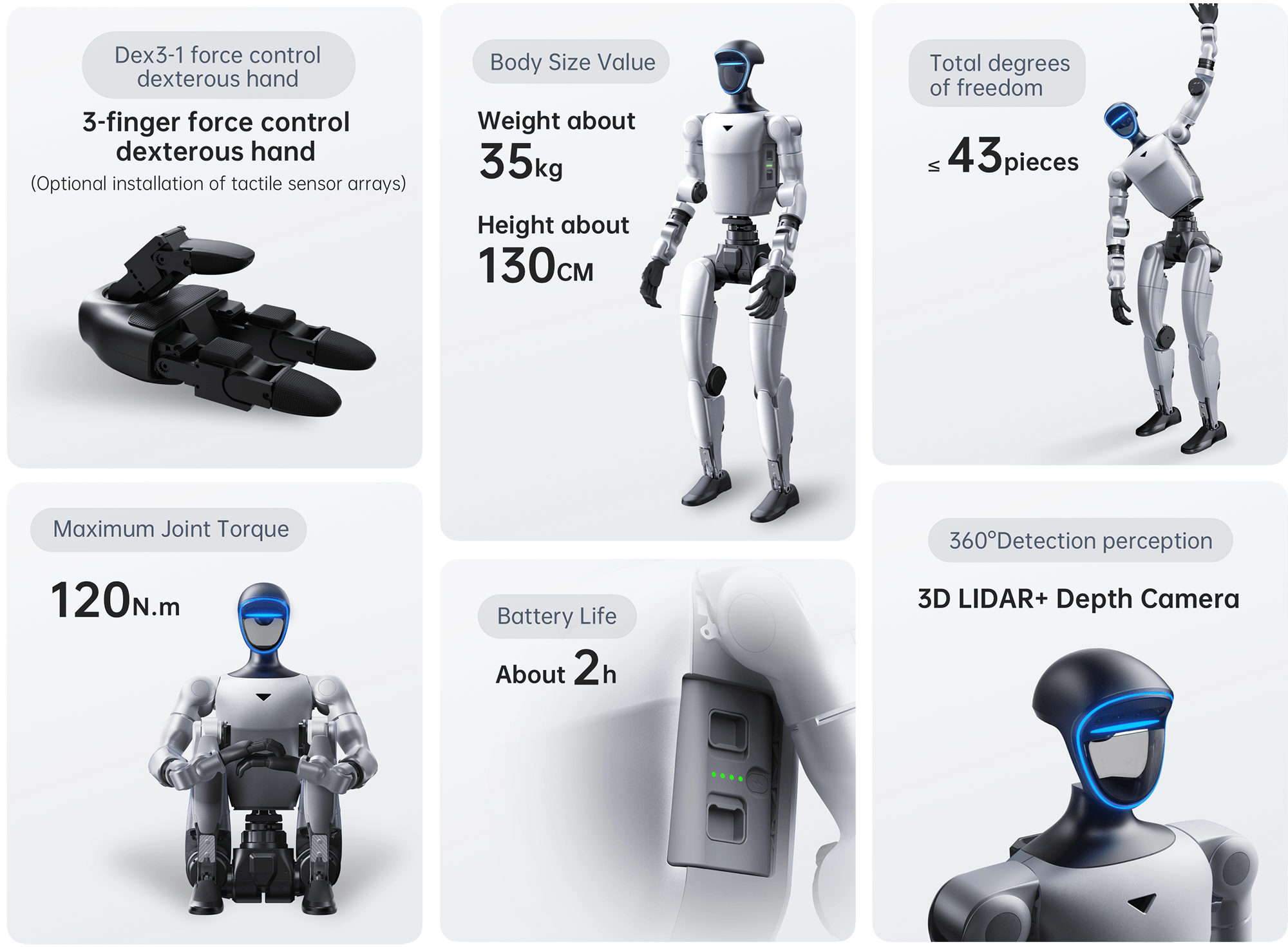
The EDU is not one product but a configurable platform. Unitree's specification table lists it with 23 to 43 degrees of freedom: the same legs and arms as the Basic, plus optional two extra waist joints, two wrist joints per arm, and Unitree's Dex3-1 three-finger hand with seven joints per hand, which can be fitted with tactile sensors. It adds a higher-torque knee (120 N.m against 90), a higher arm payload (about 3 kg against 2), an optional compute module "such as Orin", the SDK, and an 18-month warranty instead of eight months. Unitree prices all of this by quote, which is why section 8 relies on dealers' published prices.
The configurability is the point of the EDU, and also its main trap. Two G1 EDUs can differ by tens of thousands of dollars and look identical in a product photo, because the difference is in the hands, the wrist and waist joints and the compute module inside the torso. Dealers name the configurations with codes such as U1 to U14, Professional and Ultimate, and the same code does not always mean the same robot at two different sellers. Before you compare two EDU quotes, write down the joint count, the hand model, whether the hands have tactile sensors and the compute module for each, and compare those, not the code.
2.3 The G1+: a successor already announced
The newest member of the family is the G1+, which appeared on Unitree's website in September 2026. Its specification page lists 25 joints including a two-joint head, binocular and chest wide-angle cameras alongside the 3D LiDAR, a six-microphone array, two 10 W speakers, a higher arm payload, and a price of $15,000 excluding tax and shipping, with an EDU version by quote - Unitree. In China it is listed at RMB 95,000 including tax. It was not on Unitree's store when we checked.
For American buyers the G1+ raises a question nobody can answer yet. It appeared after the FCC's July 2026 rule that bars new foreign-made robots from receiving the equipment authorization they need to be sold in the US, and we found no FCC authorization on record for it. Unitree's prospectus states that its current main models, including the G1, already hold FCC authorization, so the rule "does not currently affect" their US sales, and it warns that new models may not be able to obtain one. Until an authorization for the G1+ appears, assume that the version of the G1 you can buy in the US is the current G1, and that its successor may not follow it.
3. Buying Direct from Unitree: The Price and the Fine Print
Unitree's own store is the cheapest place to buy a G1 in most of the world, and it is worth knowing exactly what you sign up for there, because the low price comes with terms that a dealer purchase does not. As of 11 October 2026 both store variants, the G1 at $13,500 and the G1 Pro at $21,500, were in stock with an Add to Cart button. That is new: from the G1's launch in 2024 until at least October 2025, the store listed it at $16,000 and marked it sold out, and the $13,500 price appeared in November 2025 - Unitree store. One trap for anyone checking for themselves: the store's page contains a hidden sentence saying the G1 "is backordered", which the page only displays when stock runs out, and many automated summaries repeat it as if it were current.
The sticker excludes shipping, duties and taxes, and the store says so in as many words: "Customer is responsible for all applicable customs duties, taxes, and import clearance in accordance with local regulations." Shipping is quoted at checkout as "Heavy Goods Shipping", and when we priced a single G1 in a test cart (without buying), the quotes were $952 to a US address, $931 to Germany, France, the Netherlands or the UK, $1,149 to Switzerland, $1,079 to Canada, $950 to Australia, $927 to India and $420 to Japan. The store offered no shipping method at all to Brazil. Payment is by PayPal only - Unitree store.
3.1 Returns, warranty and what is not covered
The store's refund policy is short: "We do not accept returns for ALL items due to the specificity of the product." Refunds are possible only if you cancel before delivery - Unitree refund policy. Orders "will normally be shipped within 30 business days", and the shipping policy, written for Unitree's robot dogs but the only one the store has, expects arrival in 20 to 45 business days from China - Unitree shipping policy. In practice that means a direct order placed today may take two to three months to arrive, against days for a robot a dealer holds in stock.
The warranty is eight months on the Basic and 18 months on the EDU, starting from the day you receive the robot - Unitree. Unitree's after-sales terms are the part most buyers never read, and they matter for a robot whose main activity is walking. They list "damage caused by tumble or fall when manipulating robot on level ground" among the things the free warranty does not cover, exclude damage caused by your own programs in developer mode, and require you to pay the postage to send the robot to Unitree before a defect is assessed - Unitree terms. Unitree covers the testing, parts, labour and return shipping only if the fault is a defect in the product itself.
None of this is unusual for a manufacturer selling a complex machine worldwide from one warehouse, but it changes the comparison with a dealer. A local dealer cannot rewrite Unitree's warranty, yet it can diagnose a fault on your continent, hold spare parts, and in the EU it owes a private buyer the statutory two-year guarantee regardless of what the manufacturer offers. When you compare a direct price with a dealer price, you are comparing a robot with a robot plus that support, and the gap between the two is the price of the support.
3.2 What a direct order really costs, by country
Putting the sticker, the quoted shipping and each country's duty and tax together gives the cost of a direct order before any customs broker's fee. The figures below use the shipping quotes above and our catalog's duty and tax rules, and they show why the direct route is a bargain in Europe and Japan and a poor deal in the US.
| Destination | Shipping quote | Import duty | Consumption tax | Direct order, before broker fees |
|---|---|---|---|---|
| United States | $952 | About 40%, plus a 0.35% processing fee | State sales tax, if any | about $19,900 plus sales tax |
| Germany | $931 | 1.7% | 19% VAT | about $17,500 (EUR 15,600) |
| United Kingdom | $931 | 0% | 20% VAT | about $17,300 |
| Canada | $1,079 | 0% | 5% GST, plus provincial tax | about $15,300 plus provincial tax |
| Japan | $420 | 0% | 10% consumption tax | about $15,300 |
| Australia | $950 | 0% | 10% GST | about $15,900 |
The table is a planning estimate, not a quote. A customs broker typically adds a few hundred dollars per entry, a business can usually reclaim VAT or GST, and US duty is assessed on the value declared at entry, which is why the import rules for your country, set out on our import rules page, are worth reading before you order.
4. Why Unitree Can Sell a Walking Humanoid for $13,500
The G1's price makes more sense once you see the company behind it. Unitree listed on Shanghai's STAR Market on 19 August 2026, and its prospectus had to set out how many humanoids it sold and for how much. It sold 5 humanoids in 2023, 412 in 2024 and 5,215 in 2025, while its average selling price per humanoid fell from about RMB 593,400 to RMB 260,400 and then RMB 166,400, about $23,000 at current exchange rates - Unitree prospectus. That is a fall of 72% in two years, and it was driven by exactly the robot this guide is about: a smaller, cheaper humanoid sold in volume. (We used the same filing in our Tesla Optimus price guide to show what volume does to humanoid prices.)
An average of about $23,000 across all of Unitree's humanoids, with the full-size H1 and H2 and the EDU editions pulling it up, is consistent with a G1 Basic selling for well under that. Three structural facts explain how Unitree gets there. First, it makes its own joint motors, the most expensive part of any legged robot, and it sells them as components to other robot builders, so the G1 inherits the cost reductions of years of quadruped production on its most expensive parts. Second, it builds in Hangzhou, inside the densest supply chain for motors, batteries and electronics in the world. Third, it sells the same body in several editions, so the cheap demonstration edition and the expensive research edition share their tooling and their parts.
4.1 What the price tells you about the market
The prospectus numbers carry a lesson for buyers beyond the G1. Humanoid robots are following the path that drones, 3D printers and quadruped robots followed before them: a handful of expensive machines for laboratories, then a sudden collapse in price as one manufacturer reaches volume, then a market where the cheapest credible product sets the reference price for everyone else. Unitree's own quadrupeds went the same way, from research instruments to products sold to hobbyists.
Two consequences follow for anyone deciding when to buy. Prices for comparable robots are more likely to fall than rise over the next few years, outside the US where tariff policy can override everything else. And the reference point is now set by China: a humanoid of the G1's size from a Western maker, where one exists at all, costs several times as much, which is why the G1 is so common in university labs and at trade shows. Research firm Omdia counted Unitree as the world's second-largest humanoid shipper in 2025 with 4,200 units, behind AgiBot's 5,168 - TechNode, a figure lower than Unitree's own count because analysts and companies define a shipment differently; the prospectus is the more authoritative number.
5. Buying a G1 in the United States: Duty, the FCC and the Dealer Premium
For an American buyer, the G1 is the rare case where buying from a dealer is cheaper than importing it yourself. That sounds backwards, because the dealer has to make a margin, so it is worth working through why. Unitree's store ships to the US on terms where the buyer pays every duty and clearance fee on arrival, and since July 2026 a Chinese-made robot like the G1 carries about 40% in US import duty. On a $13,500 robot that is roughly $5,400 before freight, a customs broker and the paperwork, which puts a direct import at around $19,800 to $20,500 delivered by our estimate. US dealers who already hold stock sell the same G1 Basic for $17,990 with the import done, a US warranty contact and delivery included.
The duty figure is not a guess and it is not the number most articles quote. US customs classifies a complete robot like the G1 under heading 8479.50 (industrial robots), which carries a 2.5% base rate, plus a 25% Section 301 tariff that has applied to that heading since 2018 (it sits on List 1, note 20(b) of chapter 99 of the US Harmonized Tariff Schedule), plus a further 12.5% Section 301 duty on Chinese goods that USTR imposed after its forced-labor investigations, in force since 24 July 2026 with no end date - USTR. The widely quoted "35%" figure leaves out both the base rate and the July layer. The tariffs struck down by the Supreme Court in February 2026 were a different set (the IEEPA duties), and the temporary 10% surcharge that replaced them expired on the same morning the forced-labor duty began, so the rate went up rather than down.
5.1 Direct import versus a US dealer, line by line
The arithmetic below uses our catalog's delivered-cost engine, the same one that prices every robot on this site for your country. Freight is priced for a crated machine of 35 kg with a dangerous-goods battery, a customs broker and bond are included, and US sales tax is left out of both routes because it depends on your state and applies to a dealer sale as well.
The gap of roughly $1,800 to $2,500 in the dealer's favour comes from three places. First, a dealer importing in volume pays duty on its own purchase price, which is not necessarily the $13,500 Unitree charges a single buyer. Second, freight for one crated robot with a lithium battery classed as dangerous goods is expensive, and a dealer spreads one container across many robots. Third, the broker, bond and entry fees are fixed costs per shipment, which a dealer pays once for a pallet and you pay once for a single machine. None of this makes the dealer generous; it makes the direct route inefficient at a quantity of one.
There is a second reason to prefer a dealer that has nothing to do with price: support. A G1 bought direct from Hangzhou that arrives with a fault has to be diagnosed and, if needed, shipped back across the Pacific, while a US dealer has a stake in fixing it locally. Several dealers also bundle setup, training or a longer warranty, and those are worth comparing as carefully as the sticker.
5.2 Is a G1 legal to buy in the US after the FCC's robot rule?
Yes, and the reason matters because the rule has been widely misreported. On 28 July 2026 the FCC added foreign-produced "advanced robotic devices", a category that includes humanoids, to its Covered List, which means a new foreign robot model can no longer receive the FCC equipment authorization it needs before it can be imported, marketed or sold in the US - FCC Public Notice DA 26-786. The action is not retroactive. A model authorized before that date can still be imported and sold, and owners can keep using what they have.
The G1 was authorized long before the cutoff. Its FCC ID, 2A5PE-YUSHU008, was granted to Unitree's parent company Hangzhou Yushu Technology on 3 March 2025 for a "Humanoid robot", which is why every G1 edition is still on sale in the US today. The practical consequence for a buyer is narrower than the headlines suggest: the G1 you can order is legal, but a future Unitree model that was never authorized may simply never reach US shelves. If you are deciding between buying now and waiting for a successor, that asymmetry belongs in your thinking, and it is covered in our import rules for every machine.
Two bills aimed at Chinese robots were pending in Congress when this guide was written, and neither has passed. The GUARD Act, introduced on 3 June 2026, would require scrutiny of robots made by China and other foreign adversaries and "would prohibit the importation of robots determined to be a national security threat" - House Select Committee on the CCP. The American Security Robotics Act would restrict federal purchases and operation, not private ones - Covington Global Policy Watch. A university or company that takes federal grants should read the second one closely; an individual buyer is not its target.
5.3 The duty can still move, in both directions
Two open processes could change the US price of a G1 within months, which is why we date every figure. The forced-labor duty is being challenged at the Court of International Trade by business plaintiffs and a group of state attorneys general; the court heard argument on 30 September 2026 and asked for further briefing in October, so a ruling could remove the 12.5% layer or leave it in place. Separately, the Commerce Department's Section 232 investigation of robotics imports, opened in September 2025, is still listed as ongoing and could add a robot-specific tariff on top - Bureau of Industry and Security.
For a buyer, the practical rule is simple. If the price matters to you to within a few thousand dollars, buy from US stock at a locked price rather than ordering an import whose duty is assessed on the day it clears customs. A dealer's price already includes the duty it paid, so a change after you order is the dealer's problem, not yours. If you do import directly, keep every customs document: if a duty is later struck down, refunds have historically gone only to importers who preserved their claims.
6. Buying a G1 in Europe: VAT, CE Marking and an Unusual Gap
Europe is the mirror image of the US. The EU's duty on an industrial robot from China is just 1.7% (our import rules set out the classification), so the cost of importing a G1 yourself is dominated by VAT, freight and a customs broker, not by tariffs. By our estimate a G1 Basic bought from Unitree and delivered to Germany costs about EUR 15,500 to 16,200 including 19% VAT, while European dealers charge from EUR 25,125 (reichelt, in stock) to about EUR 28,600 including VAT for the same robot. That is the largest gap between direct and dealer pricing for any robot in our catalog, and it deserves an explanation rather than a cheer.
Part of the gap is real cost. A European dealer handles CE conformity documentation, a European-language manual, a warranty you can enforce under EU consumer law if you are a private buyer, and returns within the EU. It pays for stock, support staff and the risk of robots that arrive damaged. Part of it is simply what the market will bear: until recently there were few authorized sellers, and buyers in universities often cannot import from a Chinese web store at all because their procurement rules require an EU invoice. If you can import yourself, the saving is large; if your organisation cannot, the dealer price is the real price.
6.1 Import versus dealer, country by country
VAT is the variable that moves the delivered price across Europe, from 17% in Luxembourg to 27% in Hungary. The chart compares our import estimate with the cheapest EU dealer price we found, reichelt's EUR 21,113 before VAT, with each country's VAT added, for four large markets.
The import column assumes you can receive a crated 35 kg robot, deal with a customs broker and accept a warranty that runs through Unitree in China. For a business, VAT on an import is usually reclaimable, which shrinks both columns by the same proportion but does not change the gap. Our guide to importing a humanoid robot walks through the customs, CE and battery-shipping steps a direct import involves. For a private buyer, the dealer route buys EU consumer rights: a legal guarantee of at least two years against the seller - Directive (EU) 2019/771, and a 14-day withdrawal right on distance purchases, neither of which you can practically enforce against a web store in China.
7. G1 Prices in the UK, Canada, Australia, the Middle East and Asia
Outside the US and the EU, the G1 is sold through a thinner network of dealers, and their prices vary far more than the cost of getting the robot there. That makes the direct-versus-dealer question sharper. In most of these countries the import duty on a robot is zero or low, so a direct order from Unitree costs little more than the sticker, the quoted shipping and the local consumption tax, while some local dealers charge nearly double that. The figures below are each dealer's own price as shown on 11 October 2026, set against our estimate of a direct order.
In the United Kingdom, robots enter duty-free and pay 20% import VAT, so a direct G1 lands at roughly £13,100 before a broker's fee by our estimate. Dealer prices run from £16,568 including VAT at RoboSavvy, which publishes its full EDU ladder, to £20,999.99 at Scan, which showed the Basic as low stock with next-day delivery - Scan. Scan's own page gave two different warranty lengths, eight months in its specification table and six months return-to-base in its warranty box, which is exactly the kind of detail to settle in writing before ordering.
In Canada, robots also enter duty-free and the federal GST is 5%, with provincial tax on top. A direct order comes to roughly CAD 21,700 before provincial tax by our estimate, while SpeedyDrone lists the Basic at CAD 25,699 and asks buyers to confirm availability before ordering, and another seller lists CAD 29,372. In Australia the gap is the widest we found: a direct order lands at about A$22,900 including GST, while Pakronics lists the Basic at A$42,834.99 including GST (out of stock) and C.R. Kennedy at A$38,720 on backorder. An Australian buyer who can handle an import saves close to A$20,000 against the cheapest listed dealer.
7.1 The Gulf, India, Japan and China
In the United Arab Emirates, the import duty is 5% and VAT is 5%. E-City lists the Basic at AED 89,999 including VAT with an estimated 60 days to delivery, and Viversio at AED 80,060 including VAT and import duties, about $21,800 to $24,500. Unitree's Middle East partner showed a placeholder price of zero, so a quote is the only way to get its number. In India, the only listing we found claimed to be made in India and recommended for ages eight and up, which does not describe a G1; Indian buyers should assume a direct import, where an effective 8.25% duty and 18% GST bring a direct order to roughly $18,400.
Japan has an exclusive distributor, TechShare, which sells by quote only, so the yen price is not public. A direct order is cheap by comparison, because Unitree quoted only $420 for shipping to Tokyo and Japan levies no duty on robots, leaving roughly $15,300 including the 10% consumption tax. And in China, Unitree's home market, the G1 Basic is listed at RMB 85,000 including 13% VAT - Unitree China, about $12,700, which is the lowest price anywhere for a buyer who can take delivery there.
These comparisons share one lesson. Where duty is low, the dealer premium is mostly a charge for support, stock and paperwork, and it varies enormously from dealer to dealer within the same country. A dealer that holds stock, answers the phone in your time zone and handles a warranty claim locally can be worth a large premium; one that charges a large premium and still quotes a 60-day lead time from China is offering you the direct route at a markup. Our collection of delivery costs by country and the import rules for each destination set out the duty, tax and paperwork in detail.
8. G1 EDU Price: The Research Editions, Tier by Tier
The G1 EDU is where the G1's price stops being a single number. Unitree does not publish an EDU price at all: its own specification table says "contact sales", and its store sells the EDU by quote - Unitree. What buyers see instead is a ladder of dealer configurations, usually named U1 upwards, that combine three choices: how many joints the robot has (23, 29 or the full 43 with hands and wrists), which hands it carries (none, Unitree's own Dex3-1, or a third-party hand), and which compute module sits inside it. Each step up the ladder adds thousands of dollars, and the top configurations cost more than six G1 Basics.
The reason for the ladder is that research groups want very different robots. A locomotion lab training walking policies needs the SDK, the onboard compute and spare batteries, and does not need hands at all. A manipulation lab needs hands, wrist joints and probably tactile sensors, and will pay for them. A lab doing teleoperated data collection needs the full arm and hand set plus headsets. Selling one fixed EDU would overcharge the first lab and underserve the second, so Unitree and its dealers price the options separately.
8.1 What each EDU tier costs
The table sets out the entry and top prices at the dealers we could verify, all read on their own pages on 11 October 2026. Dealers name their tiers slightly differently, so compare what is inside each configuration rather than its label.
| Configuration | What it adds to the Basic | US list (RobotLAB, RoboStore, Toborlife) | Generation Robots (EUR, before VAT) | quadruped.de (EUR, before VAT) |
|---|---|---|---|---|
| U1 EDU Standard | SDK, Orin NX compute, 23 joints, no hands | $43,900 | EUR 32,500 | EUR 31,500 |
| U2 EDU Plus | 3-joint waist and 7-joint arms (29 joints), no hands | $53,900 | EUR 40,000 | EUR 34,000 |
| U3 Ultimate A | U2 plus two Dex3-1 three-finger hands | $65,900 | EUR 52,000 | EUR 49,000 |
| U4 Ultimate B | U2 plus two Dex3-1 hands with touch sensors | $67,900 | EUR 54,000 | EUR 50,000 |
| U6 Ultimate D | U2 plus two Inspire five-finger tactile hands | $73,900 | EUR 58,000 | EUR 55,959 |
| U7 Ultimate E | U2 plus two BrainCo Revo 2 five-finger hands | $63,900 | EUR 49,000 | EUR 43,885 |
| Ultimate I | U2 plus two Wuji Hand 2 hands (20 joints each) | $83,900 | EUR 74,000 | EUR 56,499 |
| G1 Comp | Competition version with a moving head | $46,900 | EUR 36,500 | EUR 46,000 |
Sources: RobotLAB, Toborlife, Generation Robots and quadruped.de, read on 11 October 2026. Generation Robots' prices are its own figures before French VAT; quadruped.de's before German VAT.
Three US dealers charge identical prices for every one of these configurations, and Toborlife's EDU page shows how they are built: a base EDU price plus a published adder for each pair of hands, from $8,000 for a pair of BrainCo Revo 2 hands to $11,000 for Unitree's Dex3-1, $13,000 for the Dex3-1 with touch sensors and $30,000 for Wuji's 20-joint hands. European prices before VAT run roughly 10% to 30% below the US list for the same configuration, largely because the US price carries about 40% of import duty and the European one 1.7%. The German distributors' own ladders also contain inversions, such as the Revo 2 Touch tier costing less than the Revo 2 Basic, which appear on three German sellers' sites and are worth querying before you order.
The jump from the entry tier to the top tier is almost entirely hands and compute. The robot's body, battery and sensors are the same throughout, which is why a lab that does not need hands should resist the upsell: the entry EDU walks, balances and runs your code exactly as well as the top one. Hands are where the money goes, and they are also where the technology is least mature, so a lab buying for manipulation should ask the dealer which hand is fitted, how many fingers and joints it has, whether it has tactile sensing, and whether the SDK exposes it fully. Our explainer on why hands are sold separately covers the options across every humanoid we list.
8.2 The cost of a research setup, not just a robot
The EDU's sticker is also far from all a research group spends in its first year. A realistic setup adds a workstation with a recent NVIDIA GPU for training policies in simulation (Unitree's own Isaac Lab project says it has "only been tested on RTX 3080, RTX 3090, and RTX 4090 GPUs" - Unitree on GitHub), a spare battery or two so the robot is not idle while one charges, a gantry for testing new walking policies without a fall, and for teaching by demonstration, a teleoperation kit. RoboStore prices a G1 gantry at $850 and a full-body teleoperation kit with a PICO 4 Ultra headset at $6,000, compatible only with the U2 configuration or higher - RoboStore, and a spare battery is $700 on Unitree's store - Unitree. And it needs at least one person who can work in ROS 2, Python and C++ and knows reinforcement learning, which is the largest cost of all.
The point is not to discourage anyone but to budget honestly. A lab that buys a $44,000 EDU and nothing else will spend its first months building the infrastructure around it. A lab that budgets for the robot, the workstation, the spares and the people will be running experiments within weeks, which is what the large community of G1 researchers has shown is possible: the published code for many recent G1 papers runs on exactly this kind of setup.
9. What the Price Buys: The G1 Out of the Box
It is worth being precise about what arrives in the crate, because the G1's marketing and its specification table describe two different products. Unitree's G1 page shows dexterous hands manipulating objects, robots learning by imitation and a "robot world model", and in small print says that "some sample functions on this page are still being developed and tested, and will be opened to users in the future" - Unitree. The specification table on the same page is the contract, and it is unusually frank about the difference between the editions.
Both editions share the same body: a robot 132 cm tall, 45 cm wide and 20 cm deep standing up, folding to 69 cm for transport, weighing about 35 kg with its battery. Both have a depth camera and a 3D LiDAR for seeing the world, a four-microphone array, a 5 W speaker, Wi-Fi 6 and Bluetooth 5.2, an eight-core CPU, a 9,000 mAh quick-release battery and a 54 V charger, and both are rated for about two hours of battery life. The differences are in the joints, the hands, the compute and, above all, the permission to program. Unitree's own product diagram names the sensors as a Livox MID-360 LiDAR and an Intel RealSense D435i depth camera, and gives a moving speed of 2 m/s, a figure its specification table omits.
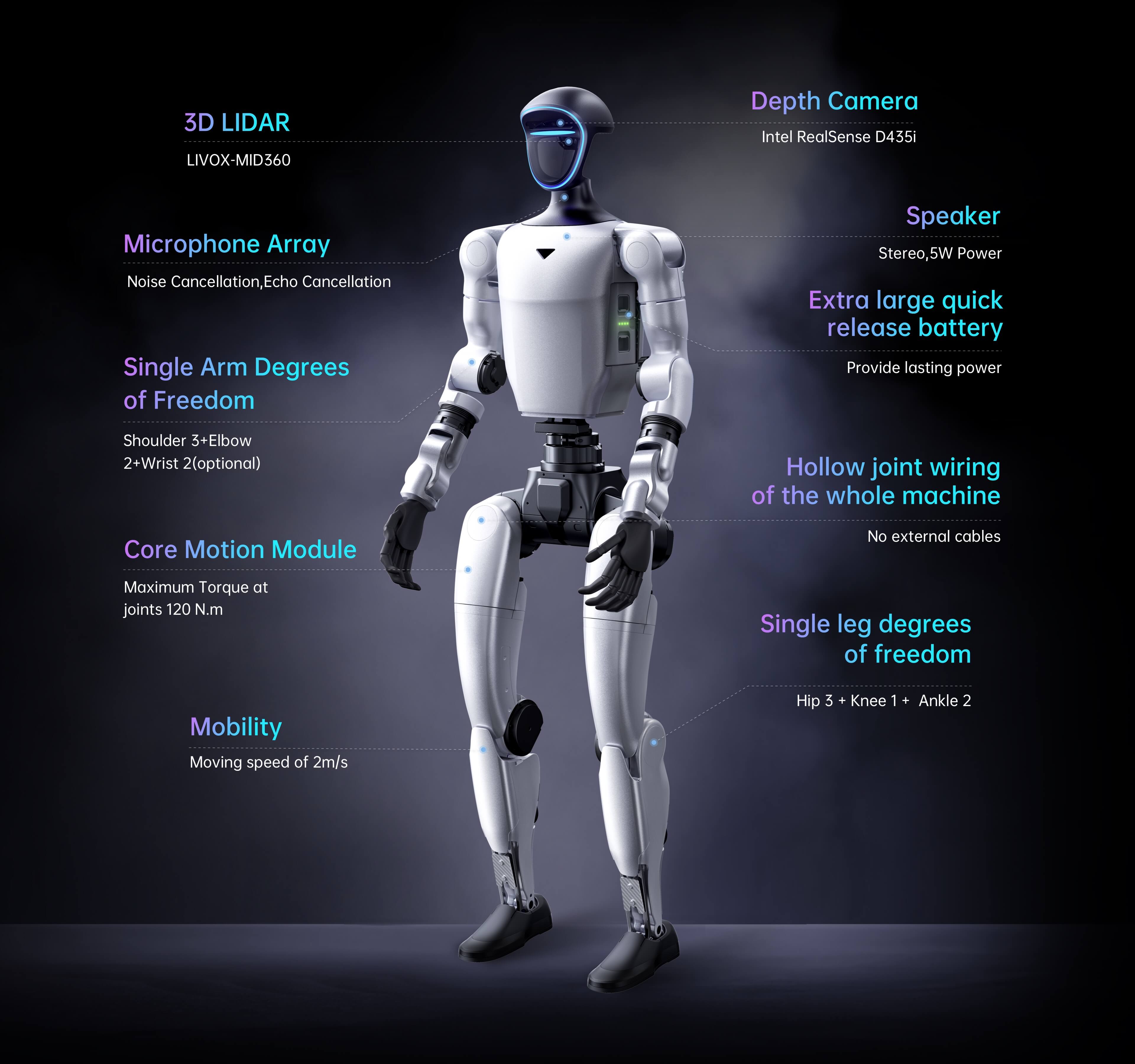
| Specification | G1 Basic | G1 EDU |
|---|---|---|
| Degrees of freedom | 23 | 23 to 43, by configuration |
| Hands | None (fixed dummy hands) | Optional Dex3-1 three-finger force-controlled hand, 7 joints each |
| Knee torque (largest joint) | 90 N.m | 120 N.m |
| Arm payload | About 2 kg | About 3 kg |
| Extra compute module | None | Optional, "such as Orin" |
| Secondary development | No | Yes |
| Warranty | 8 months | 18 months |
| Unitree price (tax and shipping excluded) | $13,500 | Contact sales |
Source: the specification table on Unitree's G1 page, read on 11 October 2026.
Two rows in that table decide most purchases. Secondary development is Unitree's term for running your own software on the robot: the Basic has none, so it does what Unitree's firmware and remote controller let it do, which is walk, run, climb small steps, recover from falls, wave and perform preset motions. The EDU opens the robot's high-level and low-level control to your code through Unitree's SDK. The warranty row is the other one buyers miss: eight months on the Basic against eighteen on the EDU, which says something about how Unitree expects each to be used, and which is one more reason a dealer's own warranty terms are worth reading.
9.1 What a G1 Basic actually does on day one
Out of the box, a G1 Basic is a remote-controlled machine. You charge the battery, stand the robot up, pair the handheld controller and drive it: walking, turning, crouching, getting up after a fall, gesturing and running through the motion routines Unitree ships, with regular over-the-air updates adding new ones. WIRED, profiling owners who rent G1s out for events, reported that one owner's robot "came with about 20 gestures and 15 dance moves built in", and that beyond that "it takes some technical knowledge to program new movements" - WIRED. The same owners said they teleoperate their robots "most of the time" in public. It does not take spoken instructions to do tasks, it does not tidy, fetch or carry anything useful, and without hands it cannot grasp. Unitree itself warns on the same page that "individual users are strongly advised to thoroughly understand the limitations of humanoid robots before making a purchase", which is rarer candour than most of the industry manages.
That is not a criticism of the robot, which is mechanically excellent, but a description of what $13,500 buys in 2026. A walking humanoid that does real work unsupervised does not exist at any price a person can pay, as our guide to what humanoid robots actually deliver documents machine by machine. The Basic is sold for demonstrations, and it is very good at them: it is the robot you see at trade shows, in shopping centres and in viral videos, because it walks convincingly, survives falls and costs less than a small car.
Unitree's own videos are the best picture of what the hardware can do, and this one, published on its official channel in October 2025, shows the agility that makes the G1 so popular at events. Keep in mind while watching that a demonstration like this is Unitree's software in Unitree's hands; a robot fresh out of the box runs the routines Unitree ships with it.
The hardware in that clip is the same in every edition. What changes between a $13,500 Basic and a $60,000 EDU is what you are allowed to make it do next, which is the subject of the next subsection.
9.2 What the EDU unlocks, and what it still needs
The EDU is the G1 that research labs buy, and its value is almost entirely in what it lets you build. With the SDK you can command the robot's balance and gait at a high level or drive individual joints at a low level, train new walking and manipulation skills in simulation and transfer them to the robot, and record demonstrations from a human operator wearing a headset. A large share of the humanoid research published in the last two years ran on real G1s: the ASAP project transferred agile motions "to the real-world Unitree G1 humanoid robot" - arXiv, UC Berkeley's VideoMimic deployed learned skills "on a real Unitree G1 robot" - arXiv, and BeyondMimic describes "the four Unitree G1 robots" its team used - arXiv. Unitree's prospectus calls the G1 the world's best-selling humanoid of 2024 and 2025, and research and teaching are what most of those robots are bought for.
That popularity is itself part of what the EDU price buys. Unitree publishes its SDK and training code openly, and its reinforcement-learning repository alone has more than 3,600 stars on GitHub - unitree_rl_gym; NVIDIA's Isaac Lab ships ready-made G1 tasks - Isaac Lab, and Google DeepMind's MuJoCo Menagerie includes a G1 model - MuJoCo Menagerie. A new G1 owner starts with years of other people's working code, which no rival at this price can match.
None of that comes in the box. The EDU needs people who know ROS 2, Python or C++ and reinforcement learning; a workstation with a recent NVIDIA graphics card for training; for manipulation work, hands, which are optional and expensive; and, for teaching by demonstration, a teleoperation setup. Our guide to the skills a humanoid really requires and our explainer on why some editions are locked go deeper. The practical point for budgeting is that the EDU's price is the entrance fee, and a realistic first-year cost for a lab includes the people and the equipment around it.
9.3 What a G1 costs to run
The running costs of a G1 are modest next to its price, but they are not zero, and a few of them surprise first-time owners. The biggest is the battery: one 9,000 mAh pack gives about two hours, a spare costs $700 on Unitree's store - Unitree or $750 at RoboStore, and anyone using the robot for a full day needs at least one; our battery reality check compares runtimes across the catalog. A replacement charger costs EUR 149.90 at Funduino in Germany, and a replacement remote controller $370 at RoboStore - RoboStore. Hands are the expensive spare: Funduino in Germany lists a Dex3-1 hand with tactile sensors at EUR 7,973 including VAT, and a replacement Jetson Orin NX compute module at EUR 3,867.50 - Funduino.
The cost nobody can price yet is repair. No seller we found publishes a price for a replacement leg or arm joint motor, Unitree's warranty excludes falls on level ground, and lab owners report broken wrist gears and overheating shoulder motors on forums and in Unitree's own GitHub issues - unitree_sdk2_python issue 129. Paid service plans exist at some dealers, RobotLAB's from $199 a month, though its fine print covers batteries for only three months - RobotLAB. We found no insurance product for a privately owned humanoid in the US or Europe, so check whether your business or home policy covers one before it arrives.
The demo owner's extras are a spare battery and a spare controller, about $1,070. The research lab's are a spare battery, a gantry and a teleoperation kit, about $7,550, and they assume the lab chose the U2 configuration, the cheapest one the teleoperation kit supports, at $53,900. Neither figure includes the workstation, sales tax, insurance or the people, and for a lab the people cost more than everything in the chart combined, a point our guide to what a humanoid robot costs develops for every size class. There is also income on the other side for some owners: WIRED reported that owners renting G1s out for events charge $800 to $1,200 an hour - WIRED, which is how some small businesses pay for theirs.
10. Renting a G1 Instead: When It Beats Buying
A surprising number of people searching for the G1's price need the robot for a few days, not a few years: a trade show, a product launch, a school visit, a film shoot. For them the purchase price is the wrong number, because a rental includes delivery, setup and often an operator, and it leaves no robot sitting in a cupboard afterwards. The G1 is the most widely rented humanoid in our catalog, with providers in the US and across Europe, and their published rates make the rent-or-buy decision easy to reason about.
Rentals come in two very different kinds, and the price gap between them is the first thing to understand. A self-service rental delivers the robot to your door with a controller and a short briefing, and you operate it yourself. A full-service booking sends a trained operator with the robot, who sets it up, runs it and takes it away. The second costs ten times as much per day because you are buying a person's day as well as a robot's.
10.1 What a G1 costs to rent, by provider
These are the published rates on each provider's own page, all checked on 8 October 2026 and listed on our humanoid rental comparison, which is kept current from the same catalog data as this guide.
| Provider | Where | What is included | Published rate |
|---|---|---|---|
| ZMProbots | US, Canada, UK and Europe through local partners | Self-service, delivered to your address, 3 to 30 days | from EUR 269 a day |
| MYBOTSHOP | From Germany | Robot only, one-week minimum | EUR 3,000 a week |
| The Robot Studio | Across the US, based in Dallas | Up to 8 hours with setup and an on-site technician | $2,800 a day |
| Airbot | San Francisco Bay Area | Delivery, setup, a trained operator and collection | $3,499 a day |
| SVRC | US, shipped nationwide | Monthly to annual leases with lease-to-own | By quote |
The spread runs from EUR 269 to $3,499 a day for nominally the same robot, and the difference is almost entirely labour, insurance and logistics. ZMProbots' full-service event day with its own operator starts at EUR 1,725, which shows how much of a staffed booking is the staff. If your event needs a robot that walks around and waves, a self-service rental and an hour of practice with the controller will do; if it needs a robot that performs a choreographed routine in front of a crowd without falling over, pay for the operator.
10.2 The break-even point
The arithmetic of renting versus buying depends on which rental you compare against. Against self-service rental at EUR 269 a day, a G1 bought by import in Germany for about EUR 15,500 pays for itself after roughly 58 rental days, and a dealer-bought one at EUR 27,000 after about 100. Against a staffed US booking at $2,800 a day, a $17,990 G1 pays for itself in about six bookings, but only if you supply the operator, the transport and the insurance yourself, which is precisely what the rental price buys.
The honest conclusion is that renting wins for anyone who needs the robot for under ten days a year, and buying wins for anyone who will use it weekly or who needs the robot on their own premises for teaching or research. A robot you own also loses value: G1s are already appearing on the second-hand market as owners upgrade to newer machines, and a two-year-old basic edition will not fetch its purchase price.
11. Security, Data and Who You Are Buying From
No honest guide to the G1's price can skip its security record, because for some buyers it changes the real cost of ownership more than any tariff. The G1 is a networked machine with cameras, a LiDAR, microphones, Wi-Fi and Bluetooth, and in the last year independent researchers have published several serious vulnerabilities in it. None of this means a G1 is unsafe to own, but it does mean that a university, a company or anyone who brings one into an office should budget for treating it like any other untrusted computer on the network.
The best-documented problem is UniPwn, disclosed on 20 September 2025 by researchers Andreas Makris and Kevin Finisterre. It affected Unitree's Go2, G1, H1 and B2 robots and allowed an attacker within Bluetooth range to gain root access, because every unit shared the same hard-coded encryption key and the "authentication" was a check for the word "unitree" in the handshake - UniPwn disclosure. The researchers wrote that "infected robots can automatically compromise other robots in BLE range". IEEE Spectrum reported that they first contacted Unitree in May 2025 and that "after some back and forth with little progress, Unitree stopped responding" - IEEE Spectrum. The flaws were registered as four CVEs, the most severe rated 8.2 out of 10 - NVD.
11.1 The 2026 findings, and a better response
A second round followed in 2026. In February, the same researcher published a way to recover the keys that protect Unitree's firmware updates, affecting "all of Unitree's current offerings" at the time - NVD. In August, researcher Olivier Laflamme published two separate chains to unauthenticated root access on the G1 EDU, one over the network and one from Bluetooth range, under the headline "Root on a $20,000 humanoid robot from Bluetooth range" - UniBLEed write-up. Both were rated high severity, and they affected G1 EDU firmware through version 1.5.2 - NVD.
The difference this time was Unitree's response. Laflamme's G1 was a gift from Unitree's own security team, he described them as "awesome to work with", Unitree paid bug bounties, and he reports that firmware 1.5.5.0 "reportedly blocks the exploit chain", while noting that he had not verified the fix himself. Unitree now runs a security response centre and publishes a security contact on its website. That is real progress from 2025, and it is the trend a buyer should weigh: a vendor that fixes reported flaws is a better bet than one that ignores them, even if the flaws keep coming.
11.2 Telemetry and where the data goes
The second concern is data. Researchers at Alias Robotics reported in September 2025 that a G1 they studied was "continuously exfiltrating multi-modal sensor and service-state telemetry" to two servers every 300 seconds without notifying the operator, which they argued conflicts with GDPR; the same paper called the robot's security architecture "the most mature we have observed in commercial robotics" - arXiv. Unitree has disputed that it collects private data without authorization, but we could not find its original statement. A May 2025 letter from the US House Select Committee on the CCP asserted that Unitree's privacy policy stores user data in China - House Select Committee letter.
The practical response costs little and is standard practice in labs that own G1s. Update the firmware before first use and keep it current. Change the default password on the EDU's development computer, which a distributor's own guide calls weak - Weston Robot. Put the robot on an isolated network segment with no route to the internet unless you need one, control it through the local SDK, and turn off Bluetooth provisioning when you are not using it. For a business in Europe, the cameras and microphones also make you a data controller under GDPR wherever the robot records people, which our import rules cover for each EU country.
11.3 Used G1s, grey imports and scams
Unitree does not publish a list of authorized dealers, so "authorized" in a seller's description is the seller's own claim. That is not a reason for suspicion in itself, since the established dealers in this guide have sold G1s for years, but it does mean the checks are yours to make. Unitree's only public warning we found asked buyers not to mistake "other companies' robot products or third-party modified equipment" for Unitree products - The Paper, and in 2025 a G1 listing on Walmart's marketplace at $21,600 appeared and then vanished without explanation - Robotics & Automation News.
Four checks catch most problems. Be wary of a "G1" priced below Unitree's own $13,500, or an "EDU" priced like a Basic, since every EDU configuration we found costs well over $40,000. In the US, ask for the robot's FCC ID before paying, and refuse a unit that cannot show one, because the FCC's guidance is that a device "with a valid FCC ID or SDoC compliance information is considered authorized" and a covered robot bought abroad without one generally cannot be legally used - FCC. Never pay a wire transfer to an individual for a "factory-direct" robot: Unitree's own store takes PayPal only. And treat any promise of returns on a robot shipped direct from Unitree with scepticism, since Unitree accepts none.
A genuine second-hand G1 can be a reasonable buy for a hobbyist, with two cautions. The Basic's warranty is only eight months and runs from the original delivery, so a used unit is almost always out of warranty, and Unitree's terms exclude damage from falls even within it. And the edition matters more than the price: a used Basic is still a Basic, locked against programming for the rest of its life, so the seller's description of the edition should be checked against what the robot's app reports before money changes hands.
12. What Else You Can Buy for G1 Money
The G1 is not the only walking humanoid in its price range any more, and anyone budgeting for one should know what the same money buys elsewhere. Our catalog lists every humanoid you can order today, and the useful comparison is not between spec sheets but between what each robot lets you do. The table below compares the G1 with its closest alternatives on the figures that decide a purchase, with each delivered price taken from the catalog for a US and a German buyer.
| Robot | Height and weight | What you can do with it | US delivered | Germany delivered |
|---|---|---|---|---|
| Unitree R1 Air | 123 cm, 27 kg | Remote-controlled demos; no programming | $7,452 (import) | EUR 5,909 (import) |
| Booster K1 | 95 cm, 19.5 kg | Fully programmable on every tier | $11,799 (dealer) | EUR 8,925 (dealer) |
| Unitree R1 EDU | 123 cm, 29 kg | Programmable, smaller than a G1 | $15,328 (import) | EUR 11,986 (import) |
| Unitree G1 | 132 cm, 35 kg | Remote-controlled demos; no programming | $17,990 (dealer) | EUR 15,462 (import) |
| Booster T2 | 140 cm, 42 kg | Programmable, open SDK | $37,999 (dealer) | EUR 26,835 (dealer) |
| Unitree H2 | 182 cm, 70 kg | Full-size remote-controlled demos | $39,900 (dealer) | EUR 33,501 (import) |
| Unitree G1 EDU | 132 cm, 35 kg | Programmable research platform | $43,900 (dealer) | EUR 38,675 (dealer) |
Read the third column first. The most important difference between these robots is not size or price but whether you are allowed to write code for them. The G1 Basic, the R1 and R1 Air and the H2 Basic are sealed: Unitree sells them as demonstration machines without secondary development, so you get the moves Unitree ships and nothing else. Booster's K1 and T2, and every EDU edition, open the robot to your own software. If you want to program a walking humanoid on the smallest budget, the G1 Basic is the wrong purchase at any price, and a Booster K1 or an R1 EDU is the right one.
The second thing the table shows is that the G1's place in the market is the middle. It is roughly twice the price of the cheapest walking humanoids and half the price of the full-size ones, it is tall enough to look like a person at a trade show and light enough for two people to carry, and it has the largest community of owners, tutorials and published research of any humanoid. That last point is easy to undervalue: when something breaks or a script misbehaves, the number of people who have already solved the problem matters more than a spec sheet. For side-by-side detail, our comparisons of the G1 and R1 and the G1 and Booster T1 put every figure in one table.
13. Which G1 to Buy, and From Whom: A Decision Framework
Everything above reduces to three questions, asked in order, and they apply to any humanoid, as our guide to buying a humanoid robot explains for the whole market. The first is whether you will ever want to write code for the robot. The second is where you are and whether you can import a crated robot yourself. The third is how much support you need when something goes wrong. The order matters because the first question cannot be undone: a G1 Basic can never be upgraded to an EDU, so a buyer who gets the first answer wrong pays twice.
The diagram walks through those questions. It deliberately starts with renting, because for a large share of the people who search for a G1's price the right answer is not to buy one at all.
The branches hide one judgment call that deserves prose. The difference between "demos" and "research" is not about who you are but about what you will do on day thirty. A school that wants pupils to watch a robot walk needs a Basic; a school that wants pupils to make a robot walk needs an EDU or a cheaper programmable robot such as the Booster K1. A company that wants a robot at its trade-show stand needs a Basic, or more likely a rental; a company that wants to test whether a humanoid can move boxes in its warehouse needs an EDU with hands, a person who knows ROS 2 and a realistic expectation of what the robot can do, which our guide to what humanoid robots actually deliver sets out in detail.
13.1 Recommendations by type of buyer
For a university or research lab in the US, the G1 EDU from a US dealer is the default, because procurement offices want a US invoice and a warranty contact, and the EDU's SDK and onboard compute are what the published research uses. Budget for hands separately if your work involves manipulation, and for a workstation with a recent NVIDIA GPU for training. In Europe, the same lab should compare a dealer's EDU price with a direct import only if its procurement rules allow a non-EU invoice; most do not.
For an event company, retailer or brand, rent first. If you find yourself renting more than about ten days a year, buy a Basic from stock, and in the US buy from a dealer rather than importing, because the dealer is cheaper and handles warranty claims locally. Add a second battery to your order: two hours of runtime is a short trade-show day.
For an individual enthusiast, the honest advice is that the G1 Basic is an expensive remote-controlled toy that you are not allowed to program, and the G1 EDU is a research instrument priced for institutions. If you want to learn robotics, a programmable robot that costs less than the G1 Basic, such as the Booster K1 or the Unitree R1 EDU, teaches you more. If you simply want a walking humanoid in your home because it is remarkable, the Basic is a legitimate choice, and our guide to humanoid robots for the home explains what it will and will not do for you there.
For a company elsewhere, outside the US and EU, start from the delivery costs to your country on our collection pages and the import rules for your destination, then ask an authorized local dealer for a quote; in several markets the dealer's price is the only practical route because of radio certification and product-safety rules.
14. What Could Change the G1's Price Next
Robot prices are usually discussed as if they only ever fall, and over the long run that is what Unitree's own numbers show. Over the next six months, though, the forces acting on the G1's price point in both directions, and a buyer timing a purchase should know which ones are scheduled and which could arrive without warning. We track each of them on our market updates page, and the robot pages change the day any of them moves.
The scheduled events are in the US. The Court of International Trade challenge to the 12.5% forced-labor duty had further briefing due in mid-October 2026, and a ruling could follow within weeks. If the court strikes the duty down, the cost of importing a G1 into the US falls by roughly $1,700, and dealers' prices could follow as their landed costs fall. The US-China trade truce agreed in Busan, which holds the existing Section 301 rates where they are, was extended to 10 January 2027 - NBC News; its expiry without a further extension would put higher rates back on the table.
14.1 The unscheduled risks
The unscheduled risks are mostly upward. The Commerce Department's Section 232 investigation of robotics imports could produce a robot-specific tariff at any time, stacked on top of the existing duties. USTR's separate investigations into excess manufacturing capacity, opened in March 2026, could add another Section 301 layer. And the FCC's July 2026 rule means that a successor to the G1, if Unitree releases one under a new model number, may not be sold in the US at all unless it receives an exemption, which would make the current G1 more valuable to American buyers, not less.
The forces pushing the price down are commercial. Unitree sold more than 5,000 humanoids in 2025 and its average price per humanoid fell by more than two-thirds in two years, so it has both the volume and the habit of cutting prices. Competition below and around the G1 is intensifying: Booster, Noetix, EngineAI and AgiBot all sell walking humanoids at prices that overlap the G1's, and several of them allow programming on their cheapest models, which the G1 Basic does not. A buyer in Europe, where the duty is small, is likelier to see the G1 get cheaper over the next year than a buyer in the US, where policy dominates the price.
The practical advice that follows from this is not to wait for a better price unless you have a specific reason to expect one. If you need a G1 for a project starting this year, the cost of waiting (a project delayed by months) is larger than any plausible price cut, and in the US the risk of a new tariff is at least as large as the chance of an old one disappearing. If you are buying out of curiosity rather than need, waiting six months costs you nothing, and the next generation of programmable robots in this price range may suit you better.
15. How This Guide Was Researched, and How It Stays Current
A price guide is only as good as the date on its prices, so here is how ours were gathered. Every price in this guide was read on the seller's own page on 11 October 2026: Unitree's store and its product data, each dealer's product page or published product feed, and where a store prices each country differently, the price it showed for the country named. Where a dealer prints a price including VAT, we say which country's VAT it includes, because a French price and a German price for the same robot are not comparable until you take the VAT out. Prices that a store prints but does not honour, such as placeholder figures on quote-only machines, are not used.
The delivered costs come from the engine that prices every robot in our catalog, using each destination's duty, consumption tax, freight and clearance rules as set out in our import rules, and the US duty stack was last re-verified against the tariff schedule on 30 September 2026. Unitree's sales figures come from its stock market prospectus, and the security findings from the researchers' own publications. The research was split into threads (Unitree's own store and filings, every dealer's price by country, and the ownership record), each handled by an AI research agent required to return the exact sentence it relied on and the address it read, and the figures were then checked against the saved pages a second time before publication. An agent can confirm what a page says, not whether it is true, which is why claims made by a seller are labelled as the seller's.
15.1 Money, and why it does not decide the ranking
This site earns a commission when a reader buys through the links marked as commission links on our robot pages, from two sellers in this guide: Unitree's own online store and Robots International. Neither pays for a position. Toborlife, which ranks first, has our application to its referral program under review and pays us nothing today. The seller ranking at the top of this guide was scored on the evidence written into each cell, and it places a seller that pays us below one that does not wherever the evidence says so. No link in the body of this guide is a referral link; the commission links live on the robot pages, next to a plain statement of which links earn us money.
Keeping the guide current is a routine rather than a promise. G1 prices are rechecked on the G1 page and the G1 EDU page, changes are logged with their dates on the updates page, and when a price, a duty rate or the G1's legal status changes, the robot pages change first and this guide follows. If you are reading this long after the date below, treat the robot pages as the live version of every table here.
Prices, editions, duties and availability in this guide were checked against Unitree's store, each seller's own page and the cited sources on 11 October 2026. Robot prices and import duties change month by month, so confirm the current price and terms with the seller before you order.