Importing a Humanoid Robot: 2026 Guide
· 59 min read · Yuma Heymans · Updated
A practical, corridor-by-corridor guide to getting a humanoid robot delivered, cleared, and legally operated in 2026.
The tariff on a Chinese humanoid entering the European Union is between 0% and 1.7%. That single number surprises almost everyone. People assume the wall between them and a walking robot is a customs duty, some punitive rate that makes the whole thing hopeless. It is not. On a EUR 15,000 robot, the duty is somewhere between nothing and about EUR 255, verified against the official EU tariff schedule for 2026 - Commission Implementing Regulation (EU) 2025/1926. The real obstacle is somewhere else entirely, and it is the reason this guide exists.
Here is the problem: the hard part of importing a humanoid is almost never the money, and almost always the paperwork, the compliance file, and the simple question of whether the robot is even for sale. A Unitree G1 costs less to import than most people expect and is harder to legally operate than anyone tells you. A Tesla Optimus cannot be bought at any price. A 1X NEO can be ordered from anywhere on Earth and delivered to almost nowhere. The gap between "I found the buy button" and "the robot is standing in my lab, cleared and legal" is where every real cost, every real risk, and every real surprise lives.
This guide walks the four routes that matter in 2026: China to the EU, buying within the EU from a reseller, China to the US, and the strange, mostly blocked corridor of US-made humanoids into Europe. It covers the customs classification fight, the 21% VAT, the CE compliance file under the Machinery Directive, the lithium battery freight rules, the stacked Section 301 tariffs in America, and the rules of actually owning and operating one of these machines: the AI Act, product liability, workplace safety, and GDPR for a robot with cameras. It ends where honesty demands it should, on the robots the answer is simply "you cannot get this one."
Contents
- First principles: what you are actually importing
- The four corridors at a glance
- Corridor one: China to the European Union
- The customs classification fight (and why it matters less than you think)
- VAT, EORI, and the importer-of-record problem
- CE compliance: the real wall
- Lithium batteries and dangerous-goods freight
- A worked landed-cost example
- Corridor two: buying from an EU reseller
- Corridor three: China to the United States
- Corridor four: getting a US-made humanoid into Europe
- The robots you cannot buy at any price
- Owning and operating one: the rules after delivery
- GDPR, cameras, and the surveillance question
- Total cost of ownership and the honest bottom line
- A decision framework for 2026
1. First principles: what you are actually importing
Before any corridor, start with the object itself, because the object determines every rule that follows. A humanoid robot is not one thing to a customs officer, a safety regulator, or a freight forwarder. To customs it is a machine in Chapter 84, a category that also contains lathes and forklifts. To a product-safety regulator it is machinery, a powered assembly with moving parts that can crush a hand. To an airline it is a lithium battery with legs, a dangerous good that determines whether it can fly at all. To a data regulator it is a mobile camera and microphone that happens to walk. Every one of those identities carries its own body of law, and importing the robot means satisfying all of them at once.
This matters because most buyers reason about a humanoid the way they reason about a laptop: pick it, pay, wait for the courier. That mental model is wrong in a way that costs money and time. A laptop is a settled product with a known tariff code, an established safety mark, and a battery small enough to fly in your carry-on. A humanoid is an unsettled product where the tariff code is genuinely arguable, no Chinese manufacturer publishes a full European conformity declaration, and the battery is large enough to make the whole crate a fully regulated dangerous good. The complexity is not bureaucratic sludge. It is the direct consequence of the machine being simultaneously a vehicle for capital equipment, a safety hazard, an energy-dense power source, and a sensor platform.
The structural insight that unlocks the whole subject is this: the friction in importing a humanoid is proportional to how much responsibility shifts onto you. When you buy from a local reseller, that company is the legal importer and it carries the compliance burden, the warranty, the product-liability exposure, and the customs paperwork. When you import directly from China, all of that lands on you personally. The price difference between the two routes, often EUR 4,000 to EUR 10,000, is not a middleman's greed. It is the market price of not becoming the importer of record. Understanding that trade-off is the single most useful thing you can carry into any of the four corridors below.
There is a second first-principles point worth stating plainly, because it reframes half the questions people ask. Almost nothing you can buy today does autonomous work out of the box. The honest state of the market in mid-2026 is that a purchasable humanoid is a remote-controlled demonstration machine on day one, a development platform if you have engineers, and autonomous only for the narrow behaviors you script or train yourself. We cover exactly what does and does not arrive working in why there is no autonomy in the box. Catalogs that verify this before you spend, such as HumanoidStore, exist precisely because the gap between the marketing reel and the crate you receive is enormous. Keep that in mind through every cost calculation that follows: you are importing a capable platform, not a worker.
This second point has a direct financial consequence that changes how you should read every price in this guide. The cheap headline number, the USD 5,900 R1 or the USD 13,500 G1, buys the version that cannot be programmed at all. Unitree and its peers split every robot into a locked base unit, controllable only by remote and app with no software development kit, and an EDU or developer tier costing two to four times more that unlocks the Python, C++, and ROS2 SDK, the onboard NVIDIA compute module, and the ability to deploy learned models. The G1 goes from USD 13,500 locked to USD 43,900 and up unlocked, a jump of more than three times for the software key alone. If your reason for importing is anything beyond a walking demo (research, manipulation, custom behavior), you are importing the EDU tier from day one, and the landed-cost arithmetic in this guide scales accordingly. Budgeting the base price for a use case that needs the developer tier is the most expensive planning mistake a first-time buyer makes, and it is invisible until the robot arrives and refuses to run a line of your code.
The third structural truth is about time, and it cuts the other way from the first two. The rules are tightening on a known schedule, so an import in 2026 is genuinely easier than the same import in 2027. The Machinery Directive applies through 19 January 2027 and the stricter Machinery Regulation (EU) 2023/1230 applies from 20 January 2027, the AI Act's high-risk obligations phase in through 2027 and 2028, and the EU's small-parcel customs reform already landed on 1 July 2026. None of these makes importing impossible, but each adds a layer of cost or paperwork, and they stack. A buyer who understands that the regulatory window is narrowing has a reason to act deliberately rather than wait, which is the opposite of the usual advice to hold out for a better robot. Sometimes the better robot arrives into a worse rulebook.
2. The four corridors at a glance
There are more possible routes than four, but four cover the overwhelming majority of real buyers, and each has a fundamentally different shape. The differences are not about distance or shipping cost. They are about which government makes the process hard and in what way. In one corridor the difficulty is European product law. In another it is American tariffs. In a third it is not law at all but manufacturer policy, the simple fact that the company will not sell to you. Naming the true obstacle in each corridor is what lets you plan around it instead of discovering it at the border.
The table below is the map for everything that follows. Read the "real obstacle" column carefully, because it is where the money and the risk actually sit. A corridor with a scary headline tariff can be easy in practice, and a corridor with a trivial tariff can be nearly impossible because of a compliance file or an availability wall. The feasibility ratings come from the corridor research maintained by import-advisory catalogs and cross-checked against primary legal sources throughout this guide.
| Corridor | Feasibility | Headline duty | The real obstacle |
|---|---|---|---|
| China to EU | Yes, with work | 0% to 1.7% | CE compliance file, importer-of-record duties |
| EU reseller to you | Yes | 0% (intra-EU) | Price premium, shorter B2B warranty |
| China to US | Yes, with work | ~40% | ~40% duty stack, and the 28 Jul 2026 FCC bar on new foreign-robot authorizations (already-approved models like the G1 are grandfathered) |
| US-made to EU | Hard | 0% (US-origin) | Manufacturer will not sell to Europe |
The pattern that emerges is instructive. The two "yes" verdicts (buying inside the EU, or importing from China with effort) are the routes where you can actually get a robot in 2026. The China-to-US route is workable but expensive because of a China duty stack of about 40%, and buying from a US distributor is now decisively cheaper than importing directly once that stack is applied. The US-to-EU corridor is rated "hard" for a reason that catches people off guard: the customs and export mechanics are trivial, but the American manufacturers simply do not offer a European order channel, so the wall is commercial, not legal. We will take each in turn, starting with the one most European buyers actually walk.
3. Corridor one: China to the European Union
This is the corridor that matters most, because China builds the humanoids that individuals and small labs can actually afford, and Europe is where a large share of the world's curious buyers live. The robots in play are the familiar Chinese platforms: the Unitree G1 at around USD 13,500, the ultra-cheap Unitree R1 at USD 5,900, the full-size H2 at a reference USD 29,900 (which superseded the older H1 at USD 90,000 and up, now final dealer stock, though Unitree's own store currently lists the base H2 as out of stock, so in practice it comes from a US or EU reseller), plus EngineAI, Booster, Fourier, and a dozen others. The good news, established at the top of this guide, is that the financial side is mild. The duty is 0% to 1.7%, and there are no anti-dumping or countervailing measures targeting Chinese robots as of July 2026 - CSET on MOFCOM export controls. The EU's trade-defense wave against China has targeted electric vehicles, aerial work platforms, and steel, not robots.
So if the tariff is trivial, why is this corridor rated "yes, with work" rather than a clean "yes"? Because three separate systems each demand something of you, and getting any one of them wrong can turn a smooth import into a detained crate. The first is customs classification, a genuine gray area where two plausible codes carry different duty rates. The second is the identity shift that happens the moment the robot crosses the border with you as the buyer: you become the legal importer under EU product law, with document-holding, labeling, and corrective-action duties that most private buyers have never heard of. The third is the lithium battery, which converts an ordinary parcel into a dangerous-goods shipment with its own rulebook. The next several sections work through each in the order you will actually encounter them.
Before diving in, it helps to see the whole process as one flow, because the steps interlock and the order matters. You cannot book freight before you know the battery rules, and you cannot clear customs before you have decided who the importer of record is. The diagram below is the map of the entire China-to-EU journey, from the decision about which route to take through to the housekeeping obligations that attach after the robot arrives.
The single most important fork in that diagram is the first one. Choosing an EU reseller collapses most of the effort, because the reseller has already done the importing. Choosing direct import is cheaper on the sticker but routes you through every box on the right-hand side, and the box at the bottom, detention, is a real outcome, not a theoretical one. We will spend the next sections on the direct-import path, because that is where the knowledge is scarce and the mistakes are expensive, then return to the reseller route in corridor two.
4. The customs classification fight (and why it matters less than you think)
Classification is the first technical decision, and it is genuinely unsettled, which is unusual for a product category this visible. A humanoid robot is a machine, not a toy, when it is a real working robot, so it lands in Chapter 84 rather than the toy chapter. But which Chapter 84 code? Two candidates compete. The first is CN 8428 70 00, "industrial robots," which is scoped to lifting, handling, loading, and unloading robots and carries a third-country duty of FREE. The second is CN 8479 50 00, "industrial robots, not elsewhere specified or included," which carries 1.7%. Both rates are verified in the 2026 Combined Nomenclature - EUR-Lex, Reg. (EU) 2025/1926.
The honest reading is that a general-purpose research and development humanoid like a Unitree G1 or R1 is most defensibly classified under 8479 50 00 at 1.7%, because it is not solely a lifting and handling machine. The 0% code is arguable for a robot genuinely dedicated to logistics tasks, but arguing it on a general-purpose platform invites a challenge. Classification is unsettled enough that a US Customs ruling once placed a demonstrational humanoid under a completely different heading for "demonstrational instruments," which tells you the category has no clean home yet - EU TARIC consultation for 8479500000. For a business importing repeatedly, the clean solution is a free Binding Tariff Information ruling, valid three years across the whole EU, which removes the ambiguity permanently.
Here is why this fight matters less than the ink spilled on it suggests. The difference between the two codes on a EUR 15,000 robot is the difference between EUR 0 and about EUR 255. That is a rounding error against the 21% VAT you will pay regardless, and a triviality against the freight and compliance costs to come. Spend ten minutes getting the code defensible and then stop worrying about it. The energy people pour into shaving 1.7% off the duty would be far better spent on the compliance file, which is the thing that can actually get the robot seized. Classification is a box to tick correctly, not a battle to win.
There is one classification trap worth flagging, because Chinese sellers sometimes suggest it. Under-declaring the robot's value to reduce the VAT base is common advice and is straightforwardly customs fraud. Dutch customs, like most EU customs authorities, values robots against known price lists, and a Unitree G1 declared at USD 3,000 will not survive contact with an officer who can look up the shop price in seconds. The penalty for a good-faith classification disagreement is a recalculation. The penalty for deliberate under-valuation is a different category of problem. Declare the real transaction value, take the defensible code, and move on to the parts that actually decide whether your import succeeds.
5. VAT, EORI, and the importer-of-record problem
Value-added tax is where the real money enters, and it dwarfs the duty by an order of magnitude. Every EU member state levies import VAT on the customs value plus transport and insurance to the EU border plus the duty itself, and only the rate differs by country. Take the Netherlands as the worked example throughout this guide: Dutch import VAT is 21% - Belastingdienst import VAT rules. On a EUR 15,000 robot with EUR 800 of freight and 1.7% duty, that is roughly EUR 3,375. Rates elsewhere in the EU range from 17% in Luxembourg to 27% in Hungary (most member states sit between 19% and 25%), so swap in your own country's rate to get your landed cost. For a private buyer this is a sunk cost, unrecoverable, paid outright at the border. For a VAT-registered business it is very different: the import VAT is deductible input VAT, and with an Article 23 license it can be deferred entirely to the periodic VAT return, so no cash leaves the business at the border at all. The net VAT cost to a compliant business approaches zero, while the private buyer eats the full 21%.
This asymmetry is the reason the private-versus-business distinction runs through every corridor in this guide. A business needs an EORI number, a free EU-wide registration that identifies it in the customs system (in our Dutch example, issued by the Douane), and should apply for the equivalent VAT-deferment scheme to avoid a EUR 3,000-plus cash outlay at the moment of clearance. The Netherlands calls this the Article 23 license; several other member states run comparable postponed-accounting schemes - Douane NL on the EORI number. A private individual typically needs neither: the courier or forwarder acts as customs representative, files the declaration on the individual's behalf, advances the duty and VAT, and bills a clearance fee of roughly EUR 15 to EUR 20 for a small express parcel, or EUR 180 to EUR 420 for the formal dangerous-goods freight entry a crated humanoid actually needs. The trade-off is stark and worth stating in plain terms.
- Business buyer - needs EORI, gets VAT back, carries importer duties
- Private buyer - no EORI, pays VAT for good, carries detention risk personally
- The premium - a business route is cheaper on tax, heavier on obligation
That short contrast hides the most important concept in the entire subject, and it deserves its own paragraph. The moment you import a CE-regulated product commercially, EU law requires that an economic operator established in the EU be responsible for it, and if you are the importer, that operator is you - Market Surveillance Regulation (EU) 2019/1020. You must hold the declaration of conformity and technical documentation, put your name and address on the product, verify the manufacturer actually did a conformity assessment, cooperate with authorities, and take corrective action if something is wrong. Customs can suspend release of goods that lack required markings under Articles 25 to 28 of that same regulation. This is the importer-of-record problem, and it is not a formality. It is the legal hook on which the entire compliance question hangs, which is exactly where we go next. For the exact duty, tax, and paperwork that apply to your own country, see the import rules by country.
6. CE compliance: the real wall
If you remember one thing from this guide, make it this: CE compliance, not the tariff, is the wall in the China-to-EU corridor. A humanoid robot is machinery, a powered moving assembly, and until 19 January 2027 it falls under the Machinery Directive 2006/42/EC, which requires a conformity assessment, an EC Declaration of Conformity, a CE mark on the product, instructions, and a technical file - Machinery Directive summary, EUR-Lex. Critically, the directive bites not only on "placing on the market" but on "putting into service," so even a robot imported for your own use must in principle comply. Mobile robots are not in the directive's high-risk Annex IV, so manufacturer self-certification is permitted, which is the one piece of good news here.
The problem is brutally simple. No Chinese humanoid maker publishes a full EU compliance package. Unitree's own G1 user manual, filed with the US FCC, contains an FCC authorization and no EU Declaration of Conformity, no Machinery Directive statement, and no RED statement, only a note that the USB charger should meet "FCC/CE standard" - Unitree G1 manual via FCC filing 2A5PE-YUSHU008. Unitree's own shop sells the G1 with the note that the customer is responsible for all customs, duties, and import clearance. European resellers exist and take on the importer role commercially, but none of their product pages actually advertises Machinery Directive CE conformity for the G1. Treat the CE status of any Chinese humanoid as unverified until you personally hold the signed EU Declaration of Conformity and the technical file. A "CE" logo on a spec sheet is not proof; the signed declaration listing directive numbers and harmonized standards is.
Machinery is only the first directive. A humanoid with WiFi and Bluetooth is radio equipment under the Radio Equipment Directive 2014/53/EU, and since 1 August 2025 the RED's cybersecurity requirements (network protection, privacy protection, fraud protection) are mandatory for internet-connected radio equipment, with harmonized standards EN 18031 - SGS on RED cybersecurity requirements. On top of that sits the EU Battery Regulation 2023/1542, under which the lithium pack is itself a regulated product needing its own CE mark and declaration since 18 August 2024, with the first EU seller carrying extended producer responsibility for collection and recycling - Battery Regulation (EU) 2023/1542. Add RoHS for hazardous substances, and a compliant humanoid import is a four-directive exercise, none of which the manufacturer has completed for you.
For a business that decides to become the importer of an uncertified unit, the cost of doing the conformity work itself is real: a multi-directive testing program (risk assessment, EMC and RED lab testing including EN 18031, documentation) typically runs EUR 5,000 to EUR 30,000 or more. That is why the pragmatic options for a business are narrow: buy from an EU distributor that has already done the work, import EXW or FOB and commission your own conformity assessment, or restrict the unit strictly to controlled R&D use. A crucial timing point sharpens the decision. Buying under the current Machinery Directive is genuinely easier than buying later, because from 20 January 2027 the new Machinery Regulation (EU) 2023/1230 applies with a hard cutover and no grace period, and its Annex I flags machinery with self-evolving behavior using machine learning for safety functions, which triggers mandatory third-party notified-body assessment - EU-OSHA on Regulation 2023/1230. Notified-body capacity is limited. A 2026 import under the old regime avoids all of that.
7. Lithium batteries and dangerous-goods freight
The battery is the third system, and it is the one that most often blindsides first-time importers, because a humanoid does not ship like a package. It ships like a hazardous cargo, because that is exactly what it is. A Unitree G1 carries a 13S, 9,000 mAh pack of roughly 421 to 439 Wh, and one threshold does the damage: above 100 Wh a lithium-ion cell or battery loses every small-battery exception and travels as fully regulated Class 9 dangerous goods, shipped under packing instruction PI 967 Section I for batteries contained in equipment (UN 3481). What triggers the cargo-aircraft-only (CAO) label is not the watt-hour rating but the net weight of battery per package: PI 967 Section I allows up to 5 kg per package on a passenger aircraft and up to 35 kg on a cargo aircraft - IATA Lithium Battery Guidance Document. The familiar 160 Wh figure is a different rule that gets misapplied to freight constantly: it is the ceiling for a battery a passenger carries in their own baggage (up to 100 Wh freely, 100 to 160 Wh only with the airline's approval, above 160 Wh not permitted at all) - IATA guidance for travelers with batteries. Either way the practical outcome is the same: humanoids arrive as crated dangerous-goods air or sea freight rather than parcel post, because a fully regulated Class 9 shipment needs a DG-trained shipper, a dangerous-goods declaration, and carrier acceptance that ordinary parcel networks do not offer, which is why the freight quote is higher and the routing more restricted than the robot's mass alone would suggest.
The manufacturer must supply a UN 38.3 test summary, the standardized safety test report for the cells, and for sea freight you also need a safety data sheet and a dangerous-goods packaging certificate. A rule that took effect on 1 January 2026 catches people out: batteries packed with equipment, or shipped loose, must now be at a maximum of 30% state of charge for air transport, though batteries installed in the equipment remain exempt from the state-of-charge cap. The practical consequence is specific and worth memorizing: ordering a spare battery alongside the robot is the single most common trigger for a shipment refusal, because the spare is a loose battery subject to the strictest handling. If you want a spare pack, plan its shipping separately and deliberately, not as a casual add-on.
The freight cost itself is moderate but not trivial. For a 35 to 70 kg crate from Shenzhen or Hangzhou to a major EU port such as Rotterdam or Frankfurt, expect roughly USD 470 to USD 1,200 all-in by air at 2026 rates, with a base air freight around USD 4.8 per kg plus a dangerous-goods surcharge and fixed handling; Unitree's own shipping estimate is USD 300 to USD 1,200. Sea LCL is cheaper per unit but adds 35 to 45 days of transit and requires a consolidator that accepts Class 9, which many refuse. Use a forwarder experienced with lithium dangerous goods out of China, insure the shipment, and agree the incoterm explicitly, because "who handles import" is decided by that single term. Unitree direct is effectively buyer-handles-import, some Chinese resellers offer true DDP where they clear EU customs for you, and business-to-business deals are usually EXW or FOB where the importing falls to you.
8. A worked landed-cost example
Numbers make the abstractions concrete, so here is a full landed-cost build-up for the most common real purchase, using the Netherlands as the worked EU example: a Unitree G1 imported directly from China by a private buyer. The same arithmetic applies to any EU country once you swap in its VAT rate. Start with the robot at its ex-works China price of USD 13,500, which is about EUR 11,880 at the USD-to-EUR rate this site uses (0.88). Add EUR 600 to EUR 1,013 of dangerous-goods air freight for a 35 kg crate. Apply 1.7% duty on the price-plus-freight, about EUR 212 to EUR 219. Apply 21% VAT on the price-plus-freight-plus-duty, about EUR 2,665 to EUR 2,754. Add a customs broker and clearance line of EUR 180 to EUR 420. The landed total comes out at roughly EUR 15,500 to EUR 16,300. Against that, the same robot from a Dutch reseller like Elektor runs about EUR 24,999 including VAT, with the importer problem already solved on your behalf.
The comparison is the whole point. The direct import saves roughly EUR 8,700 to EUR 9,500 on paper, but the private buyer carries the detention risk, has no EU warranty, and would have to ship a dangerous-goods crate back to China for any major repair. For a business, the math shifts again, because the VAT becomes recoverable and the saving is more real, but the compliance obligations become heavier and legally binding. The chart below breaks the direct-import landed cost into its components so you can see exactly where the money goes, and it makes the central lesson visible at a glance: the robot and the VAT dominate, while the duty is almost invisible.
Notice what the chart proves. The import duty is one of the two smallest bars on the chart, a sliver next to everything else and about the same size as the broker's fee for filing the paperwork, which is why the classification fight from section four is a ten-minute task rather than a strategic priority. The VAT is the second-largest cost, and it is the one a business can neutralize entirely and a private buyer cannot touch. Freight and clearance are real but modest. If you internalize this shape, you stop optimizing the wrong variable. The lever that changes your landed cost most is not the tariff code; it is whether you can reclaim VAT, which is entirely a function of whether you import as a registered business or as an individual.
One more line item belongs in any honest budget and is easy to forget: the hands. Most humanoids ship without functional hands, and dexterous end-effectors are a five-figure add-on sold separately. A Unitree Dex3-1 three-finger hand runs about USD 6,500 each, and a Dex5-1 five-finger hand about USD 25,000 each, both often locked to EDU-tier robots and higher - RoboStore Dex5-1 listing. A "complete" G1 that can actually grasp objects is not a USD 13,500 purchase; it is a USD 43,900-plus EDU chassis plus USD 13,000 to USD 50,000 of hands. Hands can cost more than the robot that carries them, and they attract their own duty and VAT on import. Budget them explicitly or you will be shocked twice, and read why the hands are sold separately before you assume any headline price includes them.
9. Corridor two: buying from an EU reseller
For most European buyers, this is the corridor that should be the default, and understanding why requires looking past the sticker price. Buying a humanoid from an established EU reseller (Elektor in the Netherlands, MyBotShop or Quadruped in Germany, Generation Robots in France, RobotShop EU) is a normal intra-EU goods purchase with none of the import friction of buying from China. The reseller or its distributor is the importer of record and the EU-established economic operator, which means the entire compliance burden from section six, the declaration of conformity, the technical file, the answering to market surveillance authorities, sits with them and not with you. That transfer of responsibility is the product you are buying, and it is worth real money.
The price premium is quantifiable and honestly stated, as long as you compare like with like. A Unitree G1 base at USD 13,500 ex-China lands at roughly EUR 15,500 to EUR 16,300 for a Dutch consumer after freight, the 1.7% EU duty, and 21% VAT, which is about EUR 12,900 to EUR 13,500 before VAT. The same base model at a German reseller like Quadruped runs EUR 23,000 excluding VAT - Quadruped.de G1 listing. Set both figures on the same pre-VAT footing and the reseller premium is roughly EUR 9,500 to EUR 10,100, about 70% to 78% over the cost of importing the base model yourself. In exchange you get roughly three-week EU lead times, an EU-law counterparty you can actually sue, EU-based first-line repair, and reverse-charge invoicing that suits business accounting. The premium is not a tariff (a self-imported humanoid under HS 8479.50 carries only a mild 1.7% EU duty); it is distribution margin plus the compliance and warranty layer.
Warranty is where the private-versus-business divide flips in the consumer's favor, and it is the most under-appreciated fact in this corridor. Under the EU Sale of Goods Directive, a consumer gets a minimum two-year legal conformity guarantee against the seller, and in the Netherlands there is no fixed two-year cap at all: a product must last as long as reasonably expected, which for a EUR 25,000-plus robot can plausibly exceed two years - ACM on the two-year warranty myth. A business gets none of this: the directive explicitly excludes B2B sales, and resellers contractually cut the professional warranty to one year, with some hard-use variants carrying no free warranty at all and a maintenance budget instead. This is the rare case where a consumer's legal position is stronger than a business's, and it is a genuine reason for an individual to buy from an EU reseller rather than import.
The VAT mechanics differ too, in a way that rewards businesses. Any EU business with a VIES-valid VAT number buying from a reseller in another member state receives a 0% intra-Community supply invoice and self-accounts its own domestic VAT via reverse charge, deducting it in the same return, so the transaction is cash-flow neutral (a Dutch buyer, for example, self-accounts the 21% Dutch VAT) - business.gov.nl on intra-EU VAT. A private buyer pays the destination-country VAT in the shelf price under the distance-selling One Stop Shop regime and cannot recover it. Businesses also gain access to standard 48 to 84 month equipment leasing, since robotics is now a recognized lease category across the EU, and to tax depreciation. Net: consumers get much stronger purchase protection, and businesses get much better cash-flow, financing, and tax treatment. Choosing between direct import and an EU reseller is therefore less about the robot and more about which set of protections and costs fits your situation.
Before we leave Europe for the American corridors, it is worth seeing this robot which you can actually buy through this corridor. The Unitree G1 is the machine at the center of the EU import story, and the image below is the reseller product shot European buyers see at checkout.
The Unitree G1, the humanoid at the center of the China-to-EU corridor

10. Corridor three: China to the United States
The American corridor inverts the European one: the customs mechanics are harder, the compliance mechanics are softer, and the whole thing is politically volatile in a way Europe's is not. That volatility is no longer only about tariffs. On 28 July 2026 the FCC added foreign-produced "advanced robotic devices" (mobile robots including humanoids and quadrupeds) to its Covered List, and once a category is on that list its equipment is barred from receiving the FCC equipment authorization that a device must have before it can be imported, marketed, or sold in the United States - FCC Public Notice DA 26-786. In plain terms, a brand-new Chinese humanoid model can no longer clear that authorization step, so it is effectively shut out of the US market. The saving grace is that the rule is not retroactive. The FCC confirmed it does not touch a consumer's continued use of a device already owned, nor a retailer's ability to keep importing and selling a model that was authorized before that date, and previously approved models can still receive updates through at least 1 January 2029. That is exactly why the Unitree G1's existing US FCC equipment authorization (FCC ID 2A5PE-YUSHU008) now matters more, not less: the G1 is grandfathered, so it stays legal to import, sell, and operate, while the machines you cannot get are the newer, never-authorized ones. A narrow conditional-approval pathway exists (the Department of War evaluates robot submissions), along with a federal-government exemption, but neither helps a private buyer. So the honest 2026 position is this: the US still has nothing like the EU's four-directive CE regime waiting to detain your crate, and for an already-authorized machine like the G1, if you can pay the duty you can generally still import the robot. For anything newer and unauthorized, the FCC action, not the tariff, is now the wall.
One qualification belongs on that verdict, and it matters for a specific kind of buyer rather than for everyone. On 8 June 2026 the Department of Defense added Unitree (Hangzhou Yushu Technology) to its Section 1260H list of Chinese military companies, alongside Alibaba, Baidu, BYD, and 61 other entities. The consequence is a procurement rule, not a border rule: the Pentagon may not enter, renew, or extend a contract with a listed entity from 30 June 2026, and may not procure goods or services produced or developed by one from 30 June 2027 - WilmerHale on the 1260H additions. Nothing in it stops a private party importing, owning, or operating a Unitree, and it is not an export control or an import ban. But it is a designation that federal, defense, and federally funded buyers treat as disqualifying, and US universities and public agencies have been among Unitree's most routine customers. If the money you are spending is federal or defense-linked, price a non-listed platform (Booster, Fourier, or a Western machine) alongside the Unitree before you commit, because the cheaper robot can fail a review that has nothing to do with customs.
The bad news is the duty. A Chinese humanoid under HTS 8479.50.00 faces a stacked duty of about 40% of customs value: a 2.5% base rate, plus 25% Section 301 (List 1, which has covered HTS 8479.50 industrial robots since July 2018) - US Harmonized Tariff Schedule, chapter 99, U.S. note 20(b), plus the 12.5% Section 301 forced-labor duty that took effect on July 24, 2026 under HTS 9903.05.31 - USTR on the forced-labor Section 301 action and CBP CSMS #69326983. On a USD 13,500 G1 that is roughly USD 5,400 in duty before the Merchandise Processing Fee. This is why the American import math is fundamentally different from the European one: in Europe the duty is a rounding error, and in America it is a third of the robot's price. It is also why buying from a US distributor frequently beats importing directly. For the machines with the lowest all-in cost once that stack is applied, see the cheapest humanoids to import to the United States. The roughly 40% figure is the stack under HTS 8479.50 and remains our planning estimate, but 8479.50 is not the only possible classification: CBP's December 2025 ruling on AgiBot humanoids, NY N356154 (10 December 2025, on the A2 Ultra and X2 Ultra, requested by Faraday Future), classified them under HTS 8479.89.9599 ("other machines ... having individual functions") rather than as industrial robots under 8479.50, and listed Section 301 List 3 (9903.88.03) and a Section 232 aluminum-derivative heading (9903.85.08) - CBP ruling NY N356154. Since the Section 232 derivative duties were restructured on 6 April 2026, 8479.89.9599 has been on the Temporary Reduction List for steel and aluminum derivatives until 31 December 2027 - Proclamation 11021, Annex III: where aluminum is at least 15% of the robot's weight, the base duty and the Section 232 duty together come to 15%, and the forced-labor duty does not apply on top. A China-origin robot under that code therefore still lands near 40% (15% plus 25% Section 301 List 3), while an EU, Japanese or Korean one pays 15%. Because the duty layers differ under that code, confirm your robot's classification with a customs broker or a binding ruling before relying on any single figure.
The landscape is genuinely unstable, and any US buyer needs to track the moving parts. The clearest demonstration of that came on July 24, 2026, when the 10% Section 122 surcharge expired by statute and USTR's forced-labor Section 301 action took effect at the same moment, 12:01 a.m. EDT. Importers who had timed entries for the widely predicted gap window found there was no gap: instead of falling to 27.5%, the collected China rate rose to about 40%, and unlike the surcharge it replaced, the new duty carries no rate cap and no expiration - USTR on the forced-labor Section 301 action. That does not make it settled: as of September 2026 the forced-labor duty is under active challenge at the US Court of International Trade, where 25 state attorneys general (led by Oregon, Arizona, and California) and business plaintiffs are contesting it, with oral argument set for 30 September 2026 and no ruling yet, so treat about 40% as the rate collected today rather than a permanent one. The same action ended the era of duty-light imports from everywhere else too: EU-origin robots now clear US customs at a combination rate of 10% and Japanese or Korean ones at 12.5%, where all three previously paid only the 2.5% base. Separately, the Commerce Department opened a Section 232 national security investigation into robotics imports in September 2025 - US Chamber comment on the Section 232 robotics investigation. As of 27 September 2026 no robotics proclamation has been published: BIS still lists the investigation as ongoing with no report or action, and whether Commerce delivered its report (due about 30 May 2026) has not been made public, so a robot-specific tariff can still arrive with little warning - BIS Section 232 investigations. During one 2025 tariff spike, the effective US cost of a G1 nearly tripled from about USD 16,000 to about USD 40,000 - Interesting Engineering on tariffs stalling US humanoid adoption. A fixed-price US reseller quote is, in effect, tariff insurance.
That leads to the practical recommendation for American buyers, which is counter-intuitive but well-founded. RoboStore, the official US Unitree distributor, sells the G1 Standard from US stock at around USD 17,990 with import handling and warranty included, so the buyer pays only state sales tax and no tariff paperwork. Direct from Unitree at USD 13,500 plus shipping plus the current ~40% duty lands at roughly USD 19,450 to 20,700, which is USD 1,500 to 2,700 more than the distributor price of USD 17,990 once you finish the arithmetic. The distributor is cheaper outright and absorbs the warranty, the support, and every piece of the paperwork, so on the base G1 there is no remaining price argument for importing it yourself. Direct import to the US only makes sense for EDU configurations quoted better by Unitree sales or for China-only SKUs the distributor does not stock. If you go direct, you need a licensed customs broker, a bond, an ISF filing for ocean freight, and an importer-of-record number (a private individual can use their SSN, a business its EIN). For most US buyers, the distributor route is both cheaper and vastly simpler.
11. Corridor four: getting a US-made humanoid into Europe
This corridor is the one that defies intuition most completely, because the obstacle is not law at all. Consider the mechanics first, because they are almost embarrassingly easy. On the US export side, commercial humanoids are generally EAR99, the least-controlled classification, and every EU member state is a close US ally, so no export license is normally required, just standard denied-party screening - trade.gov on EAR99. On the EU import side, the picture got dramatically better on 1 July 2026, when the EU eliminated all duties on US-origin industrial goods under the EU-US trade deal implementing regulations, so a US-built robot now enters the EU at 0% duty with proof of US origin - Council of the EU on the trade deal implementation. You still pay your own country's VAT (21% in the Netherlands), deductible for businesses. Export easy, import duty-free. So why is this corridor rated "hard"?
Because manufacturer policy, not government policy, is the wall. The American humanoids that everyone wants simply do not offer a European order channel in mid-2026. The 1X NEO, the only US-market consumer humanoid with an open order book at USD 20,000 to own or USD 499 per month, ships US-first: 1X has stated it will deliver primarily in the US and expand to other markets only from 2027, so European preorders sit on an undated waitlist - 1X order page. Everything else is worse. Tesla Optimus is not for sale to anyone. Figure, Apptronik, and Agility are enterprise fleet and Robots-as-a-Service deals, not products you can buy as a unit. All 2026 Boston Dynamics Atlas production is committed to Hyundai and Google DeepMind. There is no order button for a European buyer to press.
If you do manage a gray import (buying a NEO in the US and reshipping via a freight forwarder), the corridor's ease turns into a trap. You become the legal importer and manufacturer-equivalent in the EU, with no CE marking, no GPSR responsible person for a consumer product, no EU warranty, and a robot whose teleoperation and cloud service are US-scoped and may not work or be serviceable in Europe at all. The 1X NEO is a particularly poignant case because its whole value proposition depends on a human "Expert" at 1X being able to remotely drive it for tasks it does not know, a service that is explicitly US-first. A gray-imported NEO is a robot missing the very feature you bought it for.
The rational European answer, then, is to skip this corridor entirely and buy EU-made. NEURA Robotics in Germany takes open reservations with a EUR 100 refundable deposit for its 4NE1 (reported around EUR 98,000, shipping late 2026) and the smaller 4NE1 Mini at EUR 19,999, whose last publicly stated delivery window was spring 2026 and which NEURA has not confirmed as delivering as of late July 2026, so treat the Mini as reservable rather than shipping until the company says otherwise - NEURA 4NE1 product page. PAL Robotics in Barcelona sells research-grade humanoids on a quote basis today. Buying EU-made means no import corridor at all: no duty, no US export step, no CE burden falling on you, and full EU warranty law. One historical note closes this corridor: the classic European social-robot path is dead, because Aldebaran, the maker of NAO and Pepper, entered receivership in 2025 and its IP was bought by China's Maxvision, so "buy the famous French humanoid" is no longer a real option - The Robot Report on the Aldebaran asset sale.
To see the machine that anchors this corridor, here is the 1X NEO, the one US consumer humanoid with an open order book and the one Europeans most want and mostly cannot get in 2026.
The 1X NEO, orderable worldwide but delivered US-first

12. The robots you cannot buy at any price
An honest import guide has to spend real time on the robots the answer is simply "no," because a large share of buyer disappointment comes from chasing a machine that was never for sale. The most famous humanoids in the world are, in mid-2026, not purchasable by an individual or a small company at any price. This is not a temporary stock issue or a tariff problem that money can solve. It is a deliberate commercial posture: these companies are deploying their robots into their own factories or a handful of named enterprise partners, and there is no consumer or single-unit channel behind them.
Tesla Optimus is the canonical example, and it is worth being blunt because scams follow the confusion. There are no preorders, no waitlist, no reservation fee, and no announced consumer sale date; any "pre-order Optimus" offer you find is fraudulent. Nor does production mean a robot you can buy: Tesla's Q3 2026 update of 21 October 2026 says Optimus "production began in Fremont" on the lines that replaced the Model S and Model X, in an early ramp - Tesla Q3 2026 Update, but the first robots stay inside Tesla, where Musk says it needs 10,000 to 20,000 of them practising in an internal "Optimus Academy" to collect training data. Optimus 3 itself has still not been publicly revealed. On the same day's call Musk said deliveries to "companies outside of Tesla" should come around the end of 2027, industrial customers first - Motley Fool transcript. Our Tesla Optimus price guide tracks every date Tesla has given. Figure 03 is deployed through enterprise agreements, such as a parts-sequencing project at BMW's Spartanburg plant - BMW Group, and Figure offers households no order page, price or waitlist. Apptronik Apollo runs through B2B pilots with Mercedes-Benz, GXO, and Jabil. Agility Digit is Robots-as-a-Service or enterprise purchase, with Germany's Schaeffler as its European anchor buyer.
The clearest way to hold all of this in your head is a single distinction: who can actually buy the machine. Some humanoids are consumer-available, meaning an individual can order one today. Some are enterprise-only, sold to businesses and research institutions by contract. And some are in advanced testing, not sold to anyone yet. The mistake almost every newcomer makes is treating a robot from the third bucket as if it were in the first, planning a purchase around an Optimus or an Atlas that has no purchase path. The table below sorts the headline machines into their real buckets, and it is the fastest reality check in this guide.
| Robot | Who can buy it | Practical status in 2026 |
|---|---|---|
| Unitree G1 / R1 | Anyone | Orderable, China-direct or via resellers |
| 1X NEO | US consumers | Orderable, US delivery only until 2027 |
| NEURA 4NE1 | Anyone (EU) | Reservation open, EU-made, ships late 2026 |
| Figure 03 / Apollo / Digit | Enterprise only | Fleet and RaaS contracts, no unit sales |
| Tesla Optimus / BD Atlas | No one (public) | Internal or committed capacity only |
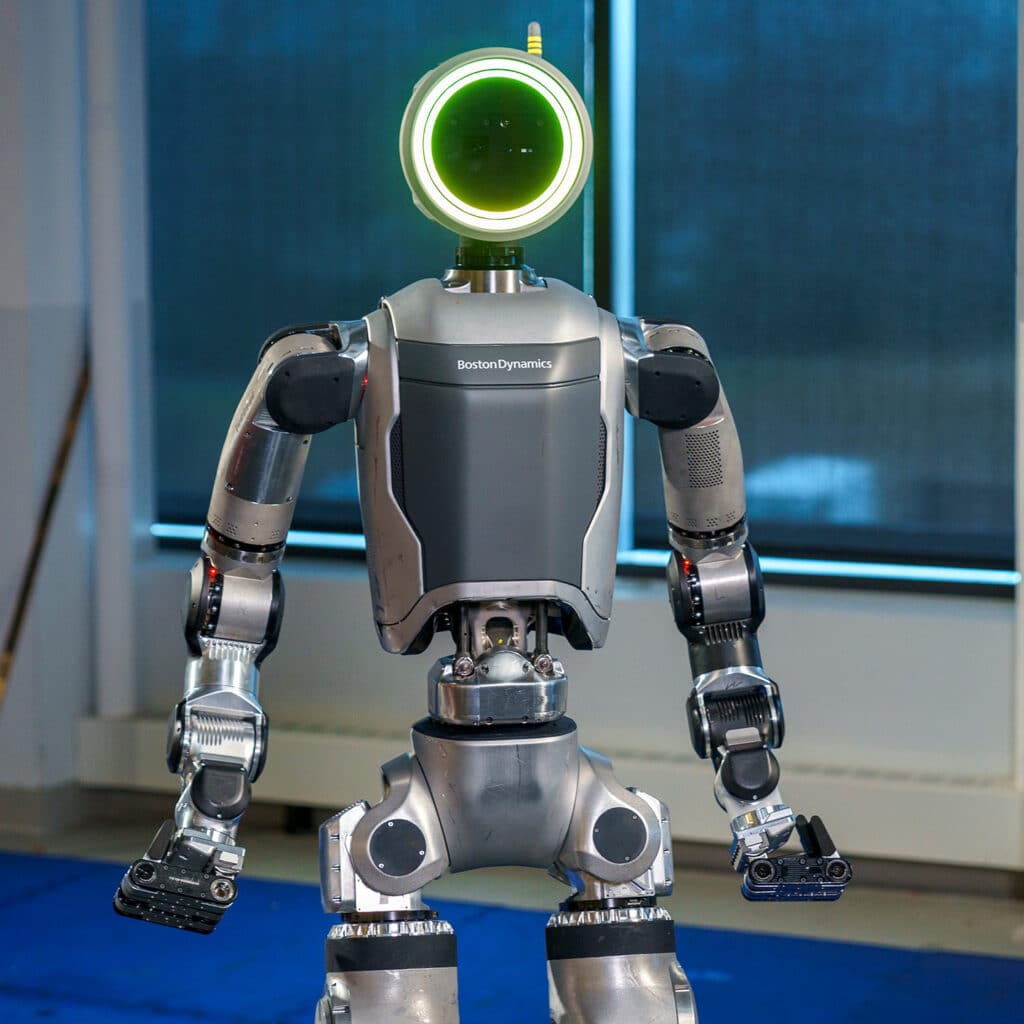
The takeaway is not despair but redirection. If your heart is set on an Optimus or an Atlas, the honest advice is to stop waiting and to buy a machine you can actually get: a Unitree G1 for research (or an H2 EDU if you need full size, since the base H2 is locked exactly like the base G1), a NEURA 4NE1 in Europe, a 1X NEO if you are in the US. The robots being deployed for real logistics and manufacturing work today (Digit, Apollo, Figure 03) reach the world only through enterprise engagements with named operators, and no amount of money makes them a checkout purchase for a small buyer. For the machines that fit real work and that you can actually acquire, see the best humanoids for logistics and real work. To see what the enterprise frontier actually looks like, here is Boston Dynamics' electric Atlas, a machine whose entire 2026 output is already spoken for.
The electric Atlas, committed to Hyundai and Google DeepMind for all of 2026
For all the enterprise machines you cannot buy, the purchasable Chinese platforms are more capable than their price suggests, which is worth seeing rather than just reading about. The Unitree G1's dynamic-motion demos are the clearest illustration of what a real, gettable research humanoid can physically do on day one, before you write a line of your own code.
That video is a useful corrective in both directions. It shows that the machine you can actually import is genuinely athletic and impressive, which is the honest good news. But it is also a scripted, trained demonstration from a controlled testing ground, which is the honest caveat: what arrives in your crate does these things only if you or the manufacturer have programmed them. The gap between the reel and the reality is exactly the gap this guide keeps returning to, and it is why the section after next, on owning and operating the robot, matters as much as the import mechanics.
13. Owning and operating one: the rules after delivery
Clearing customs is not the finish line. Once the robot is standing in your building, a second body of law takes over, and it is the part almost no import guide bothers to cover. The reassuring headline first: across the EU there is no registration, no license, no operator ID, and no type approval for owning or operating a ground robot. The drone-style rules people worry about apply only to aircraft. On your own private premises, you can own and run a humanoid with no permit of any kind. The one hard limit is that autonomous ground robots are generally not permitted on public roads or sidewalks (in the Netherlands, for example, every delivery-robot pilot runs on private property, because Dutch law has no vehicle category for a walking machine in public space).
The obligations that do exist attach to specific activities, and the most important one is workplace use. Every EU member state requires employers to risk-assess work equipment used around staff (the obligation flows from the EU Framework Directive on health and safety), and a robot is work equipment. In the Netherlands, taken as the worked example, that means a current RI&E, a risk inventory and evaluation, and a robot deployed around staff is "work equipment" under the Arbobesluit, so it must be included in the RI&E with mitigation measures, employee instruction, and safe operating procedures - ArboNed on Arbowet obligations. There is a genuine legal exposure hiding here that businesses routinely miss: operating a non-CE humanoid around employees is itself a violation of machinery and workplace law, because the Nederlandse Arbeidsinspectie (and its equivalent in every other member state) supervises machinery for professional use. The R&D-exemption argument for a research prototype exists but is narrow. This is the point where the import-side CE problem from section six comes back to bite the operation side.
Safety is not merely a paperwork matter; it is a physical one, and the numbers are sobering. A Unitree G1 is about 35 kg, and an H1 is 47 kg with joints producing up to roughly 360 N-m of torque. A fall or a flail at head height is a serious injury risk, and the counter-intuitive fact is that an emergency stop on a biped causes a fall rather than preventing one, because cutting power to a walking machine guarantees an uncontrolled collapse - IEEE Spectrum on domestic humanoid safety standards. The May 2025 incident where a tethered Unitree H1 violently flailed and nearly struck two technicians is the canonical warning, and it was a known control failure mode, not rogue AI - New Atlas on the H1 incident. Standard lab practice, for good reason, is to run these machines on gantries or tethers with a cleared floor radius, a spotter, and a physical e-stop within reach.
Certification reality reinforces the caution. No purchasable humanoid is certified safe for unsupervised home use in mid-2026. The only home-adjacent standard, ISO 13482 for personal care robots, still sets no limits, proposes no test methods, and has no enforcement mechanism. The one robot engineered around home safety, the 1X NEO, proves the rule precisely because it is unusual: it weighs only 30 kg, uses tendon-driven low-inertia actuation and a soft polymer exterior, and quotes a Head Injury Criterion under 250, a posture no metal-skeleton platform robot attempts. That is exactly why makers of metal-skeleton machines like the G1, H1, and Booster T1 position them for research and commercial use, not homes. If you are buying a platform humanoid, plan for supervised operation in a controlled space, not an appliance in the kitchen, and read what safe operation actually requires at home or in the office before you switch one on around people.
There is one more operating-side rule that is easy to overlook and increasingly important: the security posture of the robot itself. Security researchers disclosed the UniPwn exploit in September 2025, a Bluetooth Low Energy flaw giving root-level takeover of Unitree Go2, B2, G1, and H1 units because they share a single hardcoded encryption key, and the flaw is wormable robot-to-robot - Help Net Security on the Unitree G1 vulnerability. The same research found that a powered-on G1 automatically connects to servers in China and begins transmitting internal state, including audio, video, and spatial data, roughly every five minutes - IEEE Spectrum on the Unitree exploit. No EU import ban results from this, but any lab or company with confidentiality obligations should air-gap the robot on an isolated network and control it via the local SDK, which is a purely operational decision no importer would think to make in advance.
14. GDPR, cameras, and the surveillance question
A humanoid robot is a walking sensor platform, and the moment its cameras and microphones process identifiable people, the operator becomes a data controller under GDPR, with the full weight of European data-protection law attached. This is not a fringe concern for a robot that navigates by vision. The European Data Protection Board's guidance on video devices is the relevant framework: the usual legal basis is legitimate interest, purposes must be specific (naming "safety" alone is insufficient), and a data protection impact assessment (DPIA) is mandatory for systematic monitoring of publicly accessible areas and advisable for any workplace deployment - EDPB Guidelines 3/2019 on video devices. Facial recognition in public or semi-public spaces is effectively a non-starter, because it processes biometric data, a special category under GDPR.
The practical steps flow directly from that framework, and they are worth doing before the robot is ever switched on around people. Map exactly what the robot records and where the footage goes, checking specifically whether the manufacturer's software uploads video or telemetry to cloud servers outside the EU, which raises international-transfer questions on top of everything else. Run a DPIA if it will systematically film employees, visitors, or public areas. Define the legal basis, put up signage, set a retention period, and do not enable facial recognition. For purely personal, household use the GDPR household exemption largely applies, so a private owner running a robot at home has a much lighter burden than a business, though filming public space from a private robot still triggers the rules.
The Chinese-telemetry problem from the previous section collides directly with GDPR here, and the collision is where the two operating-side concerns become one. A robot that phones home to servers in China every five minutes, transmitting camera and microphone data, is not merely a security exposure; it is a potential unlawful international transfer of personal data if any identifiable person is in frame. An organization deploying such a machine around staff or customers has a genuine compliance problem that no amount of import paperwork addresses. This is one more reason the operational answer for many buyers is to firewall the robot and run it offline, and it is a reason the honest catalogs that flag telemetry behavior alongside price and import rules earn their place in a buyer's research. The surveillance question is not paranoia; it is a foreseeable legal exposure that starts the instant the robot's cameras see a person.
Looking slightly ahead, a third regulatory layer is arriving that will sit on top of machinery law and data law: the EU AI Act. Its high-risk classification framework can catch industrial and service robots that use machine learning for tasks like object recognition, grasping, or human-robot collaboration, and the Commission published draft classification guidelines in May 2026 - Debevoise on the draft high-risk guidance. The timeline was recently pushed back, which is relevant to planning: obligations for stand-alone high-risk AI systems now apply from December 2, 2027, and for high-risk AI embedded in regulated products (which is where a humanoid's safety functions live) from August 2, 2028. A robot bought in 2026 is not immediately caught, but anyone building a serious deployment should treat AI Act conformity as a cost that lands in 2027 and 2028, layered on top of the Machinery Regulation that bites in January 2027.
15. Total cost of ownership and the honest bottom line
The sticker price is roughly two-thirds of the bill, and understanding the other third is what separates a realistic budget from a painful surprise. Industry total-cost-of-ownership analyses put the three-year TCO at 36% to 42% above the sticker price, driven by integration, maintenance, training, and compliance - There's A Robot For That on humanoid cost and ROI. A USD 44,000 G1 EDU is realistically a USD 60,000-plus three-year commitment before you count a single hour of staff time. We break every recurring line down in the true total cost of ownership. The robot, in other words, is the cheapest part of a robotics program, and the import cost you spent this whole guide optimizing is only the opening line of a much longer invoice.
The recurring costs are concrete and predictable enough to plan for. Repairs after falls are routine, not exceptional: minor sensor recalibration runs USD 150 to USD 300, and a full actuator replacement USD 800 to USD 1,500, with professional repairs routing through a Shenzhen facility on a several-day turnaround plus international shipping both ways - Reboot Hub G1 repair guide. Warranty exclusions bite hard, because falls, water, and disassembly void coverage, and a walking research robot falls a lot. Insurance is now a real line item too, with general-liability premiums rising 10% to 20% when humanoids operate in a facility, and China launched the first dedicated humanoid-robot insurance products in December 2025 - Mixflow on humanoid liability insurance.
To make the trade-off between corridors legible in one view, the chart below compares the effective duty burden across the four routes on a robot of comparable value. It is the clearest possible summary of why the corridors feel so different despite shipping similar machines. The China-to-US bar towers over the others not because the robot is different but because of stacked tariffs, while the two EU-facing routes barely register on the duty axis.
China-to-US is shown at the 40% rate collected today: 2.5% MFN, plus 25% Section 301 List 1, plus the 12.5% Section 301 forced-labor duty that took effect on July 24, 2026 as the 10% Section 122 surcharge expired. The chart tells a story that reframes the whole decision. If you are in the United States, the duty stack is your dominant import variable, and buying from a US distributor at a locked price is now clearly smarter than importing directly into a roughly 40% headwind. If you are in the European Union, the duty is essentially irrelevant, and your real decision is VAT recoverability (business versus private) and whether the compliance and warranty layer of an EU reseller is worth its premium. The corridors are not variations on a theme; they are structurally different problems that happen to involve the same robots. Naming which problem you actually face is the entire value of thinking in corridors.
There is a broader first-principles observation to close this section. The reason importing a humanoid feels harder than importing almost any other consumer machine is that the humanoid sits at the intersection of four regulatory regimes (trade, machinery safety, dangerous-goods transport, and data protection) that were each written for a different object and none of which anticipated a walking, seeing, self-powered machine you could order online. The friction is not a temporary immaturity that will smooth out next year. It is the predictable result of a genuinely novel object colliding with four settled bodies of law, and it will intensify, not ease, as the Machinery Regulation and the AI Act come fully into force. Buyers who understand the machine as four regulated objects at once, rather than one gadget, are the ones who import successfully.
This is the kind of cross-domain problem that people who spend their days at the seam of automation and human systems tend to see clearly. It is worth noting, as an aside on how to think about it, that operators who work on autonomous systems in other fields reason about this the same way. Yuma Heymans ( @yumahey), who founded o-mega.ai and co-founded the AI recruitment platform HeroHunt.ai, has argued repeatedly that the hard part of deploying autonomous agents is never the core capability but the surrounding scaffolding of trust, responsibility, and rules, which is exactly the lesson a humanoid import teaches in physical form: the robot is the easy part, and the responsibility you inherit around it is the real project.
16. A decision framework for 2026
Everything above collapses into a small number of decisions, and the point of a framework is to make those decisions in the right order so you never discover a blocker after you have paid. The first and most important question is not which robot but which corridor, because the corridor determines the difficulty far more than the model does. If you are in the EU and want the lowest-friction path, buy from an EU reseller and accept the premium as the price of not becoming the importer. If you are in the EU and want the lowest cost, import from China directly, get an EORI and Article 23 deferment if you are a business, and take the compliance and detention risk seriously if you are a private buyer. If you are in the US, price the distributor route against the direct route with the current China stack applied (about 40% today: the 2.5% MFN base, 25% Section 301 List 1, and the 12.5% Section 301 forced-labor duty in force since 24 July 2026), and expect the distributor to win.
The second question is who you are to the customs and legal system, because the private-versus-business divide changes the answer to almost everything. A business recovers VAT, gets financing and depreciation, and can commission its own conformity work, but it inherits binding importer duties, workplace safety obligations, and GDPR controller status. A private individual pays VAT for keeps, gets stronger consumer warranty protection from an EU reseller, and largely escapes the workplace and data obligations for genuine household use, but carries detention risk personally on a direct import and has no legal fallback against a Chinese seller. Decide which of these you are before you shop, because it reorders the entire cost and risk picture.
The third question is whether the robot you want exists as a purchase at all, and it is the one to ask first even though it is listed third, because it can end the process before it starts. If your target is a Tesla Optimus, a Figure 03, an Apptronik Apollo, an Agility Digit, or a Boston Dynamics Atlas, the honest answer for a small buyer in 2026 is that you cannot get it, and no corridor knowledge helps. Redirect to what is gettable: a Unitree G1, R1, or H2; a NEURA 4NE1 in Europe; a 1X NEO in the US. The purchasable machines are more capable and more affordable than most people expect, and a research-tier platform you can actually develop against beats a warehouse humanoid you can only admire in a press release.
The final discipline is to treat the import as the beginning, not the end. Budget the whole machine, not the sticker: add the hands (a five-figure line most buyers forget), the spare battery, the charger, the freight, the 36% to 42% TCO uplift, the compliance work if you are the importer, and the insurance. Verify the compliance file before the robot flies, isolate the robot's network before you power it on, cover it in your RI&E before it operates around anyone, and run a DPIA before its cameras see a person. An import that ends at the customs release is only half done. The buyers who succeed are the ones who planned the operating reality with the same care they planned the crossing, and who checked, against a source that verifies prices and maps the rules rather than a marketing page, that the machine they wanted could actually reach them at all.
This guide reflects the humanoid robot import landscape as of September 2026. Tariffs, VAT rates, compliance deadlines, manufacturer availability, and prices change frequently and sometimes with only days of notice (the US Section 122 surcharge, for one, lapsed on July 24, 2026, but USTR's 12.5% Section 301 forced-labor duty took effect at that same moment, so the collected China rate rose to about 40% instead of falling to 27.5%; that forced-labor duty is now itself under legal challenge at the US Court of International Trade, with oral argument on 30 September 2026 and no ruling yet). Verify every current rate, ruling, and product price against the primary sources linked throughout before making any purchase or import decision.