Tesla Optimus Price in 2026: Can You Buy One Yet?
· 58 min read · Yuma Heymans
What Tesla has actually promised about Optimus, what its own filings say, and what you can buy while you wait.
You cannot buy a Tesla Optimus today, at any price. There is no order page, no deposit and no waitlist on tesla.com, and Tesla's annual report for 2025 says in plain words that the company has "yet to commercialize" its robots - Tesla 10-K. The first robots from its new Fremont production line are going to Tesla's own "Optimus Academy" to collect training data, not to customers - Tesla Q2 2026 Update. Speaking at Davos in January 2026, Elon Musk said "by the end of next year, I think we'd be selling humanoid robots to the public", which means the end of 2027 - Rev transcript of Musk at Davos.
The problem is that the internet answers a different question. Search for the Optimus price and you will find $20,000 to $30,000 stated as if it were a sticker, sites taking "preorder" deposits that Tesla never offered, and spec tables copied from a concept slide shown in 2021. Each of those has a source, but none of them tells you what you can actually get, when, or for how much. Meanwhile other companies shipped nearly 25,000 humanoid robots in the first half of 2026 alone, most of them made in China, and some of them can be delivered within a week.
This guide separates what is documented from what is hoped for. It sets out what Tesla has said about price and what an Optimus costs to build today, every release date Musk has given since 2021 and what happened to it, what Optimus can do now and how its demonstrations were made, how to spot the fake preorder sites, and how the market Optimus is entering has changed. It then scores the humanoids an Optimus shopper can actually consider, from Tesla's robot to the ones with a checkout today, and ends with a framework for deciding whether to wait or buy.
Contents
- Where Optimus stands in October 2026: what Tesla's own filings say
- Tesla Optimus price: what Musk has said, and what it costs to build
- Tesla Optimus release date: every promise since 2021, and what happened
- What Optimus can actually do today
- Optimus specs: what is official and what is not
- Fake Optimus preorders and other scams
- The humanoid market Optimus is entering
- What to buy instead if you want a humanoid now
- Wait for Optimus or buy now: a decision framework
- What to watch between now and 2027
- How this guide was researched, and how it stays current
Optimus and the humanoids you can consider instead, scored and ranked
Before the detail, here is Optimus next to the nine humanoids most often compared with it, scored the same way. The ranking measures what a buyer can actually get and rely on in October 2026, not how impressive each robot looks on stage, which is why the world's most talked-about humanoid ranks near the bottom: you cannot have one. Read the cells rather than the final number, because each one carries the fact behind its score, and the facts are sourced in the sections that follow.
The four criteria come from what decides a purchase. Can you get one (30%) is whether an individual or a business can order it today, and where. Published price (20%) is whether there is a real price you can pay, not a target. Proven work (30%) is the useful work its maker documents it doing, in a real setting, today. Optimus-class body (20%) is how close it comes to the full-size, dexterous humanoid Optimus is meant to be: height, payload and hands. Each criterion is scored from 0 to 10, and the final score is the weighted average.
| # | Robot | What It Does | Can you get one (30%) | Published price (20%) | Proven work (30%) | Optimus-class body (20%) | Final |
|---|---|---|---|---|---|---|---|
| 1 | Unitree H2 | Full-size humanoid for shows, demos and research | 9 - Add to Cart at Unitree's US partner with free US shipping; EU dealers | 9 - $29,900 direct, $39,900 delivered in the US | 2 - remote-controlled motion demos; base model cannot be programmed | 6 - 182 cm, 70 kg, 31 joints, fixed dummy hands | 6.3 |
| 2 | 1X NEO | Walking home robot with remote help for chores | 6 - $200 refundable deposit; US deliveries promised in 2026, none confirmed | 8 - $20,000, or $499 a month | 4 - a few tasks alone; laundry and tidying with a remote 1X Expert | 7 - 168 cm, 30 kg, carries 25 kg, 22-joint hands | 6.0 |
| 3 | Unitree G1 | Smaller walking humanoid for labs, classes and demos | 9 - sold by Unitree and at least five US and EU dealers | 10 - $13,500 direct, $17,990 from a US dealer | 2 - walks, climbs and gets up; research needs the $43,900 EDU | 3 - 132 cm, 35 kg, 2 kg payload, no hands | 5.9 |
| 4 | Agility Digit | Warehouse humanoid that moves totes on shifts | 3 - businesses only; Digit 5 early access in the first half of 2027 | 6 - about $200,000 or $8,500 a month, from its SEC filing | 9 - in production use at GXO, over 100,000 totes moved | 4 - 175 cm, 16 kg payload, paddle grippers instead of hands | 5.6 |
| 5 | Unitree R1 | Unitree's entry-level walking humanoid | 9 - Unitree store and US and EU dealers | 10 - $4,900 for the R1 Air | 1 - dances, talks and performs; cannot be programmed | 2 - 123 cm, 27 kg, no hands | 5.4 |
| 6 | AgiBot A2 Lite | Full-size stage performer from China's top shipper | 7 - Add to cart on AgiBot's global store, ships from China | 7 - $44,560 plus $500 to $3,000 shipping and duties | 1 - preloaded routines; no speech, perception or grasping | 5 - 169 cm, 63 kg, 1.5 kg payload, no hands | 4.8 |
| 7 | Figure 03 | Advanced humanoid sold as an enterprise service | 2 - enterprise agreements only, no household path | 1 - no published price | 6 - starting a parts-sequencing project at BMW | 9 - 168 cm, 60 kg, 20 kg payload, tactile hands | 4.4 |
| 8 | Boston Dynamics Atlas | Electric industrial humanoid from the best-known lab | 1 - 2026 output committed to Hyundai and Google DeepMind | 0 - no price | 5 - training on parts logistics at a Hyundai site | 9 - 190 cm, 90 kg, 30 kg sustained lift | 3.6 |
| 9 | Tesla Optimus | Tesla's humanoid, in early production for its own use | 0 - no order page, deposit or waitlist; public sales aimed at end of 2027 | 2 - no price; Musk's long-run target is about $20,000 to $30,000 | 2 - first units go to Tesla's training-data academy | 8 - 173 cm concept, 22-joint hand shown in 2024; Gen 3 unseen | 2.6 |
| 10 | XPeng IRON | Carmaker's humanoid with a human-like gait | 0 - production line started in September 2026; sales from 2027 | 0 - XPeng has never announced a price | 1 - demonstrations only | 8 - 178 cm, 21-joint hands | 1.9 |
The ranking says something uncomfortable about this market: availability and capability have not met yet. The robots you can order today, led by Unitree's H2 and G1, are excellent bodies with very little useful autonomy, sold for demonstrations, research and teaching. The robots that do real work, such as Agility's Digit, are sold only to businesses, on contracts priced like industrial equipment. The one home robot near the top, 1X's NEO, ranks second on a published price and hands close to Optimus's in dexterity, but it is a preorder whose hardest chores still run with a remote person. Optimus is aiming at the gap between the two, a full-size robot that works and costs about as much as a car, and nobody, Tesla included, has filled that gap yet.
Two cautions on reading the table. First, a high score is not a recommendation for every buyer: the H2 ranks first because you can get it and its body is closest to Optimus, not because it will do chores. Second, the Optimus row will change faster than any other, because Tesla's next update on 21 October 2026 may bring a production start, a Gen 3 reveal or a first customer. The live version of this comparison is each robot's datasheet, linked from its name.
1. Where Optimus Stands in October 2026: What Tesla's Own Filings Say
The most reliable record of Optimus is not a keynote or a post on X. It is what Tesla writes in documents it files with the US Securities and Exchange Commission, where an overstatement carries legal risk. Read in order, those filings tell a consistent story: Optimus is a development programme moving towards its first production line, not a product with customers. Tesla's annual report for 2025, filed on 29 January 2026, describes Optimus as "a general purpose, autonomous humanoid robot in development" and states plainly that "we have yet to commercialize Bots and cannot predict how demand for Bots will develop, either from commercial or consumer applications" - Tesla 10-K.
The quarterly shareholder updates fill in the timeline. In January 2026 Tesla said it planned to unveil the Gen 3 Optimus in the first quarter, calling it "our first design meant for mass production", with "start of production planned before the end of 2026 and eventual planned capacity of 1 million robots per year" - Tesla Q4 2025 Update. In April it said the first-generation line, "designed for 1 million robots a year, will replace the Model S and Model X lines in Fremont", and that Gigafactory Texas was being prepared for a second-generation line designed for a long-term capacity of 10 million robots a year - Tesla Q1 2026 Update.
1.1 The July 2026 update: production "soon", and not for customers
The most recent full update, published on 22 July 2026, is the one that matters for anyone hoping to buy. Tesla wrote that it had "decommissioned the manufacturing lines for Models S & X at our Fremont Factory" and was "installing the first-generation lines for Optimus, where we expect to start production soon". The next sentence answers the buying question directly: "The initial Optimus builds will be used in our Optimus Academy for training data collection and further functionality development" - Tesla Q2 2026 Update. The first robots off the line, in other words, are going to Tesla itself, to generate the data that teaches Optimus to do things.
The same document's capacity table lists Optimus in California and Texas with the status "Construction", which Tesla defines as "factory and infrastructure buildout as well as tool installation", and its outlook paragraph says the lines "are being installed in anticipation of production in 2026" - Tesla Q2 2026 Update. Earlier updates, from October 2025 to April 2026, had used the phrase "in anticipation of volume production" - Tesla Q1 2026 Update. The word volume quietly disappeared in July. Tesla's quarterly report filed the next day still describes the company as making "preparations and investments in large-scale production", so this is a change of emphasis, not an abandoned plan, but it is the kind of wording a careful reader notices - Tesla 10-Q.
What the July update did not contain is a picture of the robot Tesla is building. The Gen 3 design, promised for the first quarter, had still not been shown publicly by late September 2026 - Electrek. Musk has said that the images and videos of Optimus circulating online show the earlier V2 and V2.5 robots, not the third generation - Teslarati, and the renders of a Gen 3 design that a Tesla enthusiast extracted from the Tesla app in September were not published by Tesla, which has announced no reveal date - Teslarati. Every official photograph of Optimus you can find today is of an earlier robot. As recently as 2 October, TechCrunch described Optimus as a robot whose timeline Tesla "has repeatedly pushed back" - TechCrunch.
1.2 What to watch next: 21 October 2026
Tesla's third-quarter production and delivery release on 2 October 2026 did not mention Optimus at all, which is normal for that document. The next real update arrives with the third-quarter results, which Tesla will publish after the market closes on Wednesday 21 October 2026, followed by a live question and answer webcast at 4:30 p.m. Central Time - Tesla Q3 2026 deliveries release. That update should say whether production started at Fremont during the quarter, what the first robots are doing, and whether the Gen 3 design has been shown.
If you are tracking Optimus for a purchase decision, those three facts are the ones to look for, and we will update this guide and the Optimus datasheet the day the update appears. Statements on social media and in interviews move markets, but the shareholder update is where Tesla commits to dates in writing. It is also worth knowing that "Digital Optimus", which appears in the April 2026 update, is not the robot: Tesla describes it as work on "automating digital workloads", an AI software effort that shares only the name.
1.3 Why Tesla has a reason to sell Optimus, eventually
There is one more filing that explains why Optimus will be sold to outsiders, not just used inside Tesla. The pay package that Tesla shareholders approved for Elon Musk on 6 November 2025 includes, among its operational milestones, 1 million Bots delivered - Tesla 8-K. The proxy statement defines a delivery as the moment "the control of a Bot or Tesla Vehicle transfers for the first time to a third party", counted from the grant date of 3 September 2025, and notes that Tesla "will need to deliver 1 million Bots to consumers within the next 10 years" to meet it - Tesla proxy statement.
Robots that Tesla builds and keeps for its own factories or its Optimus Academy do not count towards that milestone. Only robots handed to someone else do. That gives the company a concrete reason to put Optimus on sale, which is good news for anyone who wants one in the long run. It does not tell you when, and the same proxy quotes Morgan Stanley's view that adoption will be "relatively slow until the mid-2030s, accelerating in the late 2030s and 2040s".
2. Tesla Optimus Price: What Musk Has Said, and What It Costs to Build
There is no Tesla Optimus price. There is no configurator, no list price, no deposit amount and no price in any Tesla filing. What exists is a series of statements by Elon Musk, made between 2022 and 2025, about what the robot should cost once Tesla builds it in very large numbers. Those statements are consistent with each other, which is why the figure $20,000 to $30,000 circulates so widely, but every one of them comes with a condition about volume that the factory is nowhere near meeting yet.
That condition is the part most "Optimus price" articles leave out, and it changes how you should read the number. A target price at a million units a year tells you where Tesla wants to end up. It does not tell you what the first robots will cost, who will be allowed to have them, or whether they will be sold or leased. To see the gap clearly, it helps to put Musk's words next to the independent estimates of what an Optimus costs to build today.
2.1 Every price Musk has given, with its condition
The first figure came at Tesla's AI Day on 30 September 2022, when Musk said the robot "is expected to cost much less than a car" and guessed "much less than [US] $20,000", in the context of production at "very high volume, ultimately millions of units" - IEEE Spectrum. In March 2024 he wrote on X that it "ends up costing less than half of a car", which Electrek translated into roughly $20,000 to $25,000 using Tesla's average selling price at the time - Electrek.
| Date | Occasion | What Musk said about price | The condition attached |
|---|---|---|---|
| 30 Sep 2022 | AI Day | "much less than [US] $20,000" | "very high volume, ultimately millions of units" |
| 26 Mar 2024 | Post on X | "ends up costing less than half of a car" | "ends up", a long-run figure |
| 13 Jun 2024 | Shareholder meeting | build for about $10,000, sell for $20,000 (Electrek's account) | "at a volume" |
| 10 Oct 2024 | We, Robot event | about $20,000 to $30,000 (Electrek's paraphrase) | "in the long term" |
| 29 Jan 2025 | Q4 2024 earnings call | "less than $20,000" (Electrek's paraphrase) | "once it is produced at a rate of 1 million units per year" |
The June 2024 figures come from Electrek's report of the shareholder meeting, where Musk described "building robots at a volume for about $10,000 a unit and selling them for $20,000" - Electrek. At the We, Robot event in October 2024 he said the robots would cost less than a car "in the long term", about $20,000 to $30,000 - Electrek. On the January 2025 earnings call he tied a sub-$20,000 figure to a production rate of 1 million units a year - Electrek, although reports of that call differ on whether he meant the price or the cost to make it - CNBC. We found no new consumer price from Musk or Tesla in 2026.
Read together, the five statements say one thing: $20,000 to $30,000 is a target for mass production, not the price of the first robots. Tesla's first Optimus line in Fremont is designed for a million robots a year, but Musk himself warned in July 2026 that "Optimus production will be extremely slow at first, as everything is new", adding, "This is not like making a car" - Electrek. On the July 2026 earnings call he went further: "This is going to be the hardest product to scale manufacturing that we've ever made at Tesla, because everything on the robot is new" - CNBC. Until the line runs near its design rate, the target and the real cost will be far apart.
2.2 What an Optimus costs to build today
The most specific independent estimate comes from Morgan Stanley's Robot Almanac, published in December 2025, which priced the parts in an Optimus Gen 2. With Chinese suppliers, the analysts put the bill of materials at about $46,000. With a supply chain outside China, the same robot came to about $131,000, driven mostly by actuators, the motor and gear units that move each joint, which rose from about $22,000 to $58,000 - South China Morning Post via Yahoo Tech. The estimate is for the previous generation and counts parts only, not assembly, software or margin.
Broader estimates point the same way. Bank of America put the bill of materials of a Chinese-made humanoid at $35,000 in 2025, falling below $17,000 by 2030, and said Western-built robots at the pilot stage cost $90,000 to $100,000 each to produce - Fortune. Two years earlier Goldman Sachs estimated that humanoid manufacturing costs had already fallen to between $30,000 and $150,000 a unit, a faster decline than its analysts expected - Goldman Sachs. The only American humanoid maker that has had to file its costs with regulators describes the same volume curve: Agility Robotics told the SEC that a Digit will cost about $150,000 to build at commercial launch, about $75,000 at 1,000 robots a year and about $30,000 at 10,000 a year - Agility Robotics S-4/A.
So the honest arithmetic is this: an Optimus built today costs at least twice Musk's target in parts alone, and getting to $20,000 to $30,000 depends on cheap Chinese components, huge volume, or both. Musk said in January 2026 that "there's really nothing from the existing supply chain that exists in Optimus", because the robot needs a completely new set of suppliers - CNBC. Building that supply chain at Tesla's quality bar is the work of years, not quarters, and the cost work reaches down to single components: on 1 October 2026 Musk wrote that Tesla had halved the memory on its next AI chip because it was "the only way to get enough volume for Optimus production and greatly reduces cost" - Benzinga via Yahoo Finance.
2.3 What the first customers will probably pay, and how
The first commercial Optimus deals may not be sales at all. According to a September 2026 report by The Information, summarised by Electrek, Tesla "intends to lease, not sell, Optimus to a short list of companies whose factories and warehouses look like its own", so the robots adapt more easily and their data improves the software - Electrek. Tesla has not confirmed that plan publicly, but it matches how every other Western humanoid maker sells today.
The best public benchmark for that kind of deal is Agility Robotics, because its stock-market filing had to put numbers on paper. Agility's illustrative economics for Digit 5 are about $200,000 to buy a robot plus about $20,000 to deploy it and about $36,000 a year for software and maintenance, or $8,500 a month as a rental plus about $25,000 to deploy - Agility Robotics S-4/A. An early Optimus lease is unlikely to be priced like a $25,000 consumer product. For a household, the practical meaning is simple: until Tesla publishes a consumer price on tesla.com, any figure you see is a goal, an estimate or a scam.
3. Tesla Optimus Release Date: Every Promise Since 2021, and What Happened
Release dates for Optimus have moved more than any other part of the story, so the most useful thing we can do is put them in one place. Each promise below comes from Musk or Tesla, with the date it was made and what happened afterwards. The pattern matters more than any single date, because it tells you how much weight to put on the next one.
The short version: every date for selling Optimus to outsiders has slipped by at least a year, while the engineering milestones (a prototype, a second generation, a production line) have arrived, late but real. That distinction is worth holding onto. Tesla has delivered the engineering milestones it announced, usually late. It has been far less reliable about when anyone else gets a robot.
3.1 The promises and the outcomes
| When it was said | The promise | What happened |
|---|---|---|
| 19 Aug 2021, AI Day | A prototype "probably" next year | Kept: two prototypes shown in September 2022 |
| 30 Sep 2022, AI Day | People could order one "within three years, probably not more than five years" | The three-year mark (late 2025) passed with no orders |
| Dec 2023, Gen 2 video | Use it in Tesla's factories first, then sell it once proven | Still internal in October 2026 |
| 23 Apr 2024, earnings call | Selling to outside customers by the end of 2025 | Did not happen |
| 13 Jun 2024, shareholder meeting | "a thousand to a couple thousand" robots working in Tesla factories in 2025 | January 2026: "not in usage in our factories in a material way" |
| 23 Jul 2024, post on X | "high production for other companies in 2026" | No outside sales in 2026 |
| 29 Jan 2025, earnings call | "several thousand" built and doing useful work by the end of 2025 | Missed |
| 28 Jan 2026, shareholder update | Gen 3 unveiled in Q1 2026, production before the end of 2026 | Unveiling moved to "probably middle of this year", still not shown in late September |
| 22 Jan 2026, Davos | Sales to the public by the end of 2027 | Pending |
| Aug 2026, meeting reported by JPMorgan | Outside commercial sales "as early as" the second half of 2027 | Pending |
The sources behind each row are worth knowing. At the first AI Day, after a dancer in a robot costume performed on stage, Musk said Tesla would "probably have a prototype next year" - CNBC. In 2022 he said of ordering: "I'd say within three years, probably not more than five years" - IEEE Spectrum. In December 2023 Tesla said it would use Gen 2 in its own factories and start selling once it had proven useful - Electrek. In April 2024 he said Tesla could start selling Optimus to customers outside the company by the end of 2025 - Electrek. In July 2024 Musk wrote that Tesla would have useful robots "in low production for Tesla internal use next year and, hopefully, high production for other companies in 2026" - TechCrunch.
In January 2025 he said Tesla's internal plan was about 10,000 robots that year, adding: "Will we succeed in building 10,000 exactly by the end of December this year? Probably not, but will we succeed in making several thousand? Yes, I think we will" - Electrek. A year later, on the January 2026 call, he said Optimus was "not in usage in our factories in a material way. It's more so that the robot can learn", and that Tesla would not expect "any kind of significant Optimus production volume until probably the end of this year" - Electrek.
3.2 The 2026 picture: a line, a delayed reveal, and a 2027 sale date
Three things happened to Optimus in 2026 that a buyer should know about. First, the factory became real: Tesla ended Model S and Model X production in May and converted the Fremont line to Optimus, and The Information reported that output rose from "a few dozen Optimus units a week during small-batch testing in Q2 to several hundred a week in August", with managers aiming for more than 1,000 a week by the end of the year - Electrek. According to the same report, most of those robots are used inside Tesla for testing, training and data collection.
Tesla marked the end of the Model S and Model X with a delivery event in Fremont in May, and the recording includes the moment the line is presented as the future home of Optimus, with on-screen targets of a million robots a year.
The targets on those slides are capacity, not output. The same recording shows robots walking in corridors and among guests, not working on a line, which matches what Tesla's filings say about where the programme stands.
Second, the Gen 3 reveal kept slipping. On the April 2026 earnings call Musk moved it from the first quarter to "probably middle of this year", saying competitors "do a frame-by-frame analysis whenever we release something and copy everything they possibly can"; on the same call he declined to give a production target, saying output "will move as fast as the least lucky, slowest, dumbest part in the entire 10,000" - Electrek. By late September the reveal still had not happened. Musk had set expectations for the ramp itself in January, writing on X that for Optimus "almost everything is new, so the early production rate will be agonizingly slow, but eventually end up being insanely fast" - Fortune.
Third, the sale date moved to 2027. At the World Economic Forum in Davos in January, Musk told BlackRock's Larry Fink that Tesla would be selling Optimus to the public by the end of 2027 - CNBC. In August, a JPMorgan analyst who met Tesla at Fremont reported that the company said the Gen 3 design was finalized, the supply chain "essentially locked in", and that external commercial sales could start "as early as" the second half of 2027 - Electrek.
3.3 How to plan around a date that keeps moving
If you are deciding whether to wait for Optimus, treat the second half of 2027 as the earliest plausible date for any outside customer, and expect those customers to be businesses with factories like Tesla's, on leases. A household purchase on tesla.com would come after that, and nothing Tesla has filed with regulators puts a date on it. Musk's "end of 2027" for public sales is the nearest thing to a commitment, and the record above suggests building in a margin.
The way to apply this is to separate two questions. If your question is "will Optimus exist as a real product?", the answer from the factory evidence is increasingly yes. If your question is "can I plan around having one by a given date?", the honest answer is no date before 2028 is safe. In the meantime, the machines in our list of humanoid robots you can buy now are the ones with prices and delivery times you can hold a seller to.
4. What Optimus Can Actually Do Today
A buyer's first question about any robot is what it does, and for Optimus the honest answer comes from Tesla itself. On the January 2026 earnings call, asked how many robots were deployed in its factories, Musk said Tesla was "still very much at the early stages of Optimus" and "still in the R&D phase", that Optimus had done "some basic tasks in the factory", and that "it's not in usage in our factories in a material way. It's more so that the robot can learn" - Electrek, as Tesla's own recording of the call shows from about 37:00 - Tesla Q4 2025 webcast. Six months later, Tesla's July update said the first production robots would go to its Optimus Academy "for training data collection and further functionality development" - Tesla Q2 2026 Update.
That is not a criticism unique to Tesla. It is where the whole field is: every humanoid in our catalog that does paid work does it in a narrow, prepared setting, and most of the units shipped worldwide still go to labs, classrooms and demonstrations. What makes Optimus different is the distance between that reality and the way it has been presented, which is why it pays to know how the public demonstrations were made.
4.1 Inside Tesla: supervised areas and a lot of training data
The most detailed recent picture comes from a September 2026 report by The Information, summarised by Electrek. It says the Optimus units working inside Tesla's factories "are confined to tightly controlled, supervised areas" and are programmed for specific tasks, that "it still reportedly takes several days for Optimus to learn even basic tasks", and that Tesla has more than 500,000 hours of training data and wants to double that by the end of the year, with training hubs in Colorado, Arizona and Florida - Electrek. The same report names the hand as the production bottleneck: the hand and forearm "contain over 100 screws and small components that workers still assemble by hand".
Tesla's own description of its method matches. On the July 2026 call, Tesla's vice president of AI, Ashok Elluswamy, described Optimus learning from people doing factory work, a dedicated data-collection team, an Optimus Academy where many robots practise, and reinforcement learning on the same end-to-end software approach Tesla uses for its driving system (from about 33:35 in the recording) - Tesla Q2 2026 webcast. A year earlier, Business Insider, drawing on five current and former workers, reported that Tesla had told staff in June 2025 it was "pivoting away from motion-capture suits and teleoperation and toward collecting data using only cameras" - Business Insider.
In that recording Musk repeats his view that Optimus will be the biggest product ever while calling it a very complex problem to solve, and says the early part of the production curve will be flat and long because so many of the robot's parts are new (from about 11:35). He also argues that the impressive humanoid demonstrations from other companies are pre-programmed or remotely controlled, and, as Electrek reported the call, that "no humanoid robots today can do generalized tasks without programming, but Optimus will be the first to do it" - Electrek. By his own account, then, no Optimus does that today either. It is worth watching those few minutes before reading any article, including this one, that claims to know when Optimus will be useful.
4.2 The demonstrations, and who was in control
Optimus's public demonstrations have repeatedly involved people operating the robots remotely, which is a normal way to collect training data and an unusual way to present a product. At the We, Robot event in October 2024, Morgan Stanley's Adam Jonas wrote that "these robots were not operating entirely autonomously" but "relied on tele-ops (human intervention)" - Electrek, and one robot told an attendee, "Today, I am assisted by a human" - The Verge. When Tesla showed a new 22-degree-of-freedom hand a month later, it confirmed that demonstration was teleoperated too - Electrek.
Tesla's own recap of that evening shows how the robots were presented: walking among guests, gesturing and posing for phones.
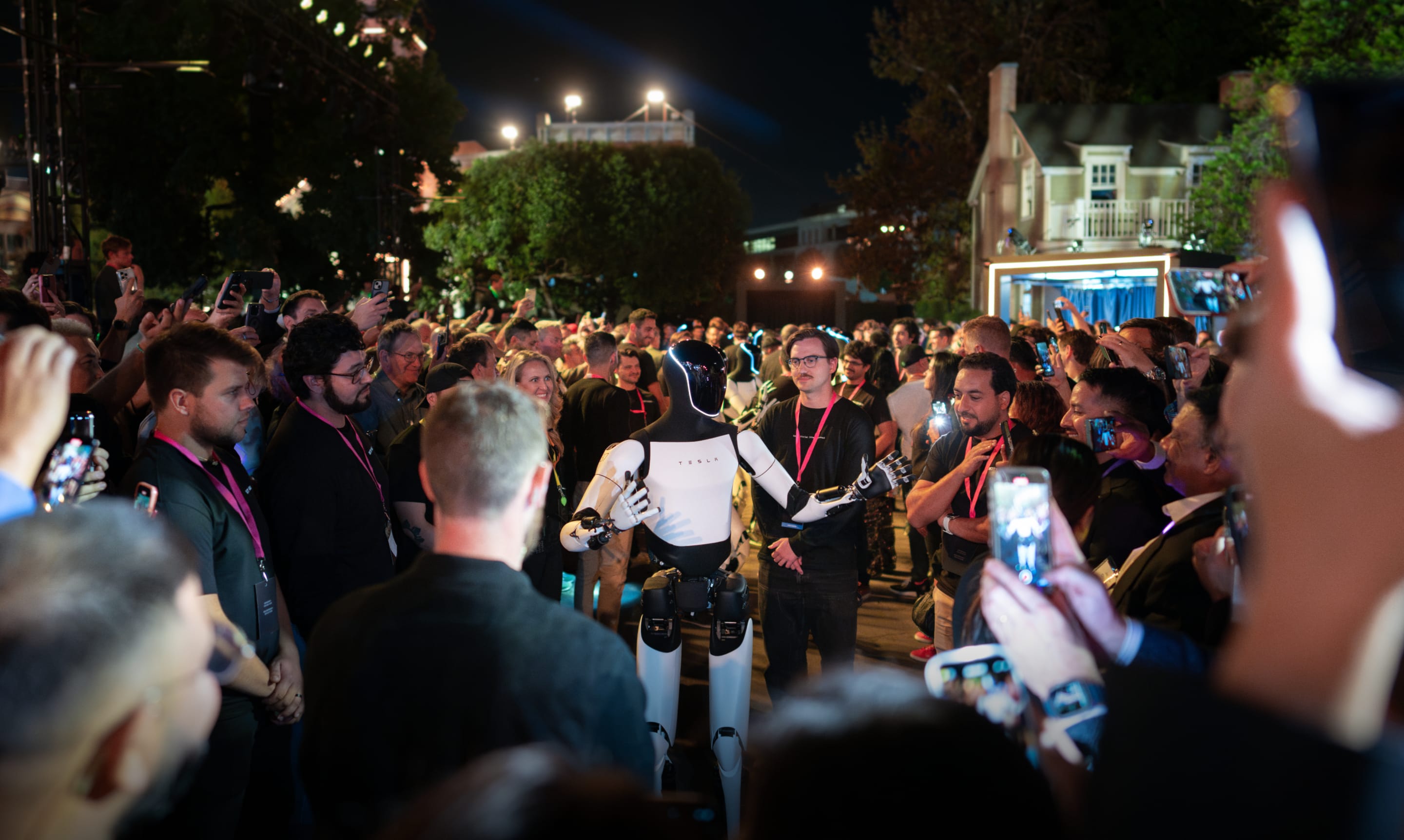
Nothing in a photograph like this one can tell you who is in control, which is exactly why the reporting around it matters more than the images.
The pattern continued into 2025. At the opening of the Tesla Diner in Los Angeles in July, staff told attendees that the Optimus serving popcorn was teleoperated - Electrek. In October Musk insisted a kung-fu video was "AI, not tele-operated", and in December an Optimus at a Tesla event in Miami fell backwards after raising both hands to its face, a motion Electrek read as an operator lifting off a virtual-reality headset; Tesla did not comment - Electrek. Business Insider's sources described teleoperation as "mostly reserved for investor visits" by late 2025, and two of them said the robot tumbled about half the time on tasks that required bending or leaning - Business Insider.
None of this means Optimus is fake. It means a video of Optimus is evidence of what its body can do, not proof of what its software can do alone. When you watch any humanoid demonstration, look for four things: whether the maker labels it autonomous, whether it plays at real speed, whether it is one continuous shot, and whether anyone off camera is holding a controller or wearing a headset. Our explainer on why no humanoid comes with autonomy in the box covers the same test for the robots you can buy today.
5. Optimus Specs: What Is Official and What Is Not
Search for Optimus specifications and you will find precise tables of height, weight, joints, battery and speed. Most of them trace back to one slide: the concept Tesla showed when it announced the Tesla Bot in August 2021, before any robot existed. Musk said then that it would be 5 ft 8 in tall, weigh 125 lb and "carry 45 pounds, lift 150 pounds" and "run 5 miles per hour" - CNBC. Converted, that is about 173 cm, 57 kg, a 20 kg carry and 2.2 m/s, the numbers many sites still list as current.
The picture Tesla still uses at the top of its own AI and robotics page is a good illustration of the problem. It shows the white-and-black robot from the Gen 2 era, not the production design the Fremont line is being built for.
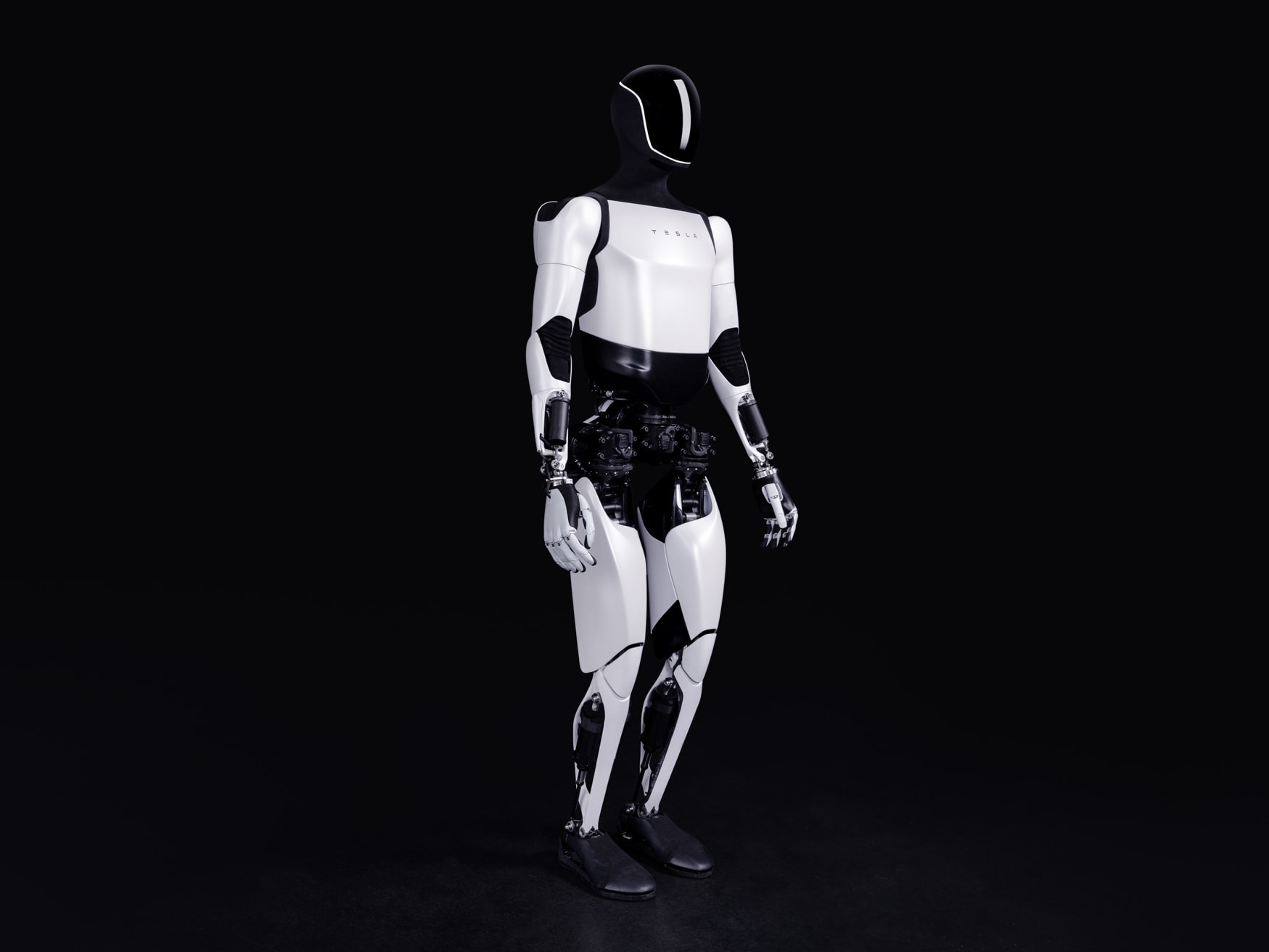
Look at the hands and the exposed actuators at the hips and knees in that image: they are the parts Tesla says it has redesigned most, and the reason a two-year-old photograph tells you little about the robot that will eventually be sold.
Tesla has published far less about the robots it actually built. In September 2022 it said the prototype's 2.3 kWh battery pack should be good for about a day's work - Electrek. For Gen 2 in December 2023 it reported a robot 10 kg lighter, walking 30% faster, with 11-degree-of-freedom hands and tactile sensing in each finger - The Robot Report. In November 2024 it said its newest hand had 22 degrees of freedom, plus three more in the wrist and forearm - Electrek. Gen 3, the version Tesla says is designed for mass production, had not been shown publicly as of early October 2026, so nobody outside Tesla knows its final specifications.
5.1 Optimus beside the humanoids it will compete with
The table below sets the figures Tesla has published next to the makers' own figures for the robots Optimus will meet in the market. For Optimus we use the 2021 concept numbers because they are the only complete set Tesla has given; treat them as a target, not a measurement. Each rival links to its datasheet in our catalog, where every figure carries its source.
| Robot | Height | Weight | Hands | Status in October 2026 |
|---|---|---|---|---|
| Tesla Optimus | 173 cm (2021 concept) | 57 kg (2021 concept) | 22 degrees of freedom shown in 2024 | Not for sale; Gen 3 not yet shown |
| Figure 03 | 168 cm | 60 kg | Tactile hands with palm cameras | Enterprise service only |
| Boston Dynamics Atlas | 190 cm | 90 kg | Three-fingered grippers | 2026 output committed to Hyundai and Google DeepMind |
| 1X NEO | 168 cm | 30 kg | 22 degrees of freedom per hand | Preorder, US deliveries promised in 2026 |
| Unitree H2 | 182 cm | 70 kg | Fixed dummy hands (base model) | On sale from $29,900 |
| XPeng IRON | 178 cm | 70 kg | 21 degrees of freedom per hand | Production line started; sales from 2027 |
The comparison shows why Optimus still matters as a design: on paper it is a full-size humanoid with a hand more dexterous than most rivals, built by a company that knows how to manufacture at scale. It also shows that the spec sheet is not what separates these machines in 2026. The two that you can actually obtain, the H2 and NEO, are the ones with the simplest promises, while the most capable bodies, Figure 03, Atlas and Optimus, are reserved for their makers' partners. When Tesla shows Gen 3, the concept figures in this table will be replaced by the official ones.
6. Fake Optimus Preorders and Other Scams
Because Optimus is famous and cannot be ordered, it is a perfect lure. In August 2025 the SANS Internet Storm Center documented Google sponsored ads for "Optimus Tesla preorder" that led to cloned Tesla websites asking for a $250 non-refundable deposit; the researcher noted that apart from an April Fool's post, "no presale has been offered by Tesla" - SANS ISC. The domains imitated Tesla's own, with names such as offers-tesla.com and prelaunch-tesla.com, and the researcher suspected the real goal was to harvest card details.
Five days later, Moonlock, the security lab of the software company MacPaw, found more of the same, including sites built to rank for searches like "Optimus pre-order" and "reserve humanoid robot" - Moonlock. The fakes have since moved from deposit pages to viral posts. In July 2026 the fact-checking site Fact Crescendo traced claims of an Optimus "robot boyfriend" with thousands of preorders to a different company's robot, and stated that "Tesla has not opened consumer sales, pre-orders, reservation lists, or deposits for the robot" - Fact Crescendo. In August it showed that a viral video of Optimus driving a Tesla on public roads was a person in an Optimus costume - Fact Crescendo. Expect more of both when Gen 3 is finally shown, because that is when search interest will spike.
6.1 How to tell a real offer from a fake one
The rules are short because Tesla's own position is simple. There is no Optimus order page, deposit or waitlist on tesla.com, and when Tesla does open orders it will announce them through its own channels, as it has for every vehicle it sells. Any site, advert or marketplace listing that takes money for an Optimus today is not Tesla, however closely it copies Tesla's design. The same applies to listings for other famous robots that are not on sale: our catalog notes that third-party marketplaces have listed XPeng's IRON with prices and "in stock" badges, although XPeng has never announced a price.
Four checks catch almost every fake. Look at the web address, because Tesla sells only on tesla.com and never through look-alike domains or search adverts. Ignore urgency, because "limited presale slots" and countdown timers are the scammer's tools, not Tesla's. Never pay a deposit by bank transfer, cryptocurrency or gift card for any robot from a seller you cannot verify. And look the robot up first: every machine in our catalog shows whether it can be ordered at all and who sells it.
If a deal for a humanoid robot looks too good, compare it against the datasheet before paying. A genuine dealer lists a specific configuration, a warranty, a delivery time and a company you can find in a business register. A scammer lists a famous name and a price that matches the headlines. If you have already paid a fake Optimus site, contact your card issuer at once: a payment to a fraudulent merchant can often be disputed and reversed if you act quickly.
7. The Humanoid Market Optimus Is Entering
When Optimus finally goes on sale, it will not be arriving in an empty market. Research firm Omdia counted about 13,000 humanoids shipped worldwide in 2025, with Chinese makers holding the top five places: AgiBot shipped 5,168, Unitree 4,200 and UBTech 1,000 - TechNode. Figure ranked seventh and Tesla ninth - CNBC. The pace has since accelerated: IDC counted nearly 25,000 humanoids shipped in the first half of 2026 alone, with Chinese companies accounting for more than 95% of them - IDC.
The same IDC report is a useful corrective to the idea that humanoids are already doing ordinary work. It found that research and education, stage performances and government data-collection centres still took 69% of shipments in the first half of 2026, down from 83.8% in 2025. Most humanoids sold so far are bought to be studied, shown or taught with, which is exactly what the machines you can buy today are good for, and exactly the job Optimus is not designed to do.
7.1 What Unitree's stock market listing revealed about prices
The clearest public numbers on what volume does to humanoid prices come from Unitree, which listed on Shanghai's STAR Market on 19 August 2026 and had to publish its sales in its prospectus. Unitree sold 5 humanoids in 2023, 412 in 2024 and 5,215 in 2025, and its average selling price fell from about RMB 593,400 to RMB 260,400 and then RMB 166,400 a unit, about $23,000 at current exchange rates - Unitree prospectus. That is a 72% fall in two years, driven by cheaper models such as the G1 and by price cuts Unitree made in 2025.
The prospectus also contains a rare outside estimate of the American makers' volumes: it estimates that Figure and Agility Robotics each shipped about 150 humanoids in 2025, figures the filing itself notes were not confirmed by those companies, and says that Tesla has not yet sold a humanoid publicly and uses its robots mainly for internal development and testing (our translation of the Chinese text). Unitree had every reason to make its rivals look small, so treat the 150 figures with care, but they are consistent with IDC's description of US makers shipping "tens of units" in 2025 while Tesla's robot "remained in internal testing" - IT Brief.
7.2 Where forecasters think the market is going
Forecasts for the next five years are large and still rising. Bank of America expects annual humanoid shipments to grow from 20,000 in 2025 to 90,000 in 2026 and 1.2 million by 2030 - Bank of America Institute. Morgan Stanley raised its forecast for China alone in June 2026 to 50,000 units this year, after starting the year at 14,000 - CNBC. XPeng started its own IRON production line on 8 September 2026 and targets commercial sales in 2027, the same year Tesla is aiming for - XPeng.
For a buyer, the market data carries two practical lessons. First, by the time Optimus is on sale, the price of a capable humanoid will very likely be lower than it is today, because Chinese makers are already cutting prices as their volumes grow, so waiting has real value whatever Tesla does. Second, the robots that will compete with Optimus for your money already exist, and our list of Chinese humanoid robots and list of American humanoid robots track which of them you can order now.
8. What to Buy Instead If You Want a Humanoid Now
If the question behind your search is "I want a humanoid robot, and Optimus is the one I have heard of", the useful answer is that the market moved while Tesla was still installing production lines. Full-size humanoids you can put in a cart now exist, made mostly in China and sold through Western dealers with warranties and local shipping. None of them is the general-purpose worker Tesla describes. Each of them is a real machine with a price, a delivery time and a datasheet you can hold the seller to, which is more than any Optimus listing can offer today.
The trade you are making is honest capability for real availability. The buyable machines walk, balance, dance, wave and carry light loads, and the developer editions let a team write its own control code, but almost none of them will do useful household or factory work out of the box. The robots that do real work, the Agility Digit moving totes in warehouses and the Figure 03 at BMW, are sold only to enterprises, in the same queue Optimus will join first. So the decision below is really three decisions: what you want the robot for, how much of the work you are willing to do yourself, and whether you can wait.
The price ladder for the robots you can order is shown below, using each maker's own list price before freight and tax. The point it makes is simple: a full-size humanoid that walks and balances already costs about what Musk says Optimus will cost one day, and Unitree's entry-level R1 costs less than many used cars. What none of these prices buys is the general-purpose worker in Tesla's presentations, which is why the sections below say plainly what each robot does and does not do.
8.1 The closest thing to Optimus you can order: Unitree H2
The Unitree H2 is the machine that most resembles Optimus in size and presence, and you can order it today. It stands about 182 cm tall, weighs about 70 kg and has 31 joints, and Unitree lists it at $29,900 on its own store, a price that excludes shipping, duty and tax - Unitree. In the United States, Unitree's official partner Toborlife sells the same base robot as the H2 Basic at $39,900 with an Add to Cart button and free 3 to 5 day US shipping, which we checked again on 7 October 2026 - Toborlife. In Germany, reichelt elektronik lists it at €49,800 including VAT and takes orders from private as well as business customers - reichelt.
Unitree's own photographs show what the H2 is for today: performances and demonstrations in public spaces, at full human scale.
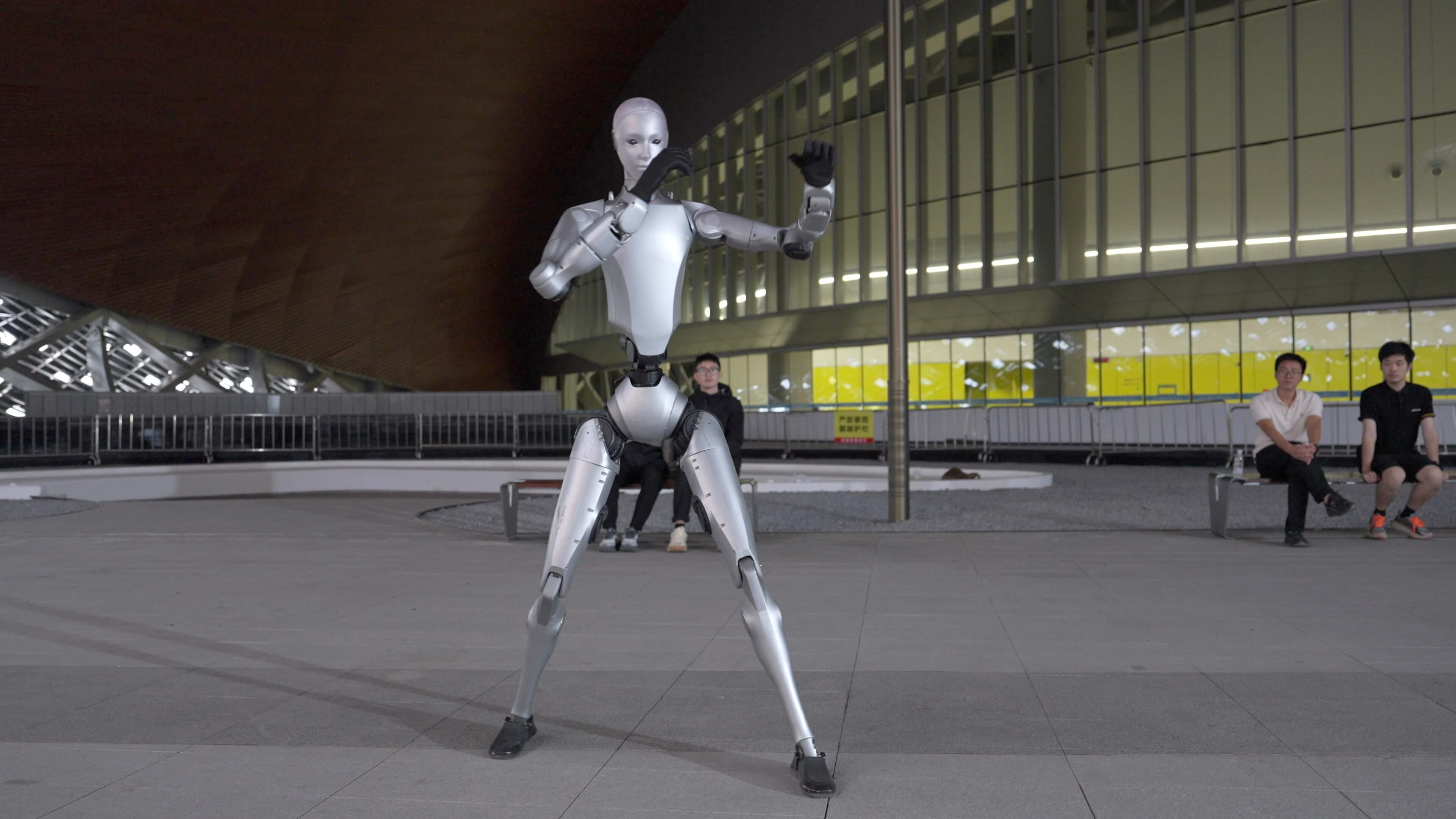
Read the fine print before you compare it with Tesla's demos, though. The base H2 has fixed dummy hands, runs remote-controlled walking and motion routines, and cannot run your own code: Unitree states that only the EDU version supports secondary development, and Toborlife's page says the Basic cannot take dexterous hand upgrades. The H2 EDU with hands and NVIDIA Jetson Thor compute costs $66,800 at Toborlife. So the H2 gives you Optimus-like scale and motion today, not Optimus-like work, and it is best for events, showrooms, demos and research groups willing to pay for the EDU.
8.2 The smaller walking platform: Unitree G1
The Unitree G1 is a smaller and cheaper walking humanoid aimed at labs, schools and enthusiasts, and you can buy it from Unitree or from at least five dealers in the US and Europe that we track. Unitree lists it at $13,500 direct, plus $300 to $1,200 shipping and import costs, and RoboStore sells it in the US at $17,990 - RoboStore. It is 132 cm tall and about 35 kg, roughly the size of a ten-year-old, with 23 joints in the base version and a 2 kg payload.
The G1 walks, climbs steps and slopes, gets back up after a fall and avoids obstacles with its LiDAR, all from the included gamepad. Like the H2, the base model is locked: there are no hands, no voice assistant and no way to program it. A G1 that you can develop on starts at $43,900 for the G1 EDU at US dealers, and our G1 versus G1 EDU comparison lays out what the extra money buys. If what attracts you to Optimus is building or studying a humanoid rather than owning a helper, the G1 EDU is a platform you can program from the day it arrives.
8.3 The entry-level walking humanoid: Unitree R1
The Unitree R1 is Unitree's entry-level humanoid and the cheapest robot in this guide, although smaller walking humanoids cost less still, such as the 98 cm Noetix Bumi at about $1,400. Unitree's store lists the 20-joint R1 Air at $4,900, the 26-joint R1 at $5,900 and the developer R1 EDU at $10,500, all before freight and tax - Unitree. Delivered to the United States, our estimate for the Air comes to $7,452 to $7,971 once shipping and import costs are added, and US dealers sell a ready-imported R1 Basic at $8,990.
At 123 cm and about 27 kg, the R1 is a demonstration and learning robot. It dances, does kung-fu routines, talks through an onboard voice and image model and is genuinely agile, but the Air and standard editions cannot be programmed and its battery lasts about an hour. It is the right machine for someone who wants to understand what a humanoid is like to live with for the price of a used car, and the wrong one for anyone hoping it will fetch things. Our list of humanoid robots under $10,000 covers it alongside the other machines at that price.
8.4 The home robot with a delivery date: 1X NEO
If your interest in Optimus is the promise of a robot that helps at home, the machine to look at is the 1X NEO, because it is the only walking home humanoid you can reserve with a delivery year attached. 1X's order page offers Early Access ownership at $20,000 with a three-year warranty, or a $499 a month subscription, both secured by a $200 refundable deposit, and it says US deliveries start in 2026 - 1X. That is, by coincidence, inside the $20,000 to $30,000 band Musk has given for Optimus.
The catch is the one our guide to home humanoid robots spends most of its length on. NEO does a short list of things on its own, such as getting the door, putting dishes away and turning off lights, while the chores people want most, laundry, emptying the dishwasher and tidying the whole house, run in what 1X calls Scheduled Expert Mode, with a person at 1X supervising the robot remotely at a time you book. Deliveries outside the US have no date. So NEO is the nearest thing to the home-robot future Musk describes, with the remote human made explicit rather than hidden.
8.5 Full-size Chinese performers: AgiBot A2 Lite and EngineAI PM01
Two more Chinese makers sell full-size or mid-size humanoids with a posted price and a checkout. The AgiBot A2 Lite is a 169 cm, 63 kg humanoid at $44,560 on AgiBot's global store, with $500 to $3,000 shipping and duties paid by the buyer - AgiBot. The EngineAI PM01, a 140 cm biped famous for a front flip, is listed at RMB 188,000 (about $26,000) on EngineAI's purchase page - EngineAI.
Both are performers and research platforms rather than workers. The A2 Lite walks under remote control and plays preloaded routines such as handshakes and Tai Chi, but it has no speech, no perception sensors and no grasping hands, and AgiBot lists light-duty work as unsupported. Delivered to the US, the tariffs on Chinese-made machinery push our estimate for the A2 Lite to $63,491 to $64,383, so for an American buyer the H2 from Unitree's US partner is the cheaper full-size machine by a wide margin. Europe's import duty on robots is low, so in Germany the same A2 Lite comes to about €49,200 to €50,100 delivered, still well above an imported H2 at about €33,500 to €34,500, as our delivered cost list for Germany shows.
8.6 The robots in Optimus's queue: Figure 03, Atlas, Digit and Apollo
The four American humanoids most often mentioned alongside Optimus share its buying status: you cannot order any of them as an individual. Figure sells the Figure 03 only as an enterprise service, and BMW is starting a parts-sequencing project with it at its Spartanburg plant - BMW Group. Boston Dynamics says every 2026 Atlas is committed to Hyundai and Google DeepMind, with other customers from early 2027 - Boston Dynamics. Apptronik's Apollo runs pilots at Mercedes-Benz with no public price.
The one with real numbers is Agility's Digit, because Agility is going public and had to file them. Its SEC filing gives illustrative Digit 5 economics of about $200,000 to buy a robot plus about $20,000 to deploy it, or $8,500 a month as a robot-as-a-service rental plus about $25,000 to deploy - SEC. Those figures are the most useful benchmark in this guide for what a working humanoid costs a business in 2026, and they are a long way from $20,000. Our Digit, Apollo and Figure 03 comparison sets the three side by side.
9. Wait for Optimus or Buy Now: A Decision Framework
Whether to wait for Optimus is not really a question about Tesla. It is a question about what you want a humanoid to do, how soon, and how much risk you can carry, and the answer changes completely depending on which of those matters most. A family hoping for help with chores, a university lab, an events company and a factory manager are all searching for the same name, and they should end up in four different places.
The useful way to decide is to work backwards from the job. If the job is real, unsupervised household or factory work, nothing you can buy as an individual does it today, Optimus included, so the choice is between waiting and accepting a robot that needs a remote human. If the job is learning, research, demonstration or entertainment, waiting buys you nothing, because the robots for that job already exist and are getting cheaper every quarter.
9.1 How each type of buyer should read the evidence
If you want help at home, the realistic options are a preorder with a remote human in the loop or patience. The 1X NEO costs about what Musk says Optimus will cost eventually, and it is the only walking home robot with a delivery year, but its maker is open that laundry and tidying run with a 1X employee guiding it. Optimus has no documented household task at all yet. Our home robot guide scores every home option, and its conclusion holds here: for most households, the right move in 2026 is to wait, and to treat a deposit as an early-adopter experiment rather than a purchase of a finished helper.
If you want to research, teach or build, do not wait for Optimus, because Tesla has published nothing about developer access, an SDK or education pricing, and its first customers are expected to be leasing businesses. The Unitree G1 EDU and R1 EDU are open to your own code today, and our guide to what you actually get in the box explains why the EDU tiers matter. If you want a humanoid for events or demonstrations, the H2 or G1 does that job today, and our guide to buying a humanoid robot walks through dealers, warranties and delivery.
If you run a factory or warehouse, the honest comparison is between robots-as-a-service contracts available now and a Tesla lease that may start in the second half of 2027. Agility's published Digit economics and Figure's and Apptronik's pilot programmes give you real numbers to plan with, and Tesla's reported plan to lease first to companies whose sites look like its own is worth a conversation if your operation resembles a car or battery factory. In every case, write the decision down with a review date, such as Tesla's quarterly results, so a delay does not quietly become a missed opportunity.
9.2 What waiting costs, and what it buys
Waiting has a real price that is easy to miss: a year or two without the robot, its data and the experience of running it, which matters to labs and businesses more than to households. It also has a real benefit. The market data in section 7 shows prices falling fast as Chinese volumes grow, and Optimus's arrival, whenever it comes, is likely to push them down further. A household that waits until 2028 will very probably pay less for more capability than one that buys today, whichever brand it chooses.
The way to apply this is to buy now only if the robot you can buy now does your job now. If it does, the H2, G1, R1 or NEO is a reasonable purchase on its own terms, and nothing about Optimus will make it less useful. If it does not, waiting is the rational choice, and the thing to watch is not Musk's next date but evidence: a production start in a Tesla filing, a public Gen 3 demonstration labelled autonomous, and a first outside customer you can name.
10. What to Watch Between Now and 2027
The Optimus story will move in identifiable steps, and each one can be checked against a primary source rather than taken on trust. The first comes soon: Tesla publishes its third-quarter results after the market closes on 21 October 2026, and its shareholder update is where it commits to production in writing. Look for three things in it: whether Optimus production started at Fremont, what the first robots are doing, and any date for the Gen 3 reveal, which Musk suggested in April could move closer to the start of production.
After that, the milestones are mostly 2027 events. Musk said on the April 2026 call that a second Optimus factory at Gigafactory Texas would probably start production around summer 2027, eventually for a higher-volume fourth generation - Electrek. Tesla told JPMorgan in August that outside commercial sales could start "as early as" the second half of 2027. Musk's date for public sales is the end of 2027. And our check of Tesla's SEC filings on 7 October found no proxy statement for a 2026 shareholder meeting, so that meeting has no date yet.
10.1 The signals that would change this guide
A few specific events would move Optimus up the ranking at the top of this guide, and we will update it the day any of them happens. A public Gen 3 reveal with a clearly labelled autonomous demonstration would raise its work score. A named outside customer, even on a lease, would raise its availability score. A price on tesla.com, or a published lease rate, would do the same for its price score. Until then, its position near the bottom reflects nothing more than the fact that nobody outside Tesla can have one.
The rivals will not stand still in the meantime. XPeng is aiming its IRON at commercial sales in 2027 from a production line it opened in September. Boston Dynamics says it will add Atlas customers beyond Hyundai and Google DeepMind in early 2027. Agility expects Digit 5 early access in the first half of 2027, and 1X has promised its first US NEO deliveries this year. Our market tracker logs these changes as they happen, with dates and sources, and the Optimus datasheet changes first whenever Tesla publishes something new.
11. How This Guide Was Researched, and How It Stays Current
A guide about a product that does not exist yet is only as good as its sourcing, so here is ours. The backbone is what Tesla has filed with the US Securities and Exchange Commission: its 2025 annual report, its quarterly report for the second quarter of 2026, its shareholder updates from October 2025 to July 2026, and the proxy statement for Musk's 2025 pay package. These are documents in which Tesla carries legal responsibility for what it writes, which is why we quote them first and quote Musk's interviews and posts second, always with the date.
Around that backbone sit Tesla's own recordings of its 2026 earnings calls and events, reporting by named journalists at Electrek, CNBC, TechCrunch, The Verge, Business Insider, IEEE Spectrum and The Robot Report, published research from IDC, Omdia, Morgan Stanley, Bank of America and Goldman Sachs, and Unitree's stock market prospectus. Where a fact reached us second-hand, as with the September 2026 report by The Information, which is behind a paywall, we say so in the sentence. Spec aggregators and catalog sites that copy one another were not used as sources.
11.1 Prices, checks and money
Every price for a robot you can buy was checked against the maker's or dealer's own page on 7 October 2026, and the delivered costs come from the same engine that prices every robot in our catalog, using each country's duty, tax and freight rules from our import rules. The research was split into threads (Tesla's filings, the history and cost record, the rival robots and market data, and the videos and images), each handled by an AI research agent required to return the exact sentence it relied on and the address it read, and the key quotes were checked against the saved pages a second time before publication. An agent can confirm what a page says, not whether it is true, which is why claims are labelled as claims.
On money: this site earns a commission from one reseller, Robots International, when a reader buys through the links marked as commission links on its robot pages. Tesla does not pay us, no maker covered here pays for its position in the ranking, and no link in this guide is a referral link. When Tesla publishes its next update, this guide and the Optimus datasheet are revised the same week, and the change is logged on the updates page.
Prices, statuses and statements in this guide were checked against Tesla's filings, the makers' own pages and the cited sources on 7 October 2026. Optimus dates have moved many times, and robot prices change month by month, so confirm the current terms on the maker's page and on our datasheets before you place an order or a deposit.