Humanoid Robot for Home: What You Can Get in 2026
· 85 min read · Yuma Heymans · Updated
The honest 2026 guide to humanoid robots for the home: what you can order, what it does alone, what a remote person still does, and what it really costs.
Of the 103 humanoid robots in our catalog, only four carry a maker-documented record of household work, and not one can be delivered to a home today to do chores on its own. Two of them can be reserved with a refundable deposit: 1X's walking NEO, at $20,000 or $499 a month - 1X, and Weave's wheeled Isaac 1, at $7,999 or $449 a month - Weave Robotics. Read those order pages closely, though, and the chores most people want, laundry, emptying the dishwasher, tidying the whole house, are done with a person at the company steering or supervising the robot from somewhere else.
That is the problem with the question nearly everyone asks: "can I buy a robot that does my housework?" It gets two unhelpful answers. The hype answer is a sped-up video of a robot folding towels, often with a human operator out of shot. The dismissive answer is that home robots are a decade away. Neither helps someone deciding whether to put down a deposit this autumn, because the truth sits in between: real machines, real prices and real delivery promises, sold at a stage where a remote human does much of the hard part and your home helps train the robot.
This guide covers every humanoid offered or promised to households as of October 2026, scored on the same five criteria. It explains from first principles why the home is the hardest place for a robot, then goes machine by machine through what each maker documents its robot doing alone and with a remote operator, using the makers' own words and their published numbers. It prices a robot against a cleaner, a laundry service and the single-chore machines already on sale, covers safety, privacy and the fine print on deposits, looks at the walking robots you can order today, and ends with a decision framework. Every figure is sourced and was checked on 5 October 2026.
A home robot, as its maker presents it

Contents
- The structural question: why the home is the hardest job in robotics
- The 2026 landscape: five kinds of offer, none of them a robot housekeeper
- 1X NEO: the walking home robot you can preorder
- Weave Isaac 1: the wheeled robot built for laundry and tidying
- Sunday Memo: the beta that bets against teleoperation
- The rest of the field: famous names, reservations, a care service and two low-cost newcomers
- How much they do alone: the human in the loop
- What it really costs: buy, subscribe, or pay a person
- Safety at home: falls, force, children, and the missing standard
- Privacy: cameras, microphones and a person you have never met
- Deposits, delivery dates and what happens if the company fails
- What you can have at home today: robots that walk and do no chores
- What happens next: 2027 and beyond
- A decision framework: preorder, wait, or buy something else
- How this guide was researched, and how it stays current
The home robots of 2026, scored and ranked
Before the detail, here is every humanoid that a maker offers or has promised to households, scored the same way. The ranking measures what a household can actually get and rely on in late 2026, not how impressive the robot looks in a demo, which is why a famous name with no way to order can rank below a small startup with a refundable deposit. Read the cells rather than the final number: each one carries the fact behind its score, and the facts are sourced in the sections that follow.
The five criteria come from what decides the purchase in practice. Availability (25%) is whether and where a household can get one, and how firm the date is. Chores (30%) is what household work the maker documents and how much of it happens without a remote person. Price and terms (15%) is whether there is a published price and how fair the deposit terms are. Safety and privacy (15%) is what the maker publishes about both. Staying power (15%) is the evidence that the company will be around to support the robot. Each criterion is scored from 0 to 10, and the final score is the weighted average.
| # | Robot | Status | What It Does | Availability (25%) | Chores (30%) | Price and terms (15%) | Safety and privacy (15%) | Staying power (15%) | Final |
|---|---|---|---|---|---|---|---|---|---|
| 1 | 1X NEO | Preorder | Walking humanoid, chores with remote Experts | 6 - $200 refundable deposit, US deliveries promised in 2026, none confirmed | 5 - five tasks alone; laundry, dishwasher and tidying via a remote Expert | 7 - $20,000 or $499/mo; deposit turns non-refundable 14 days after invitation | 5 - soft 66 lb body, owner-approved sessions; no device privacy policy | 8 - factory in production since April 2026, EQT deal | 6.0 |
| 2 | Weave Isaac 1 | Preorder | Wheeled laundry and tidying robot | 5 - $250 refundable deposit, California first in fall 2026; slipped once | 5 - Laundry Flow and Daily Reset, teleoperation when needed, no success rate | 7 - $7,999 or $449/mo; $99 membership undefined | 6 - passively stable; explicit policy on remote access and training | 4 - young company, no funding disclosed; Isaac 0 already ships | 5.3 |
| 3 | Sunday Memo | Beta | Wheeled robot trained on glove data | 3 - free, invite-only beta "launching late 2026"; scale shipping 2027-2028 | 6 - 99.1% laundry folding in unseen homes (own test); other skills unproven | 2 - no price; about $20,000 to build; no beta terms | 6 - stays upright without power, half human speed; no robot privacy policy | 7 - $165M raised at a $1.15B valuation in March 2026 | 4.8 |
| 4 | Flourish 1 | Preorder | Wheeled two-armed robot you teach from a phone | 5 - $3,555 for 50 numbered units, December 2026 estimate, US and Europe | 4 - each chore taught in about 30 min; maker says taught tasks work 80% of the time; 1.5 kg, no water | 5 - lowest price here with a refundable reservation, but sold as is, no warranty, $50/mo cloud after 6 months | 5 - stops when a person or pet enters its area; recordings asked for each time, video streamed while working | 2 - pre-seed startup, launched September 2026, hand-built first run | 4.3 |
| 5 | NEURA MiPA | Reservation | Wheeled two-armed home assistant | 5 - EUR 100 refundable reservation, "late 2026 release", Europe | 2 - carrying items and smart-home control at launch; chores left to partners | 6 - EUR 9,999 introductory price; launch contents vague | 3 - detects people at 3 m; regulation FAQ is template text | 6 - also building the 4NE1 humanoid; MiPA still in pilots | 4.1 |
| 6 | Figure 03 | No home offer | Humanoid tested in 30 rented homes | 1 - no price, order or waitlist; robots go to R&D and industry | 6 - 56% full-task success in unseen homes (own test) | 0 - no price; CEO speaks of a lease target | 4 - foam over pinch points, 61 kg; safety lawsuit in mediation | 9 - 350+ robots built by April 2026, BMW deployment | 4.0 |
| 7 | Nori A3 | Preorder | Wheeled two-armed robot taught by teleoperation | 5 - $1,688 paid in full, "fall 2026" with no date, ships to 60 countries | 2 - every task taught by your own demonstrations; maker says perception does not work yet | 5 - lowest price in the table; full payment up front, no terms or warranty published | 4 - physical and software stops, light arms; no privacy policy published | 3 - five-person YC startup, no disclosed funding | 3.7 |
| 8 | Devanthro Robody | Care service | Remote-operated care robot | 3 - pilots by inquiry, Germany only | 4 - in homes since 2024, run by operators over VR | 1 - no published price | 5 - deliberately weak 1.5 kg arms; operators see in by design | 3 - startup in pilot stage | 3.3 |
| 9 | SwitchBot onero H1 | Coming soon | Wheeled household robot | 2 - $9,999 listed, "Coming Soon", not orderable | 3 - claims laundry and dishes; one garment took about two minutes | 5 - price listed; no date or terms | 2 - nothing published on remote help or safety | 5 - smart-home brand, no shipping date | 3.2 |
| 10 | LG CLOiD | Concept | Wheeled robot shown folding laundry | 0 - real-world tests planned "around next year" | 3 - CES demos; CEO: "much slower than we aim for" | 0 - no price or date | 2 - nothing published beyond the CES release | 8 - LG set up a robotics business center in 2026 | 2.4 |
| 11 | Tesla Optimus | Announced | Humanoid still in pre-production | 0 - no order or price; first units for Tesla's own data collection | 1 - no home task documented by Tesla | 0 - no price in any filing | 1 - nothing published for homes | 9 - early production in Fremont since Q3 2026; first outside customers, businesses, expected around the end of 2027 | 1.8 |
The scores cluster low, and that is the finding: the best-scoring robot reaches 6 out of 10, because even the leader depends on a remote person for the chores buyers want most and has not yet delivered to a customer. NEO ranks first on the strength of a real factory, a published price and the broadest documented task list; Isaac 1 is close behind with a lower price, a clearer job and a more explicit privacy policy, held back by a young company's thin public record. Memo has the strongest published autonomy number but no price and no sale. The two cheapest robots, Flourish 1 at $3,555 and Nori A3 at $1,688, were added to this table on 22 October 2026: both are small startups' first runs that you teach yourself, and both rank on their price and their delivery to Europe rather than on proven housework. The famous names, Figure and Tesla, rank low for one reason only: a household cannot get one.
The table deliberately leaves out the walking robots you can buy today, such as Unitree's R1 and G1 and Booster's K1, because none of them does household chores; section 12 covers them as what they are. It also leaves out single-purpose machines such as robot vacuums and laundry folders, which section 8 prices as the alternatives they are. If a maker's offer changes, its row here changes with it: the live version of this list is our humanoid robots for the home page.
1. The structural question: why the home is the hardest job in robotics
Before naming a single robot, ask the structural question. The surface question is "which home robot should I buy?" The structural one is "why, after a decade of humanoid demos, is there still no robot you can buy that does your housework on its own?" The answer explains every price, every delivery date and every caveat in the rest of this guide, so it is worth working through from first principles rather than from press releases.
Start with what a robot needs to be useful anywhere: a known environment, a repeatable task, and a tolerance for mistakes. A factory offers all three. The parts arrive in the same place, the task repeats thousands of times a day, the floor is flat and mapped, the people nearby are trained, and a dropped part costs a few dollars. That is why the humanoids doing paid work in 2026 are in warehouses and car plants, and why our list of humanoids at work can name production deployments while the home list cannot.
A home removes all three at once. No two homes share a layout, a set of objects or a lighting pattern, and the objects move every day. The work is not one task but hundreds of short ones, each a chain of small manipulations: find the sock under the bed, pick up something soft that changes shape in the hand, open a drawer that sticks, fold, stack, carry, put away. The people nearby are children, pets, older relatives and guests, none of them trained to stay clear of a moving machine. And the cost of a mistake is high and personal: a broken glass, a scratched floor, a pinched finger, a fall on a staircase.
How home robots are developed in 2026
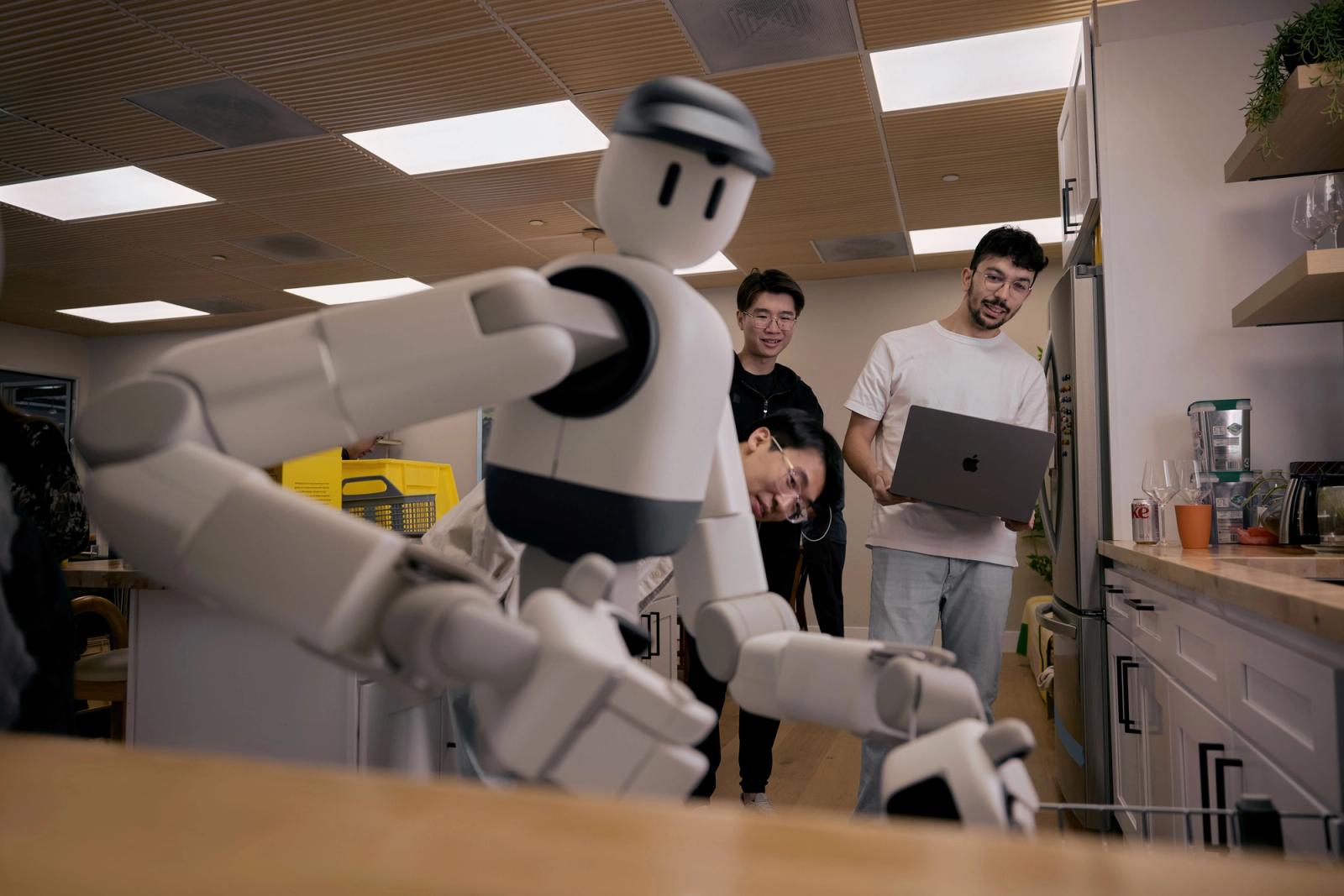
The photo shows the normal working condition of a home robot in 2026: a real kitchen, with the people who built it close by. Physical Intelligence, one of the leading robot-learning labs, describes the obstacle in plain terms: "every home is different, with different objects in different places", the problem "is made even harder by the limited availability of diverse data for such robotic systems", and "this is why most commercial robots operate in tightly controlled environments like factories or warehouses" - Physical Intelligence, archived. The household robot is not a factory robot moved indoors. It is a different, harder problem.
Then there is the economic test, which most coverage skips. A household already has three ways to get a chore done: do it yourself, pay a person, or buy a single-purpose machine. Dishwashers, washing machines and robot vacuums have absorbed the chores that a fixed machine can do, which leaves exactly the chores that need hands and judgment: folding, tidying, loading and unloading, fetching. When YouGov asked Americans in January 2025, 38% said they were interested in a household robot, and among the jobs they wanted from one were floor cleaning (93%), dishwashing (87%) and laundry (86%) - YouGov. The first of those is already solved without a humanoid; the other two are precisely the hard ones, and a robot that does them slowly and with help must still beat a person you can hire by the hour.
The deepest constraint is data. Language models learned from a large share of the text on the internet. There is no internet of robot hands folding towels, so a home robot has to collect its own experience, one home at a time. Physical Intelligence trained its pi0.5 model on "about 400 hours" of robot data "in about 100 different home environments" - arXiv, a tiny amount by the standards of language models. Every maker in this guide has built its business around closing that gap: 1X sends a remote human to finish what NEO cannot do and learns from the session, Weave keeps a teleoperator on call for Isaac 1, Sunday records people doing chores while wearing its gloves, and Devanthro pilots its Robody by remote control while it gathers the data to automate it. The robot video these companies gather also has to be labeled by people before a model can learn from it, and that labeling is paid remote work: AITraining.jobs' guide to data labeling, built by the same founders as this site, explains what the job involves and how to start.
That is the single most important idea in this guide. The product on sale in 2026 is not a finished housekeeper. It is a seat in the data-gathering phase: a robot that does a few things alone, a person somewhere else who does or supervises the rest, and a promise that the share done alone will grow. That can still be worth buying, for the right person, at the right price, with the right exit. But it has to be judged as what it is, and the rest of this guide does exactly that, starting with a map of what is actually on offer.
2. The 2026 landscape: five kinds of offer, none of them a robot housekeeper
The phrase "home robot" covers offers that have almost nothing in common, and most confusion about this market comes from comparing them as if they were one product. A refundable deposit on a robot due this winter, a free beta you have to be selected for, a care service run by remote operators, a concept shown at a trade fair and a walking toy you can order today are different things to buy, with different risks. Sorting the field by what you can do today (order, reserve, apply, inquire or nothing) is more useful than sorting it by height or by how good the demo video looks.
When this guide was first published our catalog listed 103 humanoids, and only four of them carried a maker-documented, dated record of household work: 1X's NEO, Weave's Isaac 1, Sunday's Memo and Devanthro's Robody. Two of those four can be preordered, one is a selected beta and one is a care service. Two cheaper wheeled robots have since joined them, Flourish 1 and Nori A3, both orders for a small first or second batch that you teach yourself, so the number of humanoids a household can buy today and have do chores on their own is, strictly, still zero. Around those four sit the reservations, the announced machines and the bipeds that ship but do no housework, and the diagram below groups them by the kind of commitment each one asks of you.
The groups are not a ranking of quality, and the boundaries move. Figure develops household skills in its own labs and could open a home program, Tesla says its first production units go to its own data collection, and the preorder machines will only show what they are worth once paying customers have them. What the grouping does capture is your exposure. A preorder risks a refundable deposit and your patience. A beta risks your time and your privacy. A service risks nothing up front but leaves you owning nothing. A concept risks only your attention, and a walking toy risks the full purchase price on a machine that will not do the job you may have bought it for.
Two practical consequences follow. First, the comparison that matters for most readers is between the two preorder machines, which is why they get the longest sections below, followed by the beta and the reservation that could become real products in 2027. Second, geography decides more than price does. The two big preorders are for the United States, and until late September so was every chore-capable offer in the top two groups apart from NEURA's reservation and Devanthro's German service. The two low-cost newcomers change that: Flourish builds its robot in Paris and says it sells in America and Europe, and Nori's checkout ships to 60 countries, so a reader in Europe or the UK can now order something, if it is a small startup's experimental batch. A reader in Australia still cannot. Our import rules for 38 countries explain why a robot sold in one market cannot simply be shipped to another, and the datasheets for each machine say exactly where its maker will deliver.
3. 1X NEO: the walking home robot you can preorder
NEO is the machine most people mean when they search for a humanoid robot for the home, and it is the one that comes closest to the science-fiction picture: a 5-foot-6 walking robot in a soft nylon suit, with human-like hands, that you talk to and that does chores. It is also the clearest example of everything this guide is about, because 1X, which builds NEO in California, is unusually explicit about which chores NEO does alone and which ones a person at 1X does through it.
Start with the offer. 1X's order page lists two ways in: Early Access ownership for $20,000, which comes with a three-year warranty, premium support and priority delivery, or a subscription at $499 a month, with a $200 deposit for either, labelled fully refundable, and the line "US Deliveries start 2026" - 1X. When a subscription ends you can extend it or return the robot. 1X's own pre-order terms say a subscription "may" carry a minimum number of months, to be set out when you are invited to complete the order - 1X Pre-Order Terms, and the Wall Street Journal reported a six-month minimum at launch - Daring Fireball, quoting the WSJ. Buying outright needs no extra subscription, and 1X expects NEO to cost under $1 a day in electricity. Our NEO datasheet keeps these terms current.
The heart of the offer is a split that 1X prints on the same page. Under "Autonomy", NEO "arrives with basic autonomy for early owners and grows in capability overtime", and the list reads: get the door, put dishes away, turn off lights, clean up trash, water plants. Under "Scheduled Expert Mode", for "complex tasks NEO doesn't know, an Expert from 1X can remotely supervise its actions at scheduled times to help it learn new abilities and get the job done", and that list reads: laundry, empty the dishwasher, tidy the entire house, feed the pets, bartend parties. In other words, the chores most buyers want are, for now, done with a person at 1X steering or supervising the robot. Those Experts are "1X employees physically present in the USA", and an Expert cannot connect on their own: the owner books the session and lets them in by voice or app, and NEO's ear rings change colour while one is active - 1X FAQ.
The video shows the most concrete thing 1X has achieved this year: a production line. 1X says its 58,000-square-foot Hayward factory, with more than 200 staff, "has commenced full-scale production of NEO" and has capacity for up to 10,000 robots a year, with a target of 100,000 or more a year by the end of 2027 - 1X. The same post says 1X booked out its first year of capacity, 10,000 NEOs, in five days of preorders. It also says "the current NEOs coming off the line are being prioritized for our internal team" and, to the customers asking "Where is my NEO?", that "some of you will get your NEO this year, some will get them later".
As of 5 October 2026 we found no confirmation, from 1X or from a reputable outlet, that any customer has received a NEO. In June TechCrunch reported that "none have actually been delivered" - TechCrunch, and in late September Reason described NEO as "expected to ship to consumers by the end of 2026" - Reason. In between, 1X's chief executive told the All-In podcast in July that "getting a home humanoid in 2026 is going to be rough", according to a report of the interview - Humanoids Daily. 1X runs an unlisted page recruiting pilot testers among deposit holders in the greater San Francisco area - 1X. In a September interview its chief executive set a target of 50,000 units in 2027 across home, business and developer customers - Humanoids Daily. Deliveries are coming; how many households get one this year is not public.
What does NEO actually do on its own? The only success rates 1X has published come from a January 2026 research post on its "world model", in which each task was run 30 times on one robot in a lab - 1X. The results are worth seeing, because they show both how real the progress is and how uneven it remains.
Three things stand out. Simple, forgiving motions such as steaming a shirt succeed most of the time; precise ones such as pouring did not succeed at all. The model's fine-tuning data is described as 70 hours of robot data, 98.5% of it tabletop pick-and-place. And in that research setup the model took 11 seconds to plan each 5 seconds of motion. None of this was measured in a customer's home, and 1X publishes no figure for the share of household tasks NEO completes without an Expert. 1X may have improved on these since, but it has not published newer numbers, so these are the best available.
Independent testing tells the same story from the outside. When the Wall Street Journal's Joanna Stern tested NEO before launch in October 2025, a 1X employee teleoperated it throughout; Tom's Guide, reviewing her video, concluded that "100% of the work being done was completely teleoperated through Expert Mode" - Tom's Guide. Even with a person in control, NEO nearly toppled closing the dishwasher and took two minutes to fold a shirt, according to the Journal's account - Daring Fireball, quoting the WSJ. In July 2026 WIRED watched what 1X called a fully automated NEO over a video call, and 1X told the magazine that some of its hand videos "are machine-articulated while some are operated" - WIRED. No reviewer has yet lived with an autonomous NEO at home.
The hardware is impressive for its weight. 1X lists NEO at 66 pounds, able to lift 154 pounds and carry 55, with 22 joints in each hand, a four-hour battery, a 22-decibel noise level, an NVIDIA Jetson Thor computer, two 8.85-megapixel fisheye cameras, four microphones, and Wi-Fi, Bluetooth and 5G. The hands are sealed to IP68 but the body only to IP44, cooking "will be restricted from use" at first, and 1X says NEO can climb stairs. It also tells owners to "remain attentive during operation", especially around children, vulnerable people and pets, which section 9 returns to.
So who is NEO for in 2026? A household in the United States that wants to be among the first to live with a walking humanoid, can absorb $20,000 or a $499 monthly bill, and is comfortable with a 1X employee seeing inside the home during Expert sessions. 1X's chief executive has put that bargain in plain words: "If we don't have your data, we can't make the product better" - Reason. For that buyer, a refundable deposit costs little. For anyone expecting an autonomous housekeeper this year, the published lists above are the honest answer.
4. Weave Isaac 1: the wheeled robot built for laundry and tidying
If NEO is the humanoid as science fiction imagined it, Weave's Isaac 1 is the humanoid as a laundry problem would design it. It rolls on a wheeled base, its torso telescopes from about 3 feet to 5 feet 9 inches, and its two arms end in simple grippers rather than fingers. Weave, a young San Francisco company, sells it for two jobs: "Laundry Flow" (finding and picking up dirty clothes, handling loaded hampers, folding and putting clothes away) and "Daily Reset" (making beds, fixing pillows and blankets, and putting toys, shoes and clutter back where they belong) - Weave Robotics.
The price is the lower of the two established preorders, and only the two small startups' first runs in section 6 cost less: $7,999 up front or $449 a month, with a $250 deposit that Weave says is "refundable any time until your Isaac 1 ships". The order page adds an "optional $99/mo premium membership" to the up-front price, and you choose how to pay at delivery rather than when you reserve - Weave Robotics. No Weave page says what the subscription or the membership includes, or whether there is a minimum term, so those are questions to ask before the robot ships. Our Isaac 1 datasheet records the terms as they change.
On autonomy, Weave's wording is precise: Isaac 1 "is autonomous for Laundry Flow and Daily Reset by default, with teleoperation assistance when needed to guarantee we complete tasks". It publishes no share of tasks done alone, no success rate and no time per task. The only figure it has given is from August 2025, when it said an early prototype "folds shirts end-to-end 70% autonomously, with a human helping only as needed" - Weave Robotics. Weave's own job advertisement for a "Robot Operator & Data Annotator" describes who the help is: on-site staff in San Francisco, paid $25 an hour, whose work "supports robots actively operating in the field" while the rest "helps generate the data they need to become increasingly capable on their own" - Weave careers.
Isaac 1 has not reached a customer yet. Weave says "first shipments begin in fall of 2026", with California first and the rest of the United States "following through 2027", and Europe appears nowhere in its plans. Its careers page still says Isaac 1 "will be one of the first of its kind to ship to paying customers this year" - Weave careers, and we found no report of a delivery as of 5 October 2026. History counsels patience: when Weave launched in 2024 it promised to ship its first 30 mobile robots "in fall of 2025" - Y Combinator, and its pre-order agreement says plainly that "the Device remains in development" - Weave pre-order agreement, as section 11 covers in detail.
Weave does already ship something, and it is the most useful clue to what Isaac 1 will be like. Isaac 0 is a stationary laundry folder for California homes, sold as "an early-release prototype" in limited quantities, for $249 a month or $3,999 up front plus $49 a month - Weave Robotics. It "blends autonomy with teleoperation (remote assistance by a Weave specialist) to guarantee that we complete every fold": T-shirts, shorts and long sleeves are often folded almost entirely autonomously, while other clothes need more help, an average load takes 30 to 90 minutes, and it "does not yet fold large blankets or bed sheets". When the specialist steps in, Weave says they see "feeds from the head and wrist along with diagnostic information" and that "no audio data is collected". A reporter who used a Weave robot in a San Francisco laundromat in 2025 found that "around 15%" of the order had been folded by the robot, with a person folding the rest - SF Standard.
Isaac 0, the Weave robot that ships today

Isaac 0 began as "an internal prototype of Isaac 1" - Weave Robotics: the two arms and camera mast in the photo are the same idea that Isaac 1 puts on a wheeled, telescoping base. That makes Isaac 0's record the closest thing to evidence about its sibling. Weave says it has run more than 2,000 hours in the field, and that when a fold goes wrong a remote specialist can "sub in remotely" for a correction of five to ten seconds and then "hand back off to the robot". Two things follow for an Isaac 1 buyer. The remote help is designed into the product rather than bolted on, and the speed you should expect is the speed of a careful robot plus occasional human corrections, not the speed of a person.
The hardware choices follow from the job. Weave says the wheeled base means Isaac 1 is "passively stable", the fabric shells give passive safety, the battery lasts 8 hours with a 2-hour charge, and shutters on the head cameras "make clear when the robot is working, and when it's not" - Weave Robotics. It publishes no weight, payload, top speed or noise level, and says nothing about stairs, so plan on one floor until it does. Its privacy policy is the most explicit of any maker here: the robot "may record visual content about its surroundings", Weave's "workforce may remotely access this information", and owners should configure the robot and the room "so that it only records visual content that you are comfortable sharing with Weave" - Weave privacy policy.
Who is Isaac 1 for? A Californian household whose biggest chore is laundry and evening tidying, that wants the lowest entry price among the established preorders, and that accepts remote help on the same terms as NEO. Compared with NEO it gives up legs, fingers and stairs for stability, a narrower and clearer job description, and a price less than half as high. For buyers who only want the folding, Isaac 0 is the version that exists today; for those who want to compare the two preorder machines side by side, our NEO versus Isaac 1 comparison sets their specifications and terms next to each other.
5. Sunday Memo: the beta that bets against teleoperation
Sunday Robotics is the company in this guide that disagrees most sharply with how the others gather data, and that makes its robot worth understanding even though you cannot buy it. Memo is a wheeled robot with a telescoping torso, a soft silicone shell and a hat, 1.7 metres tall and 170 pounds, with two seven-jointed arms and four-jointed hands, a 4-hour runtime and a 1-hour charge - Sunday. Sunday's founders come from robot-learning research: Tony Zhao, the chief executive, left a Stanford PhD in 2024 after work at Google DeepMind and Tesla Autopilot, and Cheng Chi, the chief technology officer, invented the Diffusion Policy method - Sunday.
Memo is not for sale. The only way in is Sunday's "Founding Family" beta, which is free, invite-only and "launching late 2026", and Sunday says it anticipates "starting to ship Memo at scale 2027-2028" - Sunday. It has announced no price. The only figure it gives is that building one Memo by hand today "costs approximately $20,000", which it says it does not expect to be the retail price, because scale manufacturing should cut costs by at least half. In March 2026 Sunday raised an oversubscribed $165 million at a $1.15 billion valuation "to stop demos and bring the first autonomous home robot to households this year" - Sunday, and its newest dated statement, in July, still put the beta in the future: "This fall, we will deploy Memo to families through our Beta Program." We found no report that the beta had started by 5 October 2026.
The interesting part is how Memo learns. Instead of operating robots remotely in customers' homes, Sunday pays people it calls Memory Developers to do their own chores at home while wearing a Skill Capture Glove, a sensor glove that it describes as "a one-to-one representation of Memo's hand", recording force, camera and joint data. Sunday says that with the glove programme "we do not need to depend on data from your home to train Memo", and that sharing feedback about the robot's behaviour "will only happen with your explicit consent" - Sunday. Its argument, published in November 2025, is that teleoperation is too slow a source of data: "Unless we invent a method orders of magnitude more efficient than teleoperation, gathering the data for a general-purpose robot will take decades" - Sunday.
The video above accompanies Sunday's strongest published number. In July 2026 it reported that its ACT-2 model folded laundry with 99.1% success over 785 autonomous attempts on nine garment types, in homes and on clothes it had collected no data from, with a median of 2 minutes 13 seconds per garment - Sunday. That is a striking result, with two limits that Sunday itself states. The test covers folding only, with socks, bras, underwear and accessories excluded. And its other skills, such as dishes, coffee, vacuuming and picking up toys, "have not yet been tested against the standard" applied to laundry, in Sunday's words. As Sunday puts it in the same post, "a robot that performs every task at 60% reliability may be less useful than one that performs a smaller number of valuable tasks reliably."
Sunday is also candid about where the product stands. Its homepage says "we are still actively improving the reliability and generalization of these skills, so Memo can do them in your home out-of-the-box", and that it trains Memo to move at "50% of a human's natural pace" for most tasks; most of the demonstration clips on that page are labelled autonomous and play at four or five times their real speed - Sunday. The beta itself will "experiment with a combination of supervision, collaboration, and complete hands-off Memo magic", without saying who supervises or whether Sunday staff can see through the robot. There is a tension worth noting here: Sunday's own funding post describes a data flywheel "from our gloves and robot fleet", and an investor wrote that once Memo is deployed "every interaction becomes training data" - Bain Capital Ventures. Sunday's privacy policy covers its website and sign-ups, not the robot.
For a reader, Memo matters in two ways. As a product, it is a free beta for a small number of selected households, which makes it an option only if you are invited, and our Memo datasheet will say when that changes. As a signal, it is the strongest public counter-argument to the remote-operator model that NEO and Isaac 1 depend on: if glove data from hundreds of real homes produces a robot that works in a new home on day one, the privacy cost of early home robots could fall sharply. Its 99.1% laundry figure is a reason to watch Sunday closely, and its own caveats are a reason not to treat the beta as a product yet.
6. The rest of the field: famous names, reservations, a care service and two low-cost newcomers
Outside the three machines above, the home-robot field divides into companies that market home help without selling it, companies that take reservations for something modest, and one company that is honest enough to sell a remote-operated service instead of a robot. None of them can deliver a humanoid that does chores to a private home in October 2026. They still matter, because the two biggest names in the field set expectations that the products on sale are then measured against, and because the reservations show where prices are heading.
Figure is the most striking case. Its homepage reads "The future of home help is here" and offers a newsletter sign-up, with no price, order page or waitlist - Figure, while its product page says Figure 03 does "laundry, cleaning, and doing dishes, all autonomously" - Figure 03. Figure's own April 2026 production update says the robots coming off its line go to internal research, data collection, "efforts for robots to perform end-to-end housework" and commercial use cases, after more than 350 units had been delivered - Figure. Its paying deployments are industrial, such as Figure 03 arriving at BMW's Spartanburg plant in June 2026 - Figure. What a household can actually book from Figure today is a human: its Index app lets you hire a person for chores, under the line "Today, services on demand. Soon, robots on demand" - Figure Index.
Figure's research is also where the most useful public number on home autonomy comes from, and section 7 returns to it. In September 2026 it took robots into 30 Bay Area homes it had never collected data in, for three tasks (tidying living rooms, folding towels, making beds), and reported full-task success in 56% of blind trials, with no partial credit - Figure. That is real progress and an honest disclosure, and it also means that roughly four attempts in ten failed. Brett Adcock, Figure's chief executive, has described a target of a car-style lease of "four or five, six hundred bucks a month" for the home robot, which he said "isn't yet for sale" - Sourcery. Treat that as an aspiration, not a price.
Tesla has no home offer and, on its own filings, no external sale of any kind yet. Its second-quarter 2026 update said "the initial Optimus builds will be used in our Optimus Academy for training data collection" - Tesla Q2 2026 Update, and its third-quarter update of 21 October 2026 says Optimus "production began in Fremont" - Tesla Q3 2026 Update. On the call that day Musk said deliveries to "companies outside of Tesla" should come around the end of 2027, for industrial work first, and that only "as we scale production" would it be "something that people can buy for their home" - Motley Fool transcript. In January 2026 Elon Musk said at Davos that Optimus would be sold to the public by the end of 2027, once reliability and safety were "very high" - Engadget. On the July earnings call he also said that other companies' humanoid demonstrations "are pre-programmed or remote controlled" and that "there is no humanoid robot that is actually able to do generalized tasks" - Yahoo Finance transcript. Our Optimus datasheet tracks each date as Tesla moves it, and our guide to the Tesla Optimus price and release date sets out every promise Tesla has made and what became of it.
NEURA Robotics, from Germany, is the only maker taking consumer reservations in Europe. MiPA costs an introductory EUR 9,999 with a fully refundable EUR 100 reservation, a price NEURA says "applies exclusively to the MiPA Home model for private households" - NEURA Robotics. The same page now points to a "late 2026 release", where NEURA's launch announcement in June 2025 had said deliveries were planned to begin in 2025 and that chores such as vacuuming, unloading the dishwasher and tidying would come from partner-built "skills" - NEURA Robotics. At launch, NEURA promises only "the basic functions listed on the website", which for the home means a helping hand, carrying items from room to room and a smart-home interface. Its newest statement, on 30 September 2026, says MiPA is still "being trained" for hospital-room assistance in pilot environments - NEURA Robotics. Our MiPA datasheet lists what the EUR 9,999 includes.
Devanthro, a Munich startup, is the most candid company in this guide. It says its Robody robots have been "in private homes since early 2024" and combine "AI and human teleoperation" - Devanthro, and its technology page states the trade-off outright: "We deploy humanoid robots today using human-in-the-loop telepresence" - Devanthro. The robot is "intentionally weak", with arms that carry 1.5 kg each, enough "to pour tea, carry a plate, or hand someone their medication". It is sold as an elder-care service through care partnerships, with no published price, and Devanthro describes 2026 as the year it "focuses on scaling Robody Cares pilots" - Devanthro. For a family in Germany caring for an older relative, that is a real option today, as long as everyone understands that a person is operating the robot.
Tau Robotics, a San Francisco startup, now sells the nearest thing to a humanoid cleaner you can book: a cleaning visit by its robots, about four and a half feet tall with 3D-printed heads and claw hands, for $60 a week with two robots or $100 for a one-time visit, through a waitlist in San Francisco only. The robots are "piloted remotely by humans", which MIT Technology Review's reporter, who had them clean her apartment, described as "closer to radio-controlled cars than Waymos"; Tau's cofounder says some tasks, such as vacuuming and mopping, already run without help, which the reporter did not see. They cleaned her kitchen and toilet, but needed help on the stairs, left taps dripping and knocked over a bottle of olive oil, and Tau had "completed only a couple hundred cleanings so far" - MIT Technology Review. Like Devanthro, Tau sells the work, not the robot, which is why it has no datasheet in our catalog.
LG showed CLOiD, a wheeled robot with two seven-jointed arms and five-fingered hands, folding laundry and making breakfast at CES in January 2026 - LG. LG's chief executive said the plan was to move it into real-world settings "around next year" and admitted "CLOiD is currently much slower than we aim for" - The Korea Times. SwitchBot lists its onero H1 household robot at $9,999 with a "Coming Soon" button, and at CES Engadget watched it take nearly two minutes to move one garment a few feet into a washing machine - Engadget. Samsung's Ballie, a rolling home robot first shown at CES in 2020, was indefinitely shelved in January 2026, with Samsung keeping it only as an internal "active innovation platform" - Engadget.
Two small startups now sell a two-armed home robot for less than many households spend on a fridge. Flourish Robots came out of stealth on 29 September 2026 with Flourish 1: a 109 cm, 20 kg wheeled robot with two gripper arms on a lifting column, $3,555 for one of "Only 50 units", "Ships December 2026" - Flourish Robots. You teach each chore by driving it from your phone for about 30 minutes, after which it repeats the task alone; the company publishes its own reliability figure, "A year ago a taught task worked 60% of the time. Today it's 80%", and lists what it cannot do: "No water", "Nothing over 1.5 kg", "No stairs". Its terms are blunt: it is "an experimental product sold in a limited run of 50 units to early adopters", sold "AS IS" with no warranty, and "Payment is taken in full at the time of order", although the pricing card speaks of a $200 deposit - Flourish Terms of Sale. Its founder told CNET that nobody at Flourish drives the robot remotely in normal use, but its privacy policy says camera data passes to its servers while it works - Flourish privacy policy.
Nori Robotics, a five-person San Francisco startup from Y Combinator's summer 2026 batch, sells the Nori A3 for $1,688, paid in full, for a second batch of 100 units that "ships fall 2026" - Nori Robotics. It is the most capable hardware for the money in this guide, with two 7-joint arms that carry 1.5 kg each and a column that lifts its head from 69 to 145 cm, but it is a developer platform first: you teach it by teleoperated demonstrations, Nori's cloud trains a policy, and the policy runs on your own computer. Its own documentation says "perceive() returns null on real hardware", meaning the robot cannot yet find objects by itself, and the skill marketplace is still to come - Nori docs. It publishes no terms, warranty or privacy policy.
Read across, these companies say the same thing in different registers. Figure markets a future it has not yet shipped and publishes data showing why. Tesla's filings are more cautious than its chief executive. NEURA has moved its date once and kept its price. LG calls its robot slow. And Wang Xingxing, the founder of Unitree, said in August 2026 that a robot able to do about 80% of tasks in an unfamiliar home might "arrive in two to three years if things move fast, or five to 10 years if they move slowly" - CNBC. That range, from someone who sells humanoids for a living, is the most honest forecast in the industry.
7. How much they do alone: the human in the loop
Every home robot in this guide ships with a person somewhere in the loop, and that is not an accident or a temporary embarrassment. It follows directly from the data problem in section 1. A robot learns a chore from examples of that chore being done, in homes like yours, with hands like its own. Those examples do not exist at scale, so each company has built a machine for producing them: the robot attempts the task, a person finishes or corrects it, and the session becomes training data for the next version. The customer is not only buying help. The customer's home is part of the factory that makes the help better.
The makers describe this loop in their own words. 1X says its training recipe includes "dexterous remote operated robot data" and "on-policy NEO data" from deployed robots - 1X. Weave advertises for operators whose work "supports robots actively operating in the field" while the rest "helps generate the data they need to become increasingly capable on their own". Devanthro says it will "deploy to homes now with human operators, generate real-world data at scale, and use that data to progressively automate" - Devanthro. Even Physical Intelligence, whose models are among the most capable in published research, writes of its best training method that "our system is not fully autonomous: it relies on human labeling and effort for reward feedback, interventions, and episode resets" - arXiv.
Sunday is the one company that rejects remote operation inside the customer's home, collecting its examples from people wearing sensor gloves in their own homes instead. That changes who supplies the data, not the underlying logic: Sunday still says its skills need more reliability before they work "out-of-the-box" in a new home. The real question for a buyer is therefore not whether a human is involved, but how much of your chore the robot does alone today, and how fast that share is growing. The honest answer is that nobody publishes the first number for a robot you can order. What is published is a set of narrower measurements, and they are worth reading carefully.
The most useful comes from Figure. In September 2026 it took robots into 30 Bay Area homes in which it had collected no data, for three tasks: tidying a living room of 13 to 15 toys, folding towels and making a bed. Its model succeeded on 56% of trials, counting only complete success, against 9% for the same model without its pretraining on video of people - Figure. Figure gave each toy a one-minute timeout and each towel three minutes, and counted any trial that needed a person to step in for safety as a failure. It is also refreshingly direct about what the number means: "The point is not that general humanoid robotics is solved," and robots today "learn the places they work in, one place at a time."
Sunday's laundry figure is higher, and narrower. Its ACT-2 model folded garments successfully 99.1% of the time across 785 attempts in homes it had no data from, taking a median of 2 minutes 13 seconds per garment, for folding only. The broadest independent measurement points the other way. At Stanford's BEHAVIOR Challenge, held with NeurIPS in December 2025, teams trained robots in a realistic simulator on 50 full household activities; the winner fully completed 12.4% of tasks on the hidden test, and nine of 18 teams managed 1% or less - BEHAVIOR Challenge. The 2026 edition doubles to 100 tasks, with winners due on 4 November 2026.
Read together, these numbers draw a clear shape. A single, well-defined chore, practised on large amounts of data, can approach reliability in homes the robot has never seen. A short list of chores lands around a coin toss. The open-ended version, "tidy the house" across everything a house contains, is still mostly unsolved. Speed follows the same pattern: Epoch AI, an independent research group, estimated in February 2026 that robots are typically three to ten times slower than humans, and noted that home robot demonstrations are often "shown accelerated up to 10×" - Epoch AI. It rated laundry folding and tidying "closest to real-world deployment" and full kitchen cleaning as having "significant limits", because no robot had cleaned a kitchen end to end.
Why is progress so uneven? Ken Goldberg of UC Berkeley puts the gap in one comparison: the text used to train chatbots would take a person about 100,000 years to read, robots have nothing remotely like it, and when the data comes from teleoperation, "every eight hours of work gives you just eight more hours of data" - UC Berkeley. Hands make it harder: a human hand has about 17,000 touch receptors, and Rodney Brooks, the co-founder of iRobot, argues that video of people doing chores carries no information about touch or force at all - Rodney Brooks. Physical Intelligence's latest model shows the gap in miniature: asked to cook a sweet potato in an air fryer it had never used, it managed part of the task, and a researcher reported raising the success rate from 5% to 95% only after about half an hour of rewording the instructions - TechCrunch.
The counter-evidence is real, and it is the reason this market exists at all. Figure's own result shows pretraining on human video lifting success in new homes sixfold, from 9% to 56%, in one year of work. Physical Intelligence has shown a robot making espresso drinks from 5:30 in the morning to 11:30 at night and folding 50 never-seen laundry items in a new home without interruption - Physical Intelligence, archived. Weave reports that adding its data to a partner's model cut the number of remote interventions per laundry load in half, measured in a working laundromat. The direction is not in doubt. The rate is, and for a household the rate is what decides whether a robot bought in 2026 is a helper or a hobby. Our learning-hub article on why there is no autonomy in the box covers the same gap for the developer robots.
8. What it really costs: buy, subscribe, or pay a person
A home robot's price only means something next to the alternatives, so start with the job it is priced against. The US government measures it every year. In 2025, Americans aged 15 and over spent an average of 1.99 hours a day on household activities, and 80.9% did some on an average day - BLS. Most of that time is not the work a home robot is being built for: cooking dominates, and lawn care, bills and pets fill much of the rest. The chores the 2026 robots target, cleaning, laundry and clearing up after meals, add up to about 39 minutes a day for the average person, and close to an hour for the average woman, whose interior cleaning, laundry and kitchen cleanup come to 0.45, 0.26 and 0.21 hours respectively - BLS Table A-1.
Now price the people who already do this work. The median maid or housekeeping cleaner in the United States earned $17.07 an hour in May 2025 - BLS. That is a wage, not what a household pays: HomeAdvisor puts a professional house cleaning at an average of $176 per visit, with most homeowners paying $118 to $238 - HomeAdvisor, while independent cleaners listed on Care.com ask a national average of $21.29 an hour - Care.com. A robot visit already undercuts that on paper: Tau Robotics' remote-piloted humanoids clean a San Francisco home for $60 a week with two robots, about a third of an average professional visit, though the one review so far found the result rough (section 6). Laundry can be bought by the pound: Poplin charges $1 a pound for next-day wash and fold in most ZIP codes and says most households send 20 to 60 pounds a week - Poplin.
Against those numbers the robot prices look less exotic than they first appear. Weave's subscription of $449 a month and 1X's of $499 a month sit inside the range of a cleaning service that comes every two weeks, which on HomeAdvisor's per-visit figures runs from about $217 to $542 a month. One person's average housework time, valued at the median cleaner wage, is worth about $290 a month; a two-adult household with average habits does about twice that. The robot is available every day rather than every other week, and it never needs to be let in. But the comparison flatters the robot in one decisive way: a cleaner arrives trained and finishes the job, while the 2026 robots do a narrower list of chores, more slowly, with a remote person finishing what they cannot.
The chart makes the purchase-versus-subscription choice concrete. Over three years, buying a NEO outright costs about $2,000 more than subscribing, and buying an Isaac 1 costs about half of three years of its subscription, before Weave's optional $99 monthly membership, whose contents Weave's pages do not spell out. Those numbers favour buying only if the robot is still useful, supported and wanted after three years, which for a first-generation machine is precisely the uncertain part. The subscription costs more over a long horizon but lets you hand the robot back, which is worth paying for when the product, its software and its maker are all in their first year.
There is also a cheaper way to automate much of the same time, and it is on sale today. Roborock sells a robot vacuum with a folding five-axis arm, the Saros Z70, for $999.99; Roborock says its gripper picks up socks, small towels, crumpled tissues and slippers up to 300 grams - Roborock. A flagship vacuum-and-mop robot such as Dreame's X60 Max Ultra Complete costs $1,499.99 with a three-year warranty - Dreame, a robot mower for a quarter-acre lawn costs $1,399.99 - Dreame, and a window-cleaning robot costs $578 - Ecovacs. The arm vacuum, the mower and the window robot together cost about $2,980, roughly six months of a NEO subscription, and each does its one job without a remote operator.
Laundry folding is the one chore where specialised machines are only just arriving. Weave also sells Isaac 0, a stationary laundry folder, for $249 a month or $3,999 up front plus $49 a month, with delivery in California estimated at four to six weeks - Weave Robotics. Syncere sells Lume, a lamp it says can fold laundry and make the bed, by invitation only from $2,699 - Syncere, and its terms warn that pre-order timelines are estimates and availability is not guaranteed - Syncere terms. SwitchBot lists its onero H1 household robot at $9,999 but marks it "Coming Soon" - SwitchBot. None of these is a walking humanoid, and that is the point: when a chore can be done by a simpler machine, the simpler machine arrives first and costs less.
Three costs are missing from every maker's page and belong in your budget anyway. The first is downtime: our guide to battery reality explains why a humanoid spends a large part of its day charging, and a home robot that charges while you are home is not working. The second is the cost of the house adapting to the robot: clear floors, reachable shelves, a charging spot and doors it can open. Neither has a price tag, but both decide whether the robot gives you back the 39 minutes a day it was bought for. The third is insurance: a product-liability firm warned in July 2026 that a homeowner's policy "might cover a visitor's injury caused by the robot but likely does not cover the homeowner's liability for the robot's unauthorized data collection from that visitor" - Wilson Elser, so ask your insurer before the robot arrives, not after. For the broader arithmetic of owning a humanoid, including repairs and support plans, see what a humanoid robot costs to own.
9. Safety at home: falls, force, children, and the missing standard
Safety is where the gap between a factory robot and a home robot is widest, and it starts with physics rather than software. A two-legged robot stays upright only because its motors are constantly correcting its balance. The draft international standard for balancing robots defines them as machines that need "active control in order to remain balanced and could become unstable in the absence of power" - ISO, archived. Pull the plug on a robot arm and it stops; cut power to a biped and it can fall, which is why the IEEE's humanoid study group warned that "even with all the joints braked and powered off", a humanoid "is not necessarily in a safe state" - IEEE Humanoid Study Group.
The same report spells out the household version of that risk: a falling machine of 60 kilograms or more "is likely to tumble or slump to the ground, trapping anything underneath, including pets, toddlers, or the elderly". This is the first-principles reason two of the four home robots in this guide are not bipeds at all. Weave says Isaac 1's wheeled base makes it "passively stable" - Weave Robotics, and Sunday says you can cut power to Memo "in any state and it will not suddenly drop its weight or fall down", adding that it trains Memo to move at 50% of a human's natural pace for most tasks - Sunday. Legs buy stairs and a human-shaped reach; wheels buy a robot that simply stops.
1X has taken the opposite bet, a walking robot made as light and soft as it can make it. Its order page lists NEO at 66 pounds with a "soft body with custom lattice polymer structure", "no pinchpoints" and low-inertia tendon drives - 1X, well below the IEEE report's average humanoid of 66 kilograms. Figure takes a similar line with multi-density foam over pinch points and soft textiles instead of machined parts on Figure 03 - Figure, which still weighs 61 kg - Figure. Softness lowers the cost of contact. It does not remove the fall, and none of these pages publishes a figure for what happens when a robot topples onto a child, because no agreed test for that exists yet.
That last point is the heart of the problem: the standard a home humanoid should meet is not finished. The current standard for robots that work close to people at home, ISO 13482, dates from 2014, and its own summary notes that no "internationally recognized data (e.g. pain or injury limits)" for collisions existed when it was written - ISO, archived. Its revision, renamed for service robots, entered its final eight-week vote on 15 September 2026, with no publication date given - ISO, archived. Even the revision, IEEE Spectrum reported, "does not, however, set limits, propose testing methods, or have enforcement mechanisms" for the way people and robots share a home - IEEE Spectrum. The dedicated standard for balancing robots, ISO 25785-1, is still a committee draft written for industrial sites, and it leaves out robots used anywhere else, naming "mobile robots intended for consumer or household use" as an example - ISO, archived.
Consumer certification is in a similar state. UL 3300, the North American standard for service, education and entertainment robots used near consumers, was revised and approved as a national standard in the United States and Canada on 14 August 2026 - UL Standards. UL Solutions issued its first certification to it in March 2026, to a shelf-scanning store robot - UL Solutions. We found no home humanoid whose maker claims UL 3300, ISO 13482 or a CE marking for the robot, and the IEEE study group's lead expected 18 to 36 more months before ratified humanoid standards are published - The Robot Report. In the United States the consumer-product regulator lists "Robotic Products" only as a planned voluntary-standards activity in its 2026 plan - CPSC.
Europe is closer to binding rules. The new Machinery Regulation applies from 20 January 2027 and puts machines whose safety functions rely on self-learning software into the class that needs third-party assessment; where consumers may use a machine, essential safety information must come on paper - EUR-Lex. The General Product Safety Regulation already requires makers to weigh a product's "evolving, learning and predictive functionalities" and the risk to children and older people - EUR-Lex, and the new Product Liability Directive treats software as a product and a missing safety update as a defect for products placed on the market after 9 December 2026 - EUR-Lex. The AI Act's high-risk duties were pushed back in July 2026 to December 2027 and August 2028 - EUR-Lex. Whether a home humanoid counts as machinery or as a household appliance under these rules is not yet settled, and none of it puts a robot in a European home this year, but a buyer there will eventually get firmer guarantees than any US rule offers today.
What has gone wrong so far happened in public, not in homes. A Unitree H1 appeared to lunge at an elderly spectator over a crowd barrier at a Chinese festival in February 2025 - The Conversation, and a remotely operated humanoid used for street promotion frightened a 70-year-old woman in Macau in March 2026 badly enough that she spent a night in hospital - Yahoo Tech. The sharpest warning came from inside a home-robot company: Figure's former head of product safety sued in November 2025, alleging its robots were "powerful enough to fracture a human skull" - CNBC. His complaint says an impact test measured forces "twenty times higher than the threshold of pain" - court filing. Figure admits the test took place but denies that characterization of its results - Figure's answer, and the case was referred to private dispute resolution in August 2026 - CourtListener.
The makers' own instructions are the best guide to living with one. 1X tells owners to "remain attentive during operation" and to follow its safety instructions "especially when in the presence of children, vulnerable people or pets" - 1X. Unitree tells buyers of its walking robots to "maintain a sufficient safety distance from the robot at all times" - Unitree, and its warranty excludes damage from falls and from collisions with people - Unitree. Read together, those sentences describe a machine that is meant to be supervised, which is also how our guide to humanoid safety at home and in the office advises treating any humanoid: clear walkways, no unattended operation around small children or pets, a known way to stop it, and stairs closed off until the maker documents that the robot handles them.
10. Privacy: cameras, microphones and a person you have never met
A home robot is, among other things, a mobile camera platform that walks into your bedroom. NEO carries two 8.85-megapixel fisheye cameras, four beamforming microphones and Wi-Fi, Bluetooth and 5G connections - 1X. Weave's privacy policy says Isaac 1 "may record visual content about its surroundings", including "content of individuals around the Robot". That makes privacy the deciding question for many households, more than price, and it is the area where the makers' public documents are thinnest.
The core issue is the remote operator. When a 1X Expert takes over NEO, a person who works for 1X sees your home through the robot's eyes. 1X's chief executive said at launch that anyone buying NEO for delivery "will have to agree that a human operator will be seeing inside their houses through the robot's camera", and described the safeguards: people can be blurred, owners can set no-go zones, and operators cannot take control without the owner's approval - Engadget. In July 2026 1X told WIRED that experts enter only when requested, that faces and sensitive information can be blurred, that owners can watch the feed in the app, and that they can end a session at any time. 1X "did not immediately answer questions" about preventing hackers from taking over the robot - WIRED.
What 1X has put in writing is shorter. Its FAQ says NEO "works without the need for data sharing", that in autonomous mode "limited sensor data may be sent to our servers to fulfill a request; it isn't stored", and that data from real-world tasks trains NEO unless you opt out, adding "we do not use this data to build a profile of you, nor do we sell this data". Its published privacy policy, last updated in October 2025, describes data collected "through our website and other interactions with us" and does not mention the robot's cameras, microphones or Expert Mode at all - 1X privacy policy. The blurring and no-go zones described to journalists do not appear in 1X's current FAQ or policy. Until a device privacy policy exists, a buyer is relying on statements made to the press.
Weave's policy is more explicit and less comforting. Its "workforce may remotely access" the robot's camera content, its listed uses include "developing, training, and fine-tuning models", and it asks owners to configure the robot and the room "so that it only records visual content that you are comfortable sharing with Weave" - Weave privacy policy. We found no retention period and no opt-out from model training in it. For Isaac 0, Weave says specialists see only head and wrist camera feeds and that "no audio data is collected". Sunday's privacy policy covers its website and sign-ups, not the robot, while its product pages promise that it does not need data from your home to train Memo.
The law protects you less than you might expect, and the company more than you might expect. In the EU, the GDPR does not apply to "a natural person in the course of a purely personal or household activity", so your own use of the robot is largely outside it; but the same regulation "applies to controllers or processors which provide the means for processing personal data for such personal or household activities" - EUR-Lex. The robot's maker and its operators are fully covered, and any transfer of footage from an EU home to staff outside the EU must meet the GDPR's conditions for international transfers. The UK regulator said the same in its June 2026 guidance on smart devices: "if you provide the means by which people process personal information for domestic purposes, the law applies to you" - ICO.
The precedents explain why this matters. In 2023 the US Federal Trade Commission charged Ring with letting "any employee or contractor" access customers' private videos, including one employee who viewed thousands of recordings from cameras in women's bathrooms and bedrooms; the proposed order included $5.8 million in refunds - FTC. Images taken inside homes by development versions of iRobot's Roomba, including a woman on the toilet, were sent to a data-labelling firm and leaked into private social-media groups by gig workers - MIT Technology Review. In 2024 hijacked robot vacuums in several US cities let strangers watch through their cameras, and one shouted racial slurs at a family - ABC News, and in 2025 researchers disclosed a Bluetooth flaw that allowed root-level takeover of Unitree's G1 and H1 humanoids - IEEE Spectrum.
Governments now treat robots in homes as a security matter as well as a privacy one. In July 2026 the US Federal Communications Commission added new foreign-produced "advanced robotic devices", including humanoids, to its Covered List, citing robots that "collect data that could be leveraged by malign actors to surveil Americans" or "to remotely commandeer the robots", while leaving robots people have already bought unaffected - FCC. The public is wary in the same direction: in a July 2026 YouGov survey for Breakwater Strategy, 48% of Americans said they would refuse free home cleaning if the data trained robots, against 34% who would accept - Breakwater Strategy.
None of this makes a home robot unusable; it makes privacy a set of decisions you take before delivery rather than after. Ask the maker in writing for the device privacy policy, how long video is kept, whether you can opt out of training without losing features, who the remote operators are and where they work. Decide which rooms the robot may never enter and when its cameras are covered. Tell guests, cleaners and babysitters, because the people your robot films did not sign your order. And treat the opt-out as part of the price: the makers are explicit that the data is part of what they are selling the robot to get.
11. Deposits, delivery dates and what happens if the company fails
A home robot is not a toaster. It needs its maker's servers, software updates, remote operators and repair network for as long as you own it, so buying one is a bet on the company as much as on the machine. That makes the fine print of the preorder, and the track record of connected home devices whose makers stumbled, part of the purchase decision rather than an afterthought. Neither 1X nor Weave has done anything wrong here; the point is to know what their own terms do and do not promise before you put money down.
Start with the deposit. 1X's order page says pre-order deposits are fully refundable "up to the point of your NEO being ready for delivery" - 1X. Its Pre-Order Terms, last updated on 28 October 2025, are stricter: once 1X sends you an Order Invitation you have 14 days, after which the $200 deposit becomes non-refundable even if you do not buy, and 1X makes "no representations about when you will actually receive an Order Invitation" - 1X Pre-Order Terms. The same terms describe the published specifications as "a general illustration" rather than a promise, and the actual Terms of Sale are only shown at purchase. If you place a deposit, put a reminder in your calendar for the day the invitation arrives.
Weave's Pre-Order Agreement is blunter still. Paying the deposit "does not constitute a commitment by Weave to deliver a Device or begin providing the Services", and the Services explicitly include its teleoperation systems; final specifications "may differ materially from prototypes, demonstrations, or marketing materials", Weave "makes no representation regarding final features, performance, or delivery dates", and a refund of the deposit is your "sole and exclusive remedy" - Weave Robotics. Weave's limited warranty runs for 24 months from installation, requires you to install its updates, and lets Weave "discontinue service and arrange retrieval of the Device" where a repair is not feasible and not covered - Weave warranty. Those are ordinary clauses for a product in development, which is exactly what the agreement says Isaac 1 is.
What protects a buyer in law is narrower than many assume. In the United States, the FTC's Mail, Internet, or Telephone Order Rule says a seller that cannot ship on time must get your consent to the delay or "promptly cancel the order and make a full refund", and its clock starts when the seller receives a properly completed order with full or partial payment - FTC. Both makers, however, frame the deposit as a reservation for a future order, and whether the rule reaches a reservation of that kind is not something the FTC's guidance settles. The safer assumption is that your protection is the refund clause in the maker's own terms, which is why the timing of that clause matters.
The longer risk begins after delivery. In December 2024 the startup Embodied announced it was closing, and its $800 Moxie robot for children aged 5 to 10 would be bricked because it depended on the cloud - Ars Technica. Its closing FAQ said the robot "will not function once services end", that refunds were not possible, and that "any user data will transfer to the new owner" if the company was sold - Embodied, archived. A new company later revived the robot on a paid plan of $29.99 a month and says that without it the robot is "a very cute paperweight" - Moxie Robots. Owners who wanted independence from any company were left with an open-source local server that needs their own computer and paid AI credits - OpenMoxie.
Promised service periods do not always hold either. When Vorwerk closed its Neato robot-vacuum brand in 2023 it promised five more years of cloud service, then shut the cloud on 6 October 2025, "about three years earlier than announced", leaving the robots in manual mode - heise. A larger company is not immune: iRobot filed for Chapter 11 in December 2025 under a plan that gave its lender and contract manufacturer, Picea, 100% of the equity - iRobot. That story ended better for owners, because the app kept working and US customer data was moved into a separate US subsidiary when the deal closed in January 2026 - iRobot. Humanoid startups fail too: K-Scale Labs, which sold an open-source humanoid, shut down in late 2025 and open-sourced its work - The Robot Report.
The lesson is not to avoid every startup, since every maker in this guide is one or was one recently. It is to ask the questions the marketing does not answer. How long will this robot receive software updates? FTC staff found that nearly 89% of 184 smart products did not say - FTC. What does it still do with the internet cut off? Who gets the data if the company is sold? And can you leave: a monthly plan you can end is a smaller bet on a first-generation machine than an up-front purchase, which is the strongest argument for the subscription prices in section 8.
12. What you can have at home today: robots that walk and do no chores
There is an awkward fact at the centre of this market. The humanoids that can be delivered to a private address this month are not the home robots, and the home robots cannot be delivered this month. What ships today is a shelf of developer bipeds and entertainment machines: real walking hardware, built in volume in China, sold through an online cart, and designed around locomotion rather than housework. If your goal is a robot in the living room soon, this is the only shelf that is stocked, so it pays to be exact about what is on it.
Start with the cheapest serious biped. Unitree lists the R1 Air at $4,900 and the fuller R1 at $5,900, with shipping quoted at $300 to $1,200 and every duty and import tax left to the buyer - Unitree. The same page carries a sentence that matters more than the price: only the EDU version supports secondary development, so the two consumer editions cannot run your own code. The robot stands 123 cm tall, weighs about 27 to 29 kg depending on the edition, talks through a built-in speech and vision model, and walks, runs and plays preloaded motions from a remote. Its arms end in fixed caps, which means it cannot pick anything up.
One rung higher, the Unitree G1 starts at $13,500 on the maker's store and repeats the warning in plainer words: this product does not support secondary development - Unitree store. What a G1 costs delivered, edition by edition and seller by seller, is in our Unitree G1 price guide. The Booster K1 is the exception on openness, a child-size biped with development access on every tier, listed at $11,799 by a US dealer - Maverick Drone. In the EU the same robot starts at EUR 9,000 with VAT included - Generation Robots. At the bottom of the ladder sits the Noetix Bumi, priced at nearly 10,000 yuan, or around $1,400, about three feet tall, whose early demos showed walking and dancing and nothing else - Engadget.
| Robot | Price where you can order it | Hands | Runs your own code | Household chores |
|---|---|---|---|---|
| Unitree R1 | $4,900 at Unitree, plus shipping and import charges | None, fixed caps | No, EDU edition only | None |
| Unitree G1 | $13,500 at Unitree, plus shipping and import charges | None on the base model | No, EDU edition only | None |
| Booster K1 | $11,999 at a US dealer (entry edition, about 20 minutes of walking per charge), from EUR 9,000 incl. VAT in the EU | None included | Yes, on every tier | None unless you build them |
| Noetix Bumi | About $1,400, retail in China only | None, arms are for gesture | Education versions only | None |
The sticker is not the delivered price either. Our catalog estimates what each machine costs at your door, and for a US address the R1 Air costs $6,870 from a US dealer with the import done, or roughly $7,450 to $7,970 if you import it yourself and pay the current duty on Chinese-made robots and freight, while a buyer in Germany should expect about EUR 5,900 to EUR 6,450 with import VAT. Every edition and seller is priced in our Unitree R1 price guide. Those figures move with tariffs and exchange rates, which is why the import rules by country are kept as a live page and the mechanics are explained in our guide to importing a humanoid robot. The point for a home buyer is simple: a "$4,900 robot" is a five-to-eight-thousand-dollar purchase in most Western countries before it has done anything.
US buyers face one more rule from 2026. In July the Federal Communications Commission stopped authorizing new foreign-produced "advanced robotic devices", humanoids included - FCC. Models approved before the change can still be imported and sold, and robots already bought are unaffected - Skadden. Both Unitree machines above were authorized in time, and our datasheets record the FCC IDs granted to the R1 in June 2026 and the G1 in March 2025. For any other imported humanoid, that ID is the first document to ask a US seller for, because a newer model without one has no ordinary route onto the US market.
Why does none of this hardware do chores? Reason from what a chore needs. Housework is manipulation: grasping soft, slippery, breakable things in clutter. These robots ship without hands, so the body cannot do the work. They also ship without household skills, because their makers sell motion and leave tasks to developers. And the consumer editions are closed, so nobody else can add the skills for you. Three missing layers (hands, skills, access) sit between a walking robot and a useful one, and our guide to what you actually get with a humanoid prices each of them. A base G1 is a superb remote-controlled demonstration. It is not an unfinished housekeeper.
So how should a household use this shelf? Treat it as a hobby and learning purchase, and buy on openness rather than on looks. A locked R1 is a conversation piece, a way to make children curious about robotics under supervision, and a prop. An open platform is a course in robotics that happens to walk: the K1, or a desktop kit from our list of programmable humanoids and kits, can be programmed, simulated and extended, and the skills you build transfer to whatever home robot arrives later. If the budget is tight, the list of humanoids under $10,000 shows what is orderable below that line. What none of them will do, at any price, is the laundry. For the wider market beyond the home, our complete guide to buying a humanoid robot covers every price tier and who sells what.
13. What happens next: 2027 and beyond
Forecasting home robots has a poor record, so start with what the forecasters actually say rather than with the most quoted numbers. The serious institutional forecasts agree on one thing: homes come last. Bank of America's research arm projected in March 2026 that humanoid shipments would rise from 20,000 units in 2025 to 10 million a year by 2035, but that "industrial and service applications are likely to come first", with household humanoids becoming the largest share only by 2060 - Bank of America Institute. The International Federation of Robotics wrote in 2025 that "mass adoption as universal household helpers may not happen in the near or medium term" - IFR. Morgan Stanley's 2025 outlook expected "only 80 million humanoids in homes by 2050", about one US household in ten - Morgan Stanley.
The researchers are more cautious still. Ken Goldberg of UC Berkeley said in 2025 of general-purpose humanoids: "I'm not saying it's not going to happen, but I'm saying it's not going to happen in the next two years, or five years or even 10 years" - UC Berkeley. Rodney Brooks wrote that believing humanoids will learn human-level dexterity "any time within decades is pure fantasy thinking" - Rodney Brooks. At the other end, Elon Musk told Davos in January 2026 that Tesla would sell Optimus to the public by the end of 2027 - Engadget, and Figure's Brett Adcock predicted on 1 January that humanoids would "perform unsupervised, multi-day tasks in homes they've never seen before" - Brett Adcock on X. Unitree's Wang Xingxing, quoted in section 6, sits between them: two to three years if things move fast, five to ten if they move slowly. A reasonable reading is that a few well-defined chores will become dependable in the next few years, while the general-purpose housekeeper remains a decade-scale project.
Why do so many companies chase it anyway? Because the prize is the largest pool of unpriced labour in the economy. The US Government Accountability Office estimated in September 2026 that unpaid household work in the United States was worth at least $5.6 to 6.0 trillion in 2024, equivalent to about a fifth of GDP, with domestic tasks such as cooking and cleaning worth $4.3 to $4.4 trillion of it - GAO. Even a small share of that is a bigger market than every factory robot combined, which is why well-funded companies keep entering a market with no proven product.
Experts have also been asked how much of that work machines could take on. In a study published in PLOS ONE in 2023, 65 AI experts in the UK and Japan predicted that on average 39% of the time spent on a domestic task could be automated within ten years, with household cleaning at 46%, dish washing at 47% and laundry at 43% - PLOS ONE. The survey ran in 2020 and 2021, so its ten-year horizon ends around 2031, and it is the right yardstick for the coming years: not "will a robot do all the housework", but "how much of the time on each chore will a machine take over, and at what price". By that measure, the folding results in section 7 are on schedule, and tidying is behind.
The next twelve months contain several dated tests worth watching, and each one will move the advice in this guide. The first is first deliveries of NEO and Isaac 1 to paying customers, followed by the first owner reports on how much is done without a remote operator. The second is Sunday's beta, promised for this autumn, and whether its laundry reliability carries over to dishes and tidying. The third is BEHAVIOR 2026, Stanford's 100-task benchmark, whose winners are due on 4 November 2026. The fourth is regulatory: the revised ISO 13482 and the EU Machinery Regulation's application date of 20 January 2027.
Read these as signals rather than a calendar. Deliveries tell you whether the robots exist outside demos; owner reports and the share of Expert sessions tell you whether the autonomy curve is bending; the Stanford benchmark tells you whether general household skill is improving independently of any one company's marketing; and the standards tell you when a home robot can be judged against agreed safety rules instead of each maker's own promises. Prices belong among them too: NEURA calls its price introductory, Sunday and Figure have not set one, and 1X's $20,000 is an early-access offer. Our market updates page logs each of these events with its date and source as it happens.
14. A decision framework: preorder, wait, or buy something else
Every section so far points to the same practical method: start from the job, not the robot. Write down the chores you would actually hand over, then sort them by what kind of problem they are. Floors are a solved problem for a fixed machine. Dishes are mostly solved by the dishwasher, apart from loading and unloading it. Washing is solved; folding and putting away is not. Tidying, fetching and carrying are not solved by anything you can buy. A home humanoid in 2026 is only worth considering for the unsolved column, and only if you accept that part of that column will be done or supervised by a person somewhere else.
The second filter is where you live, because geography removes most options before money does. In the United States two machines can be preordered with a refundable deposit, one of them for California first. In Europe no humanoid that does housework can be ordered for delivery this year; the one consumer reservation open there, NEURA's MiPA, promises carrying and voice control at launch and leaves the chores to software that partners will build later. Everywhere else the honest answer is to wait. The live list of humanoids for the home shows who sells to which country as it changes.
Read the diagram as a series of exits. Most readers leave at the first branch, because most household time goes to chores that a machine without hands already handles better and far more cheaply than a humanoid will this year. The ones who continue should notice that the deciding question for an early adopter in the United States is not price but privacy: both preorderable machines finish hard tasks with a remote operator who sees through the robot's cameras, so a household that cannot accept that has no real option in 2026, whatever its budget.
| Your situation | Best move in 2026 | Why |
|---|---|---|
| You want reliable help with chores this year | Robot vacuum and mop, dishwasher, or a cleaner | They work now and cost a fraction of a humanoid |
| US early adopter, budget for $8,000 to $20,000, fine with remote help | Refundable deposit on 1X NEO or Weave Isaac 1 | Real machines, priced, with deliveries promised from late 2026 |
| You live in the EU or the UK | Wait, or a EUR 100 MiPA reservation | Nothing that does chores ships to you this year |
| You want to learn robotics with a walking robot | An open developer platform, not a locked consumer edition | Locked models cannot be extended by anyone |
| You care for an older relative in Germany | Ask Devanthro about its Robody care pilots | A remote-operated care service, not a purchase |
If you do place a deposit, three habits protect you. First, prefer the option you can leave: a refundable deposit and a monthly plan you can cancel cost less to get wrong than an up-front purchase of a first-generation machine. Second, read the order terms for what the maker does not promise, because both preorder agreements reserve the right to change features and dates, as section 11 shows. Third, plan the home before the robot arrives: a clear charging spot, rooms it may not enter, a rule for when the cameras are covered, and an agreement with everyone in the house about what a remote operator may see. Our guide on how buying actually works covers the paperwork side of a robot order, and the true cost of owning one covers what comes after the invoice.
For everyone else, waiting is not a missed opportunity. The machines in this guide are in their first year of contact with real homes, prices are stated by the makers as introductory, and the share of work done without a remote person is the number that will decide whether any of them is worth owning. That number is not published yet. When it is, the buying decision becomes a calculation instead of a bet.
15. How this guide was researched, and how it stays current
A guide about products that mostly do not exist yet is only as good as its sourcing, so here is ours. Every statement about a robot in this guide traces to a page that was opened on 5 October 2026: the maker's order page, its FAQ, its terms, its privacy policy or a dated release, and after those, reporting by a named journalist who saw the machine. Spec aggregators and catalog sites that copy one another were not used as sources, and where a maker's marketing and its fine print disagree, the fine print is what we quote.
The guide also leans on the catalog behind this site, and that catalog has rules. It listed 103 machines when this guide was written, each stamped with the month its listing was last checked against the seller. Seventy-six of them carried a dated, sourced record of what the maker documents the robot doing, and a record older than 180 days is flagged for review. Only four machines had such a record for household chores then, and six do since 22 October 2026, which is why the home list is so short. On money: this site earns a commission from Robots International and from Unitree's own online store when a reader buys through the links marked as commission links on our robot pages, and both sell some of the walking robots in section 12. No maker of a home robot covered here pays us, and no link in this guide is a referral link.
The checking itself was split into seven threads (one maker's fine print, the safety rules, the cost data and so on), each handled by an AI research agent working in parallel, each required to return the exact sentence it relied on together with the address it read. The pages behind the figures were then opened a second time before publication. This site is built and run on Founden, a platform I run as well, and its field guide to running many AI agents at once describes the fan-out pattern used for this guide, what it costs and where it breaks. The limit of the method is worth stating too: an agent can confirm what a page says, not whether the page is true, which is why the maker claims above are labelled as claims.
Some things could not be verified by anyone, and a careful reader should hold them as open questions rather than facts. No maker publishes the share of household tasks its robot completes without a remote person. No reviewer has yet lived with one of these machines for months and reported on it. Delivery dates are statements of intent from companies that have moved them before. Where this guide gives a date or a capability, it is the maker's own current wording, with the source next to it.
Keeping it current is a matter of routine rather than promise. Prices, statuses and delivery statements on the robot pages are rechecked against the makers, and changes are logged with their dates on the updates page. When a home robot ships to its first paying customers, gains or loses a price, or changes what its remote operators do, the datasheet changes first and this guide follows. If you are reading this long after the date at the bottom, start with the live list of humanoids for the home and treat the rest as background.
Prices, delivery statements, terms and published results in this guide were checked against the makers' own pages and the cited sources on 5 October 2026; Flourish 1, Nori A3 and Tesla's October update were added on 22 October 2026. Home robots are changing month by month, so confirm the current terms on the maker's page and on our datasheets before you place a deposit.